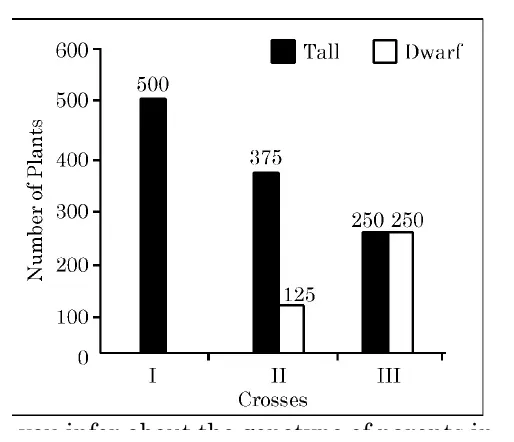
(b) Looking at bar graph of cross III, identify the type of cross performed and its importance in genetics. [2]
(b) Looking at bar graph of cross III, identify the type of cross performed and its importance in genetics. [2]
Official answer
Cross III gives Tall : Dwarf = 250 : 250 = 1 : 1, the signature of a test cross.
Type of cross — Test cross
- A test cross is a cross between an individual showing the dominant phenotype (unknown genotype) and a homozygous recessive individual.
- Here: Tt (tall) × tt (dwarf) → 1 tall (Tt) : 1 dwarf (tt), matching the 1:1 result.
Importance in genetics
- It is used to determine the unknown genotype of a dominant-phenotype individual — whether it is homozygous (TT) or heterozygous (Tt).
- A 1 : 1 ratio in the progeny proves the tested parent is heterozygous (Tt); if all offspring were tall, the parent would be homozygous (TT).
- It thus confirms the genotype without needing multiple generations.
Marking scheme
- 1.1 mark: identifying the cross as a test cross — dominant phenotype (Tt) crossed with homozygous recessive (tt) giving a 1:1 ratio.
- 2.1 mark: stating its importance — used to determine the unknown genotype of a dominant individual (homozygous vs heterozygous); a 1:1 ratio confirms it is heterozygous.
Hint
1:1 progeny with a recessive parent = test cross, used to reveal a hidden genotype.
Quick oral answer
Cross III is a test cross — a dominant tall (Tt) crossed with a homozygous recessive dwarf (tt); the 1:1 progeny ratio tells us the tall parent is heterozygous, which is why the test cross is used to reveal unknown genotypes.
Common mistakes
- 1.Calling it a back cross without specifying it is a test cross with the homozygous recessive parent — a test cross is a special back cross.
- 2.Confusing the 1:1 test-cross ratio with the 3:1 monohybrid F2 ratio.
- 3.Stating only the type of cross but omitting its importance (determining unknown genotype), losing the second mark.
Analysis and explanation
Concept
Two individuals with the same dominant phenotype (a tall plant) can have different genotypes — TT or Tt. A test cross with the homozygous recessive (tt) reveals which one it is by reading the offspring ratio.
Reading Cross III
- 1 : 1 progeny (250 : 250) → the dominant parent contributed T to half the gametes and t to the other half → it must be Tt (heterozygous).
- Had the parent been TT, every offspring would be tall (no dwarfs).
Exam trap
- Do not confuse a test cross (Tt × tt → 1:1) with an F2 selfing (Tt × Tt → 3:1). The recessive parent is the defining feature of a test cross.
Application
- Plant and animal breeders routinely use test crosses to weed out hidden recessive alleles before selecting parent stock.
Interesting facts
Mendel himself invented the test cross to prove his hypothesis of factors, crossing F1 tall plants with true dwarfs and obtaining the predicted 1:1 ratio.
Every back cross is a cross with a parental type, but only a cross with the homozygous recessive parent is called a test cross.
Question details
Q33 of 37 questions
- Board
- CBSE
- Class
- Class 12
- Subject
- Biology
- Year
- 2026
- Section
- Section D
- Marks
- 2
- Chapter
- Principles of Inheritance and Variation
- Topic
- Test Cross and Its Importance
- Bloom's level
- analyze
- Syllabus topic
- Unit VII: Genetics and Evolution — Principles of Inheritance and Variation: Test Cross
- Author
- CBSE
- Reviewed by
- Padhantu Academic Team
Spotted a mistake or something unclear?
Tell us and we will fix it.
Frequently asked questions
What is a test cross?
A test cross is a cross between an organism showing a dominant phenotype (whose genotype is unknown) and a homozygous recessive organism. The ratio of offspring phenotypes reveals whether the tested parent is homozygous dominant or heterozygous.
Why does a 1:1 ratio prove the parent is heterozygous?
A 1:1 tall-to-dwarf ratio means the dominant parent passed T to half its gametes and t to the other half. Only a heterozygote (Tt) produces two gamete types equally, so the 1:1 result confirms the parent is Tt, not TT.