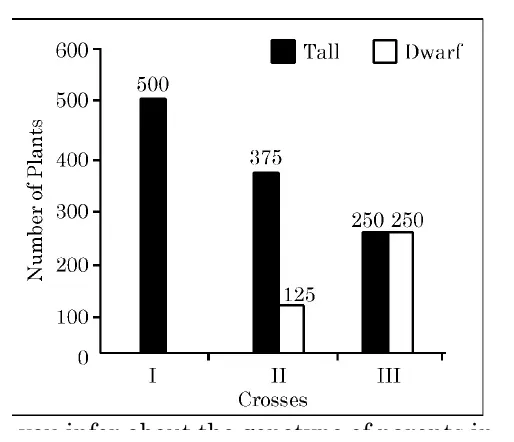
(a) What can you infer about the genotype of parents in crosses I and II? [1]
OR
(a) Which genetic cross is represented by these crosses? [1]
(a) What can you infer about the genotype of parents in crosses I and II? [1]
OR
(a) Which genetic cross is represented by these crosses? [1]
Official answer
Read each cross from its progeny ratio (Tall dominant T, dwarf recessive t).
Cross I — all Tall (500 : 0)
- No dwarf appears, so at least one parent is homozygous tall (TT).
- Most consistent genotype: TT × TT (all offspring TT). (TT × Tt also gives all tall.)
Cross II — Tall : Dwarf = 375 : 125 = 3 : 1
- A 3 : 1 F2 ratio comes only from two heterozygous parents.
- Parental genotype: Tt × Tt.
OR alternative: Both are monohybrid crosses (involving a single pair of contrasting traits, tall vs dwarf).
Marking scheme
- 1.0.5 mark: Cross I parents homozygous tall — TT × TT (TT × Tt accepted, as both give all-tall progeny).
- 2.0.5 mark: Cross II parents both heterozygous — Tt × Tt (deduced from the 3:1 ratio). OR: both are monohybrid crosses.
Hint
All-tall progeny needs a TT parent; a 3:1 ratio needs Tt × Tt.
Quick oral answer
Cross I gives only tall plants, so a parent must be homozygous TT (TT × TT); Cross II gives a 3:1 ratio, so both parents are heterozygous Tt × Tt.
Common mistakes
- 1.Assigning Tt × Tt to Cross I — that gives a 3:1 ratio, but Cross I is all tall, requiring a TT parent.
- 2.Writing phenotypes (Tall × Tall) instead of genotypes (TT, Tt) when a genotype is explicitly asked.
- 3.Ignoring that a 3:1 progeny ratio is the fingerprint of a heterozygous × heterozygous cross.
Analysis and explanation
Concept
Parental genotypes are deduced by working backwards from the phenotypic ratio of the offspring — the essence of Mendelian analysis.
Working the data
- Cross I gives only tall plants → a dwarf (tt) cannot form, so the dominant allele must be supplied homozygously by at least one parent → TT × TT (safe answer) or TT × Tt.
- Cross II gives a clean 3 : 1 ratio (375 : 125) → this is the classic F2 of a monohybrid cross → Tt × Tt.
Exam trap
- Do not write Tt × Tt for Cross I — that would produce a 3 : 1 ratio, not all-tall. Match the genotype strictly to the observed ratio.
Application
- This backward reasoning is exactly how breeders confirm whether a tall plant is pure-breeding (TT) or a hybrid (Tt) before using it as a parent stock.
Interesting facts
Mendel's classic tall × dwarf pea monohybrid cross gave 787 tall : 277 dwarf in the F2 — a ratio of 2.84:1, remarkably close to the ideal 3:1.
Tall vs dwarf height in garden pea (Pisum sativum) is controlled by a single gene affecting gibberellin synthesis, which is why it behaves as a clean Mendelian trait.
Question details
Q32 of 37 questions
- Board
- CBSE
- Class
- Class 12
- Subject
- Biology
- Year
- 2026
- Section
- Section D
- Marks
- 1
- Chapter
- Principles of Inheritance and Variation
- Topic
- Genotype of Parents in Monohybrid Crosses
- Bloom's level
- apply
- Syllabus topic
- Unit VII: Genetics and Evolution — Principles of Inheritance and Variation: Monohybrid Cross and Parental Genotypes
- Author
- CBSE
- Reviewed by
- Padhantu Academic Team
Spotted a mistake or something unclear?
Tell us and we will fix it.
Frequently asked questions
Why must a parent in Cross I be homozygous tall (TT)?
Cross I produces only tall offspring with no dwarfs. A dwarf plant (tt) can appear only if both parents carry a t allele. Since none appear, at least one parent supplies T homozygously — TT — guaranteeing every offspring receives a T allele and is tall.
How do you know Cross II parents are both heterozygous?
Cross II gives a 3:1 tall-to-dwarf ratio (375:125). This exact ratio is produced only when two heterozygotes (Tt × Tt) are crossed, giving genotypes 1 TT : 2 Tt : 1 tt, i.e. 3 tall : 1 dwarf.