(c) How do species avoid competition in nature? Explain with an example. [2]
(c) How do species avoid competition in nature? Explain with an example. [2]
Official answer
Species avoid direct competition mainly through resource partitioning — dividing up a shared resource rather than fighting to elimination.
Main mechanism — Resource partitioning
- When two potentially competing species share a limited resource, they differentiate their niches in feeding time, foraging zone or microhabitat.
- By using the same resource in different ways, both can coexist and the competitive exclusion predicted by Gause's principle is avoided.
Classic NCERT example — MacArthur's warblers
- Five closely related species of insectivorous warblers were found feeding on the same tree.
- They avoided competition by feeding in different zones of the canopy and adopting different foraging behaviour, so all five species could coexist.
Link to the given case
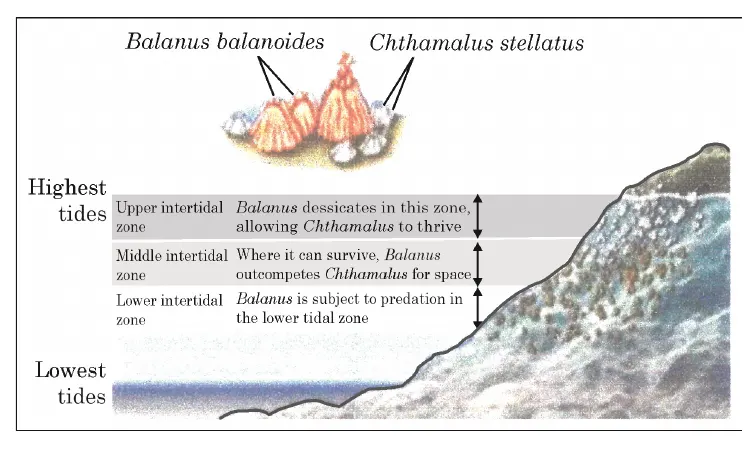
- In the barnacle case, where partitioning is not possible, Balanus competitively excludes Chthamalus from the middle zone — showing why niche differentiation is nature's usual route to coexistence.
Marking scheme
- 1.1 mark: naming and explaining resource partitioning / niche differentiation as the way competing species avoid competition (differ in feeding time, foraging zone or microhabitat).
- 2.1 mark: a correct, relevant example — MacArthur's five warbler species feeding in different zones of the same tree (or any valid partitioning example).
Hint
Think 'resource partitioning' — MacArthur's warblers dividing the same tree into feeding zones.
Quick oral answer
Species avoid competition by resource partitioning — they differentiate their niches by feeding at different times or in different zones, as MacArthur's five warbler species did on the same tree, allowing coexistence.
Common mistakes
- 1.Writing that species avoid competition through mutualism or cooperation — the NCERT mechanism asked for is resource partitioning.
- 2.Giving no specific example, or an irrelevant one; the 5 warbler species (MacArthur) is the standard scoring example.
- 3.Describing how Balanus excludes Chthamalus (that is competition occurring, not being avoided).
Analysis and explanation
Concept
Interspecific competition occurs when two species compete for the same limiting resource. Nature's common resolution is resource partitioning — each species evolves to use a slightly different part of the niche (Gause's competitive exclusion principle says two species with identical niches cannot coexist indefinitely).
Why the example works
- MacArthur (1958) showed five warbler species on one conifer partitioned the tree by canopy height and foraging behaviour, so no two exploited exactly the same micro-niche.
- This is contrasted in the exam with Connell's barnacle study (the case stimulus), where the superior competitor Balanus eliminates Chthamalus from the middle intertidal zone.
Exam trap
- The question asks how competition is avoided, not how it plays out. Answer with partitioning/niche differentiation, not with predator-avoidance or mutualism.
Real-world relevance
- Resource partitioning explains high biodiversity in tropical forests, where many species share space by dividing light, food and time.
Interesting facts
Robert MacArthur's 1958 study of five warbler species on a single spruce tree is a foundational paper in ecology and is cited directly in the NCERT textbook.
Joseph Connell's barnacle experiments on the Scottish coast (the source of this case) are among the most famous field demonstrations of competitive exclusion in nature.
Question details
Q31 of 37 questions
- Board
- CBSE
- Class
- Class 12
- Subject
- Biology
- Year
- 2026
- Section
- Section D
- Marks
- 2
- Chapter
- Organisms and Populations
- Topic
- Avoiding Competition — Resource Partitioning
- Bloom's level
- understand
- Syllabus topic
- Unit X: Ecology — Organisms and Populations: Interspecific Competition and Resource Partitioning
- Author
- CBSE
- Reviewed by
- Padhantu Academic Team
Spotted a mistake or something unclear?
Tell us and we will fix it.
Frequently asked questions
What is resource partitioning?
Resource partitioning is the division of a shared, limited resource by competing species — they use it in different ways, at different times, or in different microhabitats. This niche differentiation lets both species coexist instead of one excluding the other.
How did MacArthur's warblers avoid competition?
Five insectivorous warbler species lived and fed on the same tree but partitioned it: each fed mainly in a different zone of the canopy and used different foraging behaviour, so they did not compete directly for exactly the same insects.