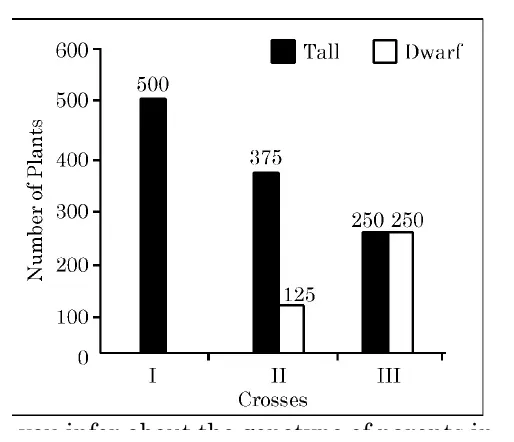
(c) What conclusion can you draw from the results of bar graphs of crosses I and II? Name the genetic principle illustrated. [1]
(c) What conclusion can you draw from the results of bar graphs of crosses I and II? Name the genetic principle illustrated. [1]
Official answer
Reading Crosses I and II together reveals Mendel's first two laws.
Conclusion
- Cross I (all tall): Tall completely masks dwarf, so Tall is dominant over dwarf.
- Cross II (3 : 1): The dwarf trait, hidden in the tall F1 parents, reappears in the offspring — the alleles must have separated (segregated) during gamete formation.
Genetic principle illustrated
- Law of Dominance (from Cross I) and the Law of Segregation / Law of Purity of Gametes (from the 3 : 1 ratio of Cross II).
Marking scheme
- 1.0.5 mark: conclusion — Tall is dominant over dwarf (Cross I) and the recessive dwarf trait reappears in a 3:1 ratio (Cross II) because alleles segregate.
- 2.0.5 mark: naming the principle(s) — Law of Dominance and Law of Segregation (Law of Purity of Gametes).
Hint
All-tall = dominance; reappearance of dwarf in 3:1 = segregation.
Quick oral answer
Cross I shows tall is dominant over dwarf (Law of Dominance), and the 3:1 ratio in Cross II shows the masked dwarf allele segregates out and reappears — the Law of Segregation.
Common mistakes
- 1.Naming only one law when the two crosses together illustrate both dominance and segregation.
- 2.Saying dwarf 'disappeared' rather than being masked — it is hidden, not lost, and reappears in Cross II.
- 3.Calling the 3:1 result the Law of Independent Assortment, which applies only to dihybrid (two-gene) crosses.
Analysis and explanation
Concept
Mendel's monohybrid results encode two laws. The all-dominant Cross I shows the Law of Dominance (one allele expresses, the other is masked). The 3:1 Cross II shows the Law of Segregation — the two alleles of a heterozygote separate cleanly into gametes so the recessive phenotype resurfaces.
Reasoning from data
- No blending occurs: dwarf is fully hidden in Cross I and returns unchanged in Cross II, proving alleles stay pure (Law of Purity of Gametes).
Exam trap
- Both laws should be named. Writing only 'dominance' or only 'segregation' gives an incomplete answer; the 3:1 ratio is the classic evidence for segregation.
Application
- These laws underpin why recessive genetic disorders can skip a generation and reappear in children of unaffected carriers.
Interesting facts
Mendel published these laws in 1866, but their significance was ignored until 1900 when de Vries, Correns and Tschermak independently rediscovered them.
The 'Law of Purity of Gametes' name reflects Mendel's insight that a gamete carries only one allele of a pair, never a blend.
Question details
Q34 of 37 questions
- Board
- CBSE
- Class
- Class 12
- Subject
- Biology
- Year
- 2026
- Section
- Section D
- Marks
- 1
- Chapter
- Principles of Inheritance and Variation
- Topic
- Law of Dominance and Segregation
- Bloom's level
- understand
- Syllabus topic
- Unit VII: Genetics and Evolution — Principles of Inheritance and Variation: Mendel's Laws of Dominance and Segregation
- Author
- CBSE
- Reviewed by
- Padhantu Academic Team
Spotted a mistake or something unclear?
Tell us and we will fix it.
Frequently asked questions
Which Mendel laws do Crosses I and II illustrate?
Cross I (all tall offspring) illustrates the Law of Dominance — the tall allele masks the dwarf allele. Cross II (3:1 ratio) illustrates the Law of Segregation, because the hidden recessive dwarf trait reappears when the two alleles of the heterozygous parents separate into gametes.
Why is it called the Law of Purity of Gametes?
During gamete formation the two alleles of a gene separate so that each gamete carries only one of them, in a pure, unblended form. This is why the recessive trait can resurface unchanged in later generations.