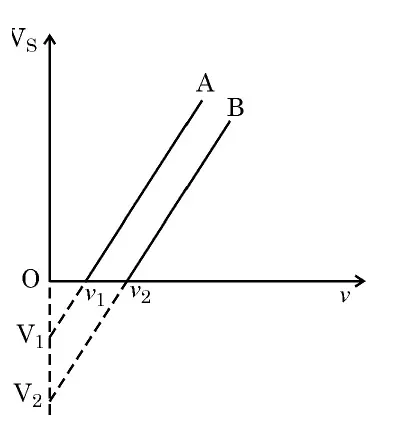
For radiation of frequency incident on the surfaces of A and B, the maximum kinetic energy of ejected electron is
For radiation of frequency incident on the surfaces of A and B, the maximum kinetic energy of ejected electron is
Options
Official answer
Correct option: (A) greater for metal A because it has a smaller work function.
Maximum kinetic energy: .
- Metal A has the smaller threshold frequency , so .
- For the same incident frequency ν, a smaller φ leaves more energy as kinetic energy.
Hence is greater for metal A.
Marking scheme
- 1.1 mark: correct option (A) — greater for A because it has the smaller work function.
- 2.Reasoning credit for and identifying from .
- 3.No marks for options B, C (B greater) or D (independent of φ).
Hint
at fixed ν; smaller work function ⇒ larger , and A has the smaller threshold frequency.
Quick oral answer
Since equals minus the work function, at the same frequency the metal with the smaller work function keeps more kinetic energy; metal A has the lower threshold , so its photoelectrons are faster.
Common mistakes
- 1.Thinking a larger work function gives a larger kinetic energy (it does the opposite).
- 2.Assuming kinetic energy is independent of the metal because the graph lines are parallel — the intercept still shifts .
- 3.Confusing threshold frequency with the energy of the emitted electron.
Analysis and explanation
Concept:
Einstein's equation shows that for a fixed incident frequency the photoelectron's maximum kinetic energy depends only on the work function: the smaller the work function, the larger the leftover kinetic energy.
Reading the graph:
- Metal A intercepts the frequency axis at the smaller value , so its threshold frequency and work function are smaller.
- At any common (so both metals emit), .
Why the distractors fail:
- (B), (C) claim B is greater — a larger work function or higher threshold means less kinetic energy, not more.
- (D) is wrong because K_max clearly depends on φ; only the slope , not the intercept, is metal-independent.
Exam trap:
Do not confuse 'more energy needed to escape' with 'more energy left over' — a higher work function takes away kinetic energy.
Interesting facts
Because the two lines are parallel, the vertical gap between them — the difference in stopping potential at any frequency — is constant and equals .
Metals with low work functions like sodium (2.28 eV) and potassium (2.30 eV) release faster photoelectrons than high-work-function metals like platinum (about 6 eV) under the same light.
depends only on frequency and work function, never on intensity — a fact that sealed the case for the photon model over classical wave theory.
Question details
Q34 of 39 questions
- Board
- CBSE
- Class
- Class 12
- Subject
- Physics
- Year
- 2026
- Section
- Section D
- Marks
- 1
- Type
- MCQ
- Chapter
- Dual Nature of Radiation and Matter
- Topic
- Comparing maximum kinetic energy of photoelectrons
- Bloom's level
- analyze
- Syllabus topic
- Unit VII: Dual Nature of Radiation and Matter — Einstein's Photoelectric Equation and Maximum Kinetic Energy
- Author
- CBSE
- Reviewed by
- Padhantu Academic Team
Spotted a mistake or something unclear?
Tell us and we will fix it.
Frequently asked questions
Why does metal A give photoelectrons with more kinetic energy than metal B?
Maximum kinetic energy is . Metal A has the smaller threshold frequency , so its work function is smaller. At the same incident frequency the two metals absorb the same photon energy , but A spends less of it escaping the surface, leaving more as kinetic energy. So is larger for A by exactly .
Does the maximum kinetic energy depend on the intensity of the light?
No. depends only on the frequency of the incident light and the metal's work function. Increasing intensity increases the number of photoelectrons per second but not their maximum kinetic energy — one of the key experimental facts explained only by the photon picture.