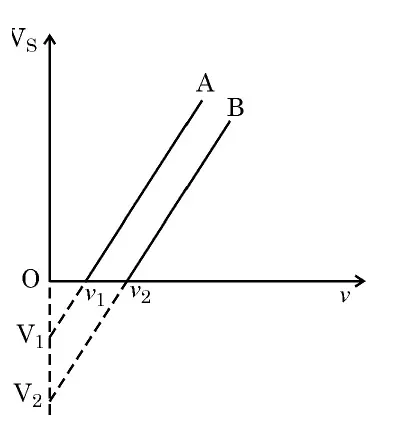
From the graph, the work functions of A and B are (h is Planck's constant and e value of charge on an electron)
From the graph, the work functions of A and B are (h is Planck's constant and e value of charge on an electron)
Options
Official answer
Correct option: (C) and
From Einstein's photoelectric equation, . Each line meets the ν-axis at the threshold frequency:
- For metal A the intercept is , so
- For metal B the intercept is , so
The work function equals Planck's constant times the threshold frequency, giving and .
Marking scheme
- 1.1 mark: correct option (C) and .
- 2.Reasoning credit for stating where is the x-intercept (threshold frequency).
- 3.No marks for options with wrong dimensions (, or ).
Hint
Set in : the x-intercept is the threshold frequency, and (that intercept).
Quick oral answer
Set the stopping potential to zero in ; the line then crosses the frequency axis at the threshold frequency, so the work function is Planck's constant times that intercept — for A and for B.
Common mistakes
- 1.Reading the y-intercept as the work function instead of using the x-intercept.
- 2.Quoting and as the work functions, ignoring that a work function must have units of energy.
- 3.Confusing threshold frequency with the frequency at which the two lines cross.
Analysis and explanation
Concept:
Einstein's equation , written as , is a straight line of slope . Where the line crosses the frequency axis, , so , i.e. . The x-intercept of each line is therefore its threshold frequency.
Reading the graph:
- Line A cuts the ν-axis at .
- Line B cuts the ν-axis at .
Why the other options fail:
- (A) are frequencies, not energies — dimensionally wrong for a work function.
- (B) are potentials (volts); multiplying by e would give energy, but the plain V-values are not the work function.
- (D) has units of volts, again not energy.
Exam trap:
Watch units — a work function is an energy (joule or eV), so only has the right dimensions.
Interesting facts
Robert Millikan, who initially doubted Einstein's photon idea, spent a decade measuring these – lines and in 1916 used their slope to give one of the best early values of Planck's constant.
The x-intercept (threshold frequency) is a fixed property of the metal — the two parallel lines never move sideways unless you change the metal.
Caesium, with a work function near 2.1 eV, has such a low threshold that even yellow light ejects electrons, which is why it is used in photocathodes.
Question details
Q33 of 39 questions
- Board
- CBSE
- Class
- Class 12
- Subject
- Physics
- Year
- 2026
- Section
- Section D
- Marks
- 1
- Type
- MCQ
- Chapter
- Dual Nature of Radiation and Matter
- Topic
- Work function from V_s–ν graph
- Bloom's level
- understand
- Syllabus topic
- Unit VII: Dual Nature of Radiation and Matter — Photoelectric Effect and Einstein's Equation (stopping potential vs frequency graph)
- Author
- CBSE
- Reviewed by
- Padhantu Academic Team
Spotted a mistake or something unclear?
Tell us and we will fix it.
Frequently asked questions
How do you read the work function off a stopping-potential vs frequency graph?
Use . When the stopping potential is zero, the incident frequency equals the threshold frequency , and the line crosses the frequency axis there. Since , the work function is — Planck's constant times the x-intercept. For metal A that intercept is and for B it is , giving work functions and .
Why are the lines for A and B parallel?
The slope of every V_s–ν line is , which depends only on Planck's constant and the electron charge — universal constants. So all metals give lines of the same slope; they differ only in where they cross the frequency axis, which reflects their different work functions.