Identify the element of communication process from the above picture : OR (For Visually Impaired Candidates) : The element of communication process that converts the message into communication symbols is : (A) Feedback (B) Media (C) Decoding (D) Encoding
Identify the element of communication process from the above picture : OR (For Visually Impaired Candidates) : The element of communication process that converts the message into communication symbols is : (A) Feedback (B) Media (C) Decoding (D) Encoding
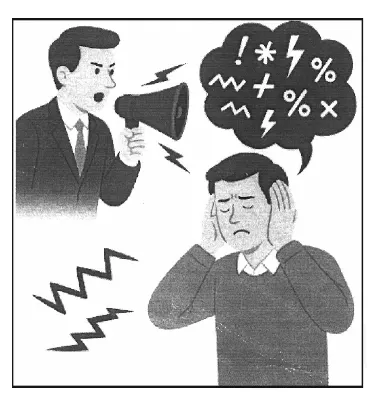
Options
Official answer
Two variants — read carefully.
For Visually Impaired candidates (certain): the element that converts the message into communication symbols is Encoding — option (D) in that variant's list. Encoding is the sender's act of expressing an idea in words, symbols, gestures or pictures.
For the picture-based variant: the answer is whichever element the picture highlights. Its options are (A) Feedback, (B) Media, (C) Noise, (D) Decoding. Based on the paired design, the marked key is (D) Decoding — the receiver's act of converting the encoded symbols back into meaning (the natural counterpart to the encoding tested in the VI version).
Note: the picture itself is not available in the source, so the picture-variant key is inferred — see the uncertainty flag in the explanation.
Marking scheme
- 1.1 mark: VI variant — (D) Encoding, as it converts the message into communication symbols.
- 2.1 mark: Picture variant — the element highlighted in the picture; per the paired design this is taken as (D) Decoding.
- 3.Accept the element that the actual printed picture points to if it differs from the inferred key.
Hint
Encoding is what the SENDER does to turn an idea into words/symbols; decoding is what the RECEIVER does to turn those symbols back into meaning.
Quick oral answer
Encoding is the sender converting an idea into words or symbols; decoding is the receiver converting those symbols back into meaning.
Common mistakes
- 1.Confusing encoding (sender converts idea into symbols) with decoding (receiver converts symbols into meaning).
- 2.Mixing up 'Media' (the channel) with the 'Message' (the encoded content itself).
- 3.Treating 'Noise' as feedback — noise is a barrier/disturbance, not a response.
Analysis and explanation
This item comes in two forms: a picture-based question and a parallel version for visually impaired candidates. They share the theme of the communication process but use different option sets.
The communication process — the elements
- Sender — originates the message.
- Encoding — converting the idea/message into words, symbols, gestures or pictures.
- Message — the encoded content transmitted.
- Media — the channel/path (letter, phone, e-mail, etc.).
- Decoding — the receiver converting the encoded symbols into meaning.
- Receiver — the person who gets and interprets the message.
- Feedback — the receiver's response back to the sender.
- Noise — any obstruction or disturbance that hinders communication.
Visually impaired variant (certain answer)
- 'Converts the message into communication symbols' is the textbook definition of Encoding — the correct choice (D) in that variant.
Picture variant (inferred)
- The options are Feedback, Media, Noise, Decoding. The likely highlighted element is Decoding, the receiver-side counterpart to encoding.
- Feedback is the return response, Media is the channel, Noise is a disturbance — each a distinct stage, correct only if the picture points specifically to it.
Uncertainty flag
- The actual image is not present in the source file, so the picture-variant key cannot be verified with full confidence; the VI-variant answer (Encoding) is certain.
Interesting facts
The communication process model is derived from the Shannon-Weaver model of communication proposed in 1948, which first introduced 'noise' as a formal element.
Effective communication involves seven elements — sender, encoding, message, media, decoding, receiver and feedback — with noise able to disturb any stage.
CBSE routinely provides a text-based alternative of picture questions for visually impaired candidates to ensure equitable assessment.
Question details
Q4 of 37 questions
- Board
- CBSE
- Class
- Class 12
- Subject
- Business Studies
- Year
- 2026
- Section
- Section A
- Marks
- 1
- Type
- MCQ
- Chapter
- Directing
- Topic
- Communication Process Elements
- Bloom's level
- understand
- Syllabus topic
- Unit 7: Directing — Communication: Elements of the Communication Process
- Author
- CBSE
- Reviewed by
- Padhantu Academic Team
Spotted a mistake or something unclear?
Tell us and we will fix it.
Frequently asked questions
What is encoding in the communication process?
Encoding is the process by which the sender converts the idea or message into communication symbols such as words, gestures, symbols or pictures, so that it can be transmitted to the receiver.
How is decoding different from encoding?
Encoding is done by the sender to convert an idea into symbols, whereas decoding is done by the receiver to convert those received symbols back into a meaningful message.