(a) Identify and define the ecological phenomenon demonstrated by this observation. [1]
OR
(a) State the principle that explains the elimination of one species. [1]
(a) Identify and define the ecological phenomenon demonstrated by this observation. [1]
OR
(a) State the principle that explains the elimination of one species. [1]
Official answer
The barnacle observation is the classic demonstration of interspecific competition.
Phenomenon: Interspecific competition (competitive exclusion / competitive release).
Definition: Interspecific competition is the interaction in which individuals of two different species compete for the same limited resource (here, space on the rock), and the presence of one species adversely affects the other — so much so that the superior competitor, Balanus, restricts Chthamalus to the upper zone. When Balanus is removed, Chthamalus expands, confirming the effect.
OR (alternative sub-part): The principle explaining elimination of one species is the Competitive Exclusion Principle (Gause's Principle) — two species competing for the same resources cannot coexist indefinitely; the competitively inferior one is eventually eliminated.
Marking scheme
- 1.1 mark: correctly names the phenomenon as interspecific competition (competitive release) AND gives its definition — two species competing for the same limited resource, one adversely affecting the other.
- 2.OR 1 mark: names and states the Competitive Exclusion Principle (Gause's Principle) — two species competing for the same resources cannot coexist indefinitely; the inferior competitor is eliminated.
Hint
Barnacles on a rock competing for space = interspecific competition; the principle that the loser is eliminated is Gause's Competitive Exclusion Principle.
Quick oral answer
This is interspecific competition — Balanus and Chthamalus barnacles compete for space on the rock, and when Balanus is removed Chthamalus spreads; the principle that the loser is eliminated is Gause's Competitive Exclusion Principle.
Common mistakes
- 1.Naming it 'predation' or 'mutualism' — it is competition; the two barnacles fight for the same space (a limited resource).
- 2.Giving only the name without a definition (or only a definition without the name) — the mark needs identification AND definition.
- 3.Confusing the two alternatives: the OR part specifically wants the Competitive Exclusion (Gause's) Principle, not just 'competition'.
Analysis and explanation
Concept:
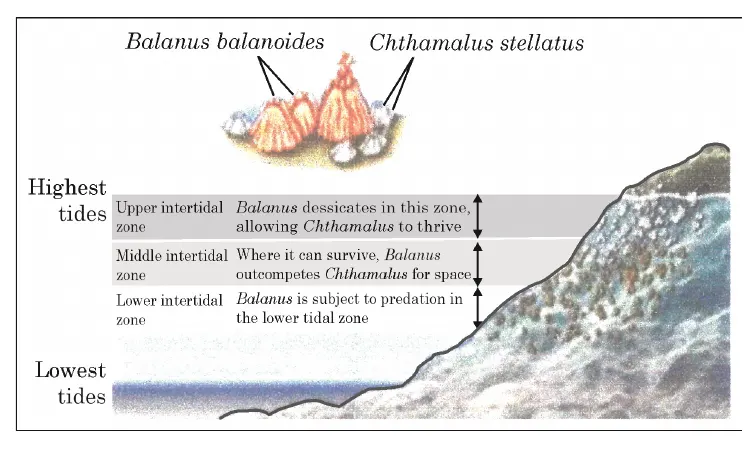
This is Connell's classic barnacle experiment on the Scottish coast, the textbook proof of interspecific competition in Organisms and Populations.
What the diagram shows:
- On the intertidal rocks, the larger Balanus competitively excludes the smaller Chthamalus from the lower/middle zone.
- When Balanus is experimentally removed, Chthamalus expands into the lower zone — showing its range was limited by competition, not by physical factors.
Exam trap:
- The answer depends on which alternative is attempted: the first asks to identify and define the phenomenon (interspecific competition / competitive release); the 'OR' asks for the principle (Competitive Exclusion / Gause's Principle). Read the chosen part carefully.
Real-world:
Competition shapes species distributions everywhere — it explains why closely related species often occupy different microhabitats to reduce overlap.
Interesting facts
This experiment was performed by Joseph Connell in 1961 on the coast of Scotland using Chthamalus stellatus and Balanus balanoides, and remains the classic field proof of interspecific competition.
G.F. Gause formulated the Competitive Exclusion Principle in 1934 from lab experiments on two Paramecium species, where one always eliminated the other in shared cultures.
The removal experiment shows competitive release — a species can occupy a wider 'fundamental niche' once its competitor is gone.
Question details
Q29 of 37 questions
- Board
- CBSE
- Class
- Class 12
- Subject
- Biology
- Year
- 2026
- Section
- Section D
- Marks
- 1
- Chapter
- Organisms and Populations
- Topic
- Interspecific Competition / Competitive Exclusion
- Bloom's level
- analyze
- Syllabus topic
- Unit X: Ecology — Organisms and Populations: Population Interactions (Competition and Competitive Exclusion)
- Author
- CBSE
- Reviewed by
- Padhantu Academic Team
Spotted a mistake or something unclear?
Tell us and we will fix it.
Frequently asked questions
What does the barnacle experiment prove?
It proves interspecific competition. Balanus competitively excludes Chthamalus from the lower intertidal zone; when Balanus is experimentally removed, Chthamalus expands its range there, showing that its distribution was limited by competition rather than by physical conditions.
What is the Competitive Exclusion Principle?
Also called Gause's Principle, it states that two species competing for the same limited resources cannot coexist indefinitely at constant population values. The competitively inferior species is eventually eliminated from the shared habitat.