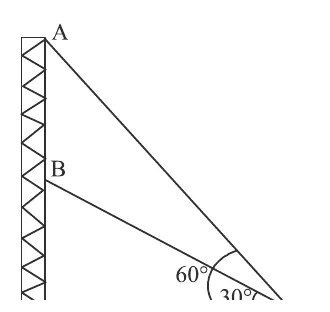
Find the distance AB.
Find the distance AB.
Official answer
, found using tan 60° and tan 30° with OP = 6 m and subtracting the lower section's height from the total height.
Marking scheme
- 1.1 mark: correctly finding and using for both angles of elevation.
- 2.1 mark: correctly subtracting to get () with correct unit.
Hint
First find PB and PA separately using , then AB = PA − PB.
Quick oral answer
I find the heights of B and A separately using for each angle of elevation, then subtract PB from PA to get the length of the upper section , which is .
Common mistakes
- 1.Reporting PA (the full tower height) as the answer for AB instead of subtracting PB.
- 2.Mixing up which angle of elevation (30° or 60°) corresponds to which point (B or A).
- 3.Arithmetic slip while simplifying to (rationalising the surd).
Analysis and explanation
Find AB, the length of only the upper section of the tower (from B to apex A).
Concept
- OP = 6 m; angle of elevation of B = 30°; angle of elevation of A (apex) = 60°.
- tan θ = height/OP gives the tower heights PB and PA in right triangles OPB and OPA.
Key points
- AB is the difference PA − PB, not either height alone, since B lies between P and A.
Common mistakes
- Reporting PA (total height) as AB.
- Forgetting to rationalise 6/√3 to 2√3.
Interesting facts
Two-angle-of-elevation problems like this mirror how surveyors historically measured inaccessible heights using a theodolite from a single fixed ground station.
The triangle used here has side ratios , one of the two 'standard' triangles (along with ) that CBSE trigonometry problems are built around.
Question details
Q50 of 56 questions
- Board
- CBSE
- Class
- Class 10
- Subject
- Mathematics (Standard)
- Year
- 2026
- Section
- Section E
- Marks
- 2
- Chapter
- Some Applications of Trigonometry
- Topic
- Heights and Distances — Case Study (Radio Tower/Support-Wire Problem)
- Bloom's level
- apply
- Syllabus topic
- Unit 5: Trigonometry — Some Applications of Trigonometry: finding the height of an upper section of a tower using two angles of elevation from the same point
- Author
- CBSE
- Reviewed by
- Padhantu Academic Team
Spotted a mistake or something unclear?
Tell us and we will fix it.
Frequently asked questions
Why can't AB just be equal to PA?
PA is the total height from the ground to the apex of the tower, while AB is only the length of the upper section from point B to the apex. .
What is the numeric value of AB?
, which is approximately .