Find the length of the wire from the point 'O' to the top of section 'A'.
Find the length of the wire from the point 'O' to the top of section 'A'.
Official answer
— obtained from with .
Marking scheme
- 1.1 mark: correctly applying (or an equivalent correct method, e.g. finding PA via tan 60° then OA via Pythagoras/sine) to get OA = 12 m with the unit (m).
Hint
OA is the hypotenuse of right triangle OPA; use (adjacent/hypotenuse), with OP = 6 m.
Quick oral answer
OA is the hypotenuse of right triangle OPA, so I use , giving .
Common mistakes
- 1.Using (which relates PA and OP, the two legs) instead of (which directly relates OP and the hypotenuse OA).
- 2.Confusing which point (A, the apex) has the 60° angle versus point B (which has 30°), since A is higher up the tower yet is asked about second.
- 3.Omitting the unit (metres) in the final answer.
Analysis and explanation
Part (ii) of the radio-tower case study — find the wire length OA using the 60° angle of elevation.
Concept
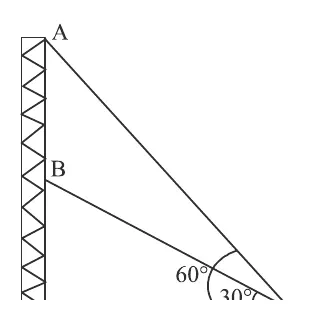
- Tower has two sections: A (top) above B, standing on foot P; wire runs from ground point O to A.
- Given: OP = 6 m, angle of elevation of A from O = 60°.
- In right triangle OPA (right angle at P), OP is adjacent to the 60° angle and OA (the wire) is the hypotenuse.
Key points
- Correct ratio: (adjacent/hypotenuse) since OA is the hypotenuse, not a leg.
Common mistakes
- Using tan 60°, which relates the two legs PA and OP, not the wire OA.
- Confusing OA (wire, hypotenuse) with PA (tower height, a leg).
Interesting facts
Guy-wire (support wire) calculations like this are used in real life to determine the exact cable length needed for radio masts and transmission towers before installation.
The sine and cosine ratios were first tabulated systematically by the Indian mathematician Aryabhata (5th century CE), whose 'ardha-jya' (half-chord) is the direct ancestor of the modern trigonometric functions used in this problem.
Question details
Q49 of 56 questions
- Board
- CBSE
- Class
- Class 10
- Subject
- Mathematics (Standard)
- Year
- 2026
- Section
- Section E
- Marks
- 1
- Chapter
- Some Applications of Trigonometry
- Topic
- Heights and Distances — Case Study (Radio Tower/Support-Wire Problem)
- Bloom's level
- apply
- Syllabus topic
- Unit 5: Trigonometry — Some Applications of Trigonometry: finding the length of a supporting wire using angle of elevation and the cosine ratio
- Author
- CBSE
- Reviewed by
- Padhantu Academic Team
Spotted a mistake or something unclear?
Tell us and we will fix it.
Frequently asked questions
Why is cosine used here and not tangent?
Tangent relates the two legs of the right triangle (PA and OP), while OA itself is the hypotenuse. Since OP (adjacent) and the angle are known and the hypotenuse OA is required, cosine (adjacent/hypotenuse) is the direct ratio to use.
Could the sine ratio also be used?
Yes, indirectly: first find PA using (), then use to get the same answer, OA = 12 m. The cosine method is faster since it needs only one step.