OR
Find the area of .
OR
Find the area of .
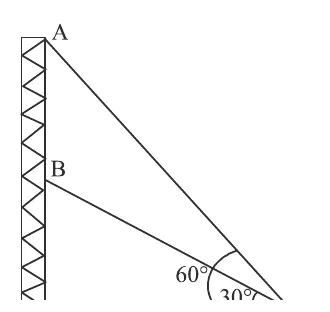
Official answer
, using the right angle at P and PB found from .
Marking scheme
- 1.1 mark: identifying that is right-angled at P, finding , and correctly stating Area = .
- 2.1 mark: correct substitution and final numeric value with correct unit (m²).
Hint
is right-angled at P (tower ⟂ ground), so Area = — no need to find the hypotenuse OB.
Quick oral answer
Since the tower is vertical and the ground is horizontal, has a right angle at P, so its area is simply half of OP times PB, which comes to .
Common mistakes
- 1.Unnecessarily calculating the hypotenuse OB and applying Heron's formula instead of the simple for a right triangle.
- 2.Using PA instead of PB (confusing this with the AB-only calculation from the OR-alternative part).
- 3.Forgetting to square the unit (m²) since this is an area, not a length.
Analysis and explanation
OR part: find the area of using the same triangle as Q50, viewed as a mensuration problem.
Concept
- OP (horizontal ground) ⊥ PB (vertical tower section), so ; is right-angled at P.
- Area of a right triangle = 1/2 × (leg 1) × (leg 2) = .
Key points
- (from the angle of elevation of B).
- No need for Heron's formula or the hypotenuse OB once the right angle is spotted.
Common mistakes
- Not recognising and instead trying Heron's formula unnecessarily.
- Using OB (hypotenuse) as a leg by mistake.
Interesting facts
Any right triangle's area can be found instantly as half the product of the two sides enclosing the right angle — one of the fastest area shortcuts in the CBSE mensuration syllabus.
This 'OR' choice structure (distance vs. area) is a standard CBSE design feature in case studies, letting students pick whichever sub-skill they are more confident with.
Question details
Q51 of 56 questions
- Board
- CBSE
- Class
- Class 10
- Subject
- Mathematics (Standard)
- Year
- 2026
- Section
- Section E
- Marks
- 2
- Chapter
- Some Applications of Trigonometry
- Topic
- Heights and Distances — Case Study (Radio Tower/Support-Wire Problem)
- Bloom's level
- apply
- Syllabus topic
- Unit 6: Mensuration (Trigonometry application) — area of a right triangle formed by a vertical tower section and its ground base
- Author
- CBSE
- Reviewed by
- Padhantu Academic Team
Spotted a mistake or something unclear?
Tell us and we will fix it.
Frequently asked questions
Do I need the hypotenuse OB to find this area?
No. Since the triangle is right-angled at P, only the two legs ( and ) are needed: .
Can I attempt both Q50 and this OR question?
No — in CBSE 'OR' sub-parts, only one of the two alternatives should be attempted; only the first attempted one is usually evaluated.