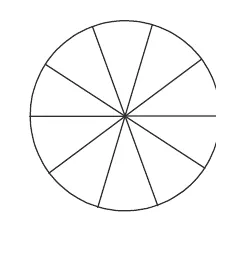
A brooch is crafted from silver wire in the shape of a circle with a diameter of 35 cm. The wire is also used to create 5 diameters, dividing the circle into 10 equal sectors as shown in figure.
Based on the above information, answer the following questions :
A brooch is crafted from silver wire in the shape of a circle with a diameter of 35 cm. The wire is also used to create 5 diameters, dividing the circle into 10 equal sectors as shown in figure.
Based on the above information, answer the following questions :
Official answer
No marks are attached to this stem; it only sets up context (circle of diameter 35 cm with 5 diameters forming 10 equal sectors) for the numbered sub-questions that follow. The clean divisibility of 35 by 7 signals that should be used throughout.
Marking scheme
- 1.No marks are allocated to this introductory stem; marks are awarded only in the numbered sub-questions Q38(i) and Q38(ii) that follow.
Hint
Since the diameter (35 cm) is a multiple of 7, use for exact answers throughout this case study.
Quick oral answer
This is just the background information for the brooch case study — a circle of diameter 35 cm split into 10 equal sectors by 5 diameters — the actual questions on radius and circumference follow after this.
Common mistakes
- 1.Treating the introductory stem itself as a question requiring a numeric answer, when it is only context for the sub-parts.
- 2.Using instead of despite the diameter (35 cm) being a clear multiple of 7.
- 3.Confusing '5 diameters creating 10 sectors' with '10 diameters' — each diameter passes through the centre and creates 2 sectors, so 5 diameters create exactly 10 equal sectors.
Analysis and explanation
Introductory stem of the brooch case study — sets up context and the hint to use .
Concept
- A silver-wire brooch is a circle of diameter 35 cm, further divided by 5 diameters into 10 equal sectors, like spokes of a wheel.
- Each sector's central angle = (relevant to later parts).
Key points
- is a deliberate CBSE hint: use for exact, clean values (not 3.14, which gives messy decimals).
Real-world
- Models a physical jewellery design problem, testing fluent conversion between diameter, radius, circumference, and sector measures.
Interesting facts
A real circular brooch divided into 10 equal sectors by 5 diameters mathematically mirrors a 10-spoke wheel design, a motif seen in ancient Indian temple architecture (e.g., the wheel of the Konark Sun Temple).
CBSE frequently sets circle diameters as multiples of 7 (7, 14, 21, 28, 35, 42...) specifically so that the fractional value π = 22/7 yields whole-number or simple-fraction answers, avoiding messy decimals in board exams.
Question details
Q52 of 56 questions
- Board
- CBSE
- Class
- Class 10
- Subject
- Mathematics (Standard)
- Year
- 2026
- Section
- Section E
- Marks
- 0
- Chapter
- Areas Related to Circles
- Topic
- Areas Related to Circles — Case Study (Silver Brooch)
- Bloom's level
- understand
- Syllabus topic
- Unit 6: Mensuration — Areas Related to Circles: circumference and sectors of a circle
- Author
- CBSE
- Reviewed by
- Padhantu Academic Team
Spotted a mistake or something unclear?
Tell us and we will fix it.
Frequently asked questions
Why is the diameter chosen as 35 cm specifically?
Because 35 is a multiple of 7, using gives exact, clean values for radius and circumference, which is the standard CBSE convention for such problems.
How many sectors do 5 diameters create?
10 equal sectors, since each diameter divides the circle in half through the centre, and 5 diameters (10 rays from the centre, evenly spaced) create 10 equal 36° sectors.