If the intensity of the incident radiation for both metals A and B, is doubled keeping its frequency constant, then
If the intensity of the incident radiation for both metals A and B, is doubled keeping its frequency constant, then
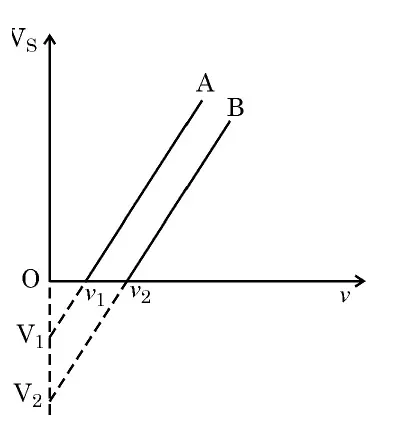
Options
Official answer
Correct option: (D) the slope of the parallel lines will not change but more electrons will be emitted per second.
- The slope of the V_s–ν line is , which depends only on universal constants — intensity cannot change it.
- Threshold frequency is a property of the metal — intensity cannot change it either.
- Doubling intensity means twice as many photons per second, so more photoelectrons are emitted per second (larger photocurrent).
Marking scheme
- 1.1 mark: correct option (D) — slope unchanged, more electrons emitted per second.
- 2.Reasoning credit for stating slope = is constant and photocurrent ∝ intensity.
- 3.No marks for options claiming the slope or threshold frequency changes.
Hint
Intensity changes the number of photoelectrons (photocurrent), not the slope or the threshold frequency.
Quick oral answer
Doubling the intensity just doubles the number of photons and hence photoelectrons per second; the slope of the graph stays at h over e and the threshold frequency is unchanged, so option D.
Common mistakes
- 1.Believing higher intensity raises the maximum kinetic energy or stopping potential — it does not.
- 2.Thinking intensity changes the slope of the V_s–ν line; the slope is always .
- 3.Assuming a brighter beam lowers the threshold frequency of the metal.
Analysis and explanation
Concept:
In the photoelectric effect, frequency controls the energy of each photoelectron (hence stopping potential and the slope ), while intensity controls the number of photons per second and hence the number of photoelectrons — the saturation photocurrent.
Applying it:
- Slope = h/e: fixed. Doubling intensity leaves it unchanged.
- Threshold frequency : a material constant, unchanged by intensity.
- Photocurrent ∝ intensity: doubling intensity doubles the emission rate.
Why the distractors fail:
- (A), (B) claim the slope changes — impossible, since is universal.
- (C) claims a lower threshold — the threshold depends only on the metal's work function.
Exam trap:
'Doubling intensity' tempts students to think electrons get more energetic; in fact only the count of electrons rises, not their maximum kinetic energy.
Interesting facts
It was precisely this intensity-independence of electron energy that classical wave theory could not explain and that Einstein resolved with photons in 1905, work honoured by his 1921 Nobel Prize.
The saturation photocurrent is directly proportional to intensity, which is the basis of light meters and solar-cell photodiodes.
Even the dimmest light above threshold ejects electrons instantly (within about s), while intense light below threshold ejects none — a striking demonstration that frequency, not intensity, unlocks emission.
Question details
Q35 of 39 questions
- Board
- CBSE
- Class
- Class 12
- Subject
- Physics
- Year
- 2026
- Section
- Section D
- Marks
- 1
- Type
- MCQ
- Chapter
- Dual Nature of Radiation and Matter
- Topic
- Effect of intensity on the V_s–ν graph
- Bloom's level
- understand
- Syllabus topic
- Unit VII: Dual Nature of Radiation and Matter — Effect of Intensity and Frequency in Photoelectric Effect
- Author
- CBSE
- Reviewed by
- Padhantu Academic Team
Spotted a mistake or something unclear?
Tell us and we will fix it.
Frequently asked questions
What changes on a stopping-potential vs frequency graph when you double the light intensity?
Nothing on the graph moves. The slope stays at because those are universal constants, and each metal's x-intercept (threshold frequency ) is a fixed material property. Intensity only controls how many photons arrive per second, so the photoelectric current increases, meaning more electrons are emitted per second — but their maximum kinetic energy and stopping potential are unchanged.
Then what does intensity actually control in the photoelectric effect?
Intensity sets the rate of photon arrival, so it fixes the number of photoelectrons emitted per second and hence the saturation photocurrent. Frequency, by contrast, sets the energy per photon and therefore the maximum kinetic energy and stopping potential of the photoelectrons.