The feasible region of a linear programming problem with objective function is shown below. The maximum value of Z - minimum value of Z is
The feasible region of a linear programming problem with objective function is shown below. The maximum value of Z - minimum value of Z is
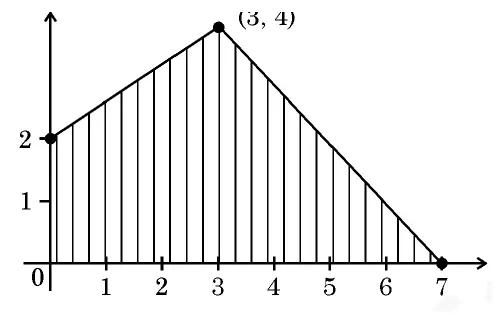
Options
Official answer
The correct option is (D) 43.
Reasoning: Evaluating at each corner point of the feasible region, the maximum occurs at giving Z = 43, and the minimum occurs at the origin giving Z = 0, so .
Marking scheme
- 1.1 mark: correct option (D) 43 — no partial marking for MCQ.
Hint
Evaluate Z at every corner (vertex) of the shaded feasible region and subtract the smallest value from the largest.
Quick oral answer
By the Corner Point Theorem, the maximum and minimum of a linear objective function on a bounded feasible region occur at its vertices, so I evaluate Z at each corner and subtract the smallest from the largest.
Common mistakes
- 1.Evaluating Z at only one or two corner points instead of all vertices of the feasible region.
- 2.Confusing the maximum value alone (43) with the required difference ().
- 3.Misreading the coordinates of a vertex from the graph, leading to an incorrect Z value.
Analysis and explanation
This is a corner-point-theorem application on a bounded feasible region.
Why (D) is correct: By the Corner Point Theorem, the optimal (maximum/minimum) value of a linear objective function over a bounded feasible region occurs at one of its corner points. For the region shown, evaluating at each vertex — — gives Z = 0, 35, 43, and 14 respectively. The maximum is 43 (at (3,4)) and the minimum is 0 (at the origin), so .
Why the distractors are wrong:
- (A) 8 and (B) 29 do not correspond to any valid pair of corner-point Z-values for this region; they likely result from picking the wrong pair of vertices or an arithmetic slip.
- (C) 35 is the value of Z at (7,0) alone, not the required difference — a common error is stopping after computing Z at just one boundary vertex instead of comparing all corners.
Interesting facts
The Corner Point Theorem (also called the Fundamental Theorem of Linear Programming) guarantees that for a bounded feasible region, the optimal value of a linear objective function always occurs at a vertex, never strictly inside the region — a fact that follows from the convexity of the feasible region.
Linear programming was developed by George Dantzig in 1947 as the Simplex Method to solve resource-allocation problems for the US Air Force; CBSE's graphical corner-point method is a simplified two-variable version of this same idea.
Question details
Q17 of 44 questions
- Board
- CBSE
- Class
- Class 12
- Subject
- Mathematics
- Year
- 2026
- Section
- Section A
- Marks
- 1
- Type
- MCQ
- Chapter
- Linear Programming
- Topic
- Linear Programming - Feasible Region
- Bloom's level
- apply
- Syllabus topic
- Unit 4: Linear Programming — Graphical Method, Corner Point Theorem
- Author
- CBSE
- Reviewed by
- Padhantu Academic Team
Spotted a mistake or something unclear?
Tell us and we will fix it.
Frequently asked questions
What is the Corner Point Theorem used to solve this MCQ?
It states that for a bounded feasible region, the maximum and minimum values of a linear objective function occur at one of the corner points (vertices) of the region, so you only need to evaluate Z at each vertex rather than every point in the region.
Why is the minimum value taken as 0 in this feasible region?
Because the origin is a vertex of this particular bounded feasible region, and evaluates to 0 there, which is the smallest of all the corner values.