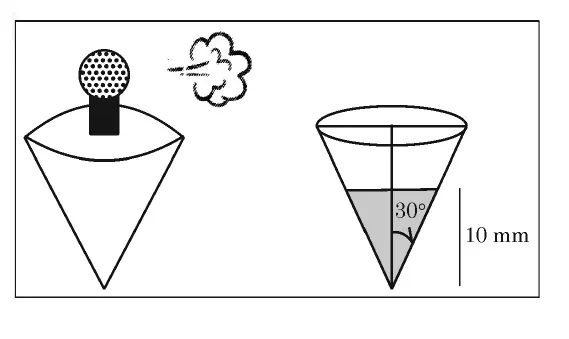
A room freshner bottle in the shape of an inverted cone sprays the perfume at regular intervals such that volume of the perfume in the bottle decreases at the steady rate of . Find the rate at which level of perfume is dropping at an instant when level of perfume in the bottle is , if the semi-vertical angle of conical bottle is .
A room freshner bottle in the shape of an inverted cone sprays the perfume at regular intervals such that volume of the perfume in the bottle decreases at the steady rate of . Find the rate at which level of perfume is dropping at an instant when level of perfume in the bottle is , if the semi-vertical angle of conical bottle is .
Official answer
The level of perfume is dropping at a rate of 3/(100π) mm/min ().
Setup: For a cone with semi-vertical angle α, radius , so volume . With , , giving .
Applying rates: . Substituting and gives , i.e., the level is dropping at 3/(100π) mm/min.
Marking scheme
- 1.1 mark: correctly expressing by eliminating r.
- 2.1 mark: differentiating to get , substituting , , and solving .
Hint
Use to write V purely as a function of h, then differentiate with respect to time.
Quick oral answer
Since , I write purely in terms of as , differentiate with respect to time, then substitute and to get .
Common mistakes
- 1.Keeping both r and h as separate variables in without eliminating r using the semi-vertical angle relation.
- 2.Sign errors — forgetting that volume is decreasing, so should be substituted as , not .
- 3.Using instead of when substituting into the volume formula.
Analysis and explanation
This is a classic related-rates (rate of change) problem combining cone geometry with time-differentiation.
Concept: Since the cone's radius and height are linked by the fixed semi-vertical angle (), volume can be expressed purely in terms of h, allowing dV/dt and dh/dt to be related directly via the chain rule.
Key steps: Express , differentiate with respect to time to get dV/dt in terms of , then substitute the known instantaneous values ( since volume decreases, ) to isolate dh/dt.
Exam trap: Students often forget to convert r into a pure function of h before differentiating, instead keeping two variables (r and h) and getting stuck without a second equation. Always eliminate r first using .
Real-world link: This models any conical container (perfume bottle, ice-cream cone, funnel) where fluid drains or evaporates at a known volumetric rate — engineers use identical related-rates reasoning to size drain valves or estimate depletion times.
Interesting facts
This exact 'inverted cone' related-rates setup (funnel, ice-cream cone, or conical tank) is one of the most frequently recurring problem types across CBSE and NCERT calculus exercises.
Semi-vertical angle π/6 (30°) is a favourite exam choice because gives a clean , simplifying the volume formula to .
Question details
Q22 of 44 questions
- Board
- CBSE
- Class
- Class 12
- Subject
- Mathematics
- Year
- 2026
- Section
- Section B
- Marks
- 2
- Type
- Very Short Answer
- Chapter
- Application of Derivatives
- Topic
- Related Rates - Cone Volume
- Bloom's level
- apply
- Syllabus topic
- Unit 2: Application of Derivatives — Rate of Change of Quantities (Related Rates)
- Author
- CBSE
- Reviewed by
- Padhantu Academic Team
Spotted a mistake or something unclear?
Tell us and we will fix it.
Frequently asked questions
Why is taken as negative in this problem?
Because the perfume volume is decreasing over time (it is being sprayed out), so its rate of change with respect to time is negative: .
How do you eliminate the radius r from the cone's volume formula?
Using the semi-vertical angle α, , so . Substituting this into gives V purely as a function of h: .