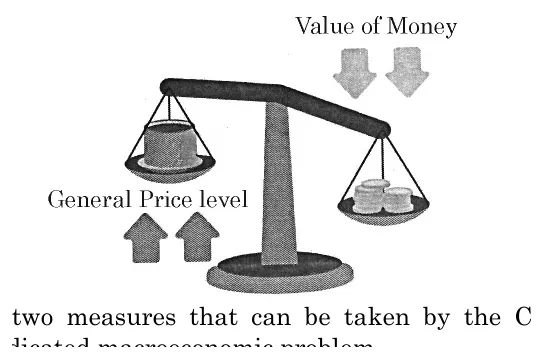
Refer the given image carefully : Explain any two measures that can be taken by the Central Bank to control the indicated macroeconomic problem.
Note : The following question is for the Visually Impaired Candidates only in lieu of Q. No. 15. State and explain any two measures that can be taken by the Central Bank to control the situation of deficient demand.
Refer the given image carefully : Explain any two measures that can be taken by the Central Bank to control the indicated macroeconomic problem.
Note : The following question is for the Visually Impaired Candidates only in lieu of Q. No. 15. State and explain any two measures that can be taken by the Central Bank to control the situation of deficient demand.
Official answer
The image depicts deficient demand (Aggregate Demand falls short of Aggregate Supply at full-employment level, causing unemployment/recessionary gap). To correct this, the Central Bank (RBI) uses an expansionary (cheap money) monetary policy:
- Repo Rate cut: RBI reduces the rate at which it lends short-term funds to commercial banks. This lowers banks' cost of borrowing, so they in turn reduce lending rates for businesses and consumers. Cheaper credit encourages more investment and consumption spending, raising Aggregate Demand and closing the deficient-demand gap.
- Open Market Operations (purchase of securities): RBI buys government securities from banks and the public in the open market. This directly injects money into the economy, increasing the cash reserves of banks, expanding their lending capacity, and raising overall money supply and Aggregate Demand.
(Reduction in CRR/SLR, releasing more funds for lending, is an equally valid alternative measure.)
Marking scheme
- 1.1 mark for correctly identifying the macroeconomic problem as deficient demand.
- 2.1.5 marks for explaining the first measure (e.g., Repo Rate cut) with reasoning on how it raises AD.
- 3.1.5 marks for explaining the second measure (e.g., Open Market Operations/CRR-SLR cut) with reasoning on how it raises AD.
Hint
Deficient demand needs an expansionary monetary policy — lower repo rate, buy securities via OMO, or cut CRR/SLR.
Quick oral answer
Deficient demand is corrected by an expansionary monetary policy — the Central Bank cuts the Repo Rate and/or buys securities through Open Market Operations, both of which increase money supply and stimulate Aggregate Demand.
Common mistakes
- 1.Suggesting contractionary measures (raising repo rate/CRR) — these are meant for excess demand/inflation, the opposite problem.
- 2.Naming a measure without explaining the transmission mechanism (how it actually raises Aggregate Demand).
- 3.Confusing fiscal measures (tax cuts, government spending) with monetary measures when the question specifically asks about the Central Bank.
Analysis and explanation
Concept: Deficient demand arises when Aggregate Demand (AD) is less than Aggregate Supply (AS) corresponding to full-employment level of output, creating a deflationary/recessionary gap, rising unemployment, and downward pressure on prices.
Why these measures work: Both a Repo Rate cut and an OMO purchase work by increasing the availability and lowering the cost of credit in the economy — this stimulates borrowing for investment and consumption, which are direct components of Aggregate Demand ().
Exam trap: Students must correctly identify that deficient demand needs an EXPANSIONARY policy (increasing money supply/AD), not a contractionary one (which is used for excess demand/inflation). Confusing the direction of policy for the two opposite situations is the most common error.
Real-world relevance: RBI cut the Repo Rate sharply during the COVID-19 slowdown (from 5.15% in Feb 2020 to 4.00% by May 2020) and conducted large OMO purchases precisely to counter deficient demand and revive economic activity.
Interesting facts
The RBI cut the Repo Rate to a historic low of 4.00% in May 2020 specifically to counter deficient demand caused by the COVID-19 lockdown.
Open Market Operations were first used extensively by the US Federal Reserve in the 1920s and remain one of the most flexible day-to-day tools of monetary policy worldwide.
A cut in CRR of just 0.5 percentage points can release tens of thousands of crores of additional lendable funds into the Indian banking system.
Question details
Q15 of 37 questions
- Board
- CBSE
- Class
- Class 12
- Subject
- Economics
- Year
- 2026
- Section
- Section A
- Marks
- 4
- Type
- Short Answer
- Chapter
- Money and Banking
- Topic
- Central Bank Measures to Correct Deficient Demand
- Bloom's level
- apply
- Syllabus topic
- Unit 3: Money and Banking / Unit 4: Determination of Income and Employment — Monetary Policy Measures (Repo Rate, CRR/SLR, Open Market Operations) to Correct Deficient Demand
- Author
- CBSE
- Reviewed by
- Padhantu Academic Team
Spotted a mistake or something unclear?
Tell us and we will fix it.
Frequently asked questions
What is deficient demand?
Deficient demand is a situation where Aggregate Demand falls short of Aggregate Supply corresponding to the full-employment level of output, leading to unemployment, unsold stocks, and a recessionary/deflationary gap in the economy.
Why does a Repo Rate cut help fight deficient demand?
A lower Repo Rate reduces banks' cost of borrowing from the RBI, letting them lend to businesses and consumers at lower interest rates. Cheaper credit boosts investment and consumption spending, directly raising Aggregate Demand.