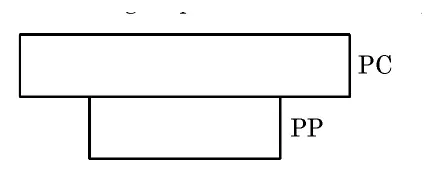
(a) Given below is a pyramid found in an ecosystem, where each bar represents the standing crop available in the trophic level.
[Diagram: an inverted ecological pyramid – a wide upper bar labelled 'PC' resting on a narrower lower bar labelled 'PP'.]
(i) Identify the kind of pyramid and with the help of an example explain the conditions where this kind of pyramid is possible in nature. [1]
(ii) Write any two limitations of ecological pyramids. [1]
OR
(b) In an ecosystem there was loss of biodiversity due to some project in that area.
(i) How will biodiversity be affected? (2 points) [1]
(ii) List two major causes of loss of biodiversity. [1]
(a) Given below is a pyramid found in an ecosystem, where each bar represents the standing crop available in the trophic level.
[Diagram: an inverted ecological pyramid – a wide upper bar labelled 'PC' resting on a narrower lower bar labelled 'PP'.]
(i) Identify the kind of pyramid and with the help of an example explain the conditions where this kind of pyramid is possible in nature. [1]
(ii) Write any two limitations of ecological pyramids. [1]
OR
(b) In an ecosystem there was loss of biodiversity due to some project in that area.
(i) How will biodiversity be affected? (2 points) [1]
(ii) List two major causes of loss of biodiversity. [1]
Official answer
The wider consumer bar (PC) resting on a narrower producer bar (PP) means the pyramid is upside-down — that is the key.
(a)(i) Kind of pyramid and where it occurs:
- It is an inverted pyramid of biomass (standing crop).
- Seen in an aquatic (sea/pond) ecosystem: the standing crop of phytoplankton (producers, PP) at any instant is small, yet it supports a much larger biomass of zooplankton and consumers (PC).
- This is possible because the tiny producers reproduce and are consumed very rapidly (high turnover), so their small standing biomass still sustains a bigger consumer biomass.
(a)(ii) Any two limitations of ecological pyramids:
- They assume a simple food chain and do not accommodate a food web.
- They do not consider the same species belonging to two or more trophic levels.
- Saprophytes/decomposers are given no place, though they are vital.
(OR (b), briefly): loss of biodiversity → decline in plant productivity and lowered ecosystem stability/resistance to disturbances; two major causes → habitat loss & fragmentation and over-exploitation.)
Marking scheme
- 1.½ mark: identifying it as an inverted pyramid of biomass (standing crop).
- 2.½ mark: correct example/condition — aquatic/sea ecosystem where small phytoplankton biomass with high turnover supports larger consumer biomass.
- 3.½ + ½ mark: any two valid limitations of ecological pyramids (simple food chain assumed / species at multiple trophic levels ignored / decomposers not placed).
- 4.OR (b): ½+½ two effects of biodiversity loss (reduced productivity, reduced stability/resistance); ½+½ two causes (habitat loss & fragmentation, over-exploitation, alien species, co-extinctions).
Hint
Wide consumers on a thin producer base = inverted biomass pyramid; think phytoplankton feeding a bigger zooplankton crop in the sea.
Quick oral answer
This is an inverted pyramid of biomass, typical of a sea ecosystem, where a small standing crop of fast-reproducing phytoplankton supports a much larger biomass of zooplankton and fish; its limitations are that it ignores food webs, multi-level species, and decomposers.
Common mistakes
- 1.Writing 'inverted pyramid of energy' — the pyramid of energy is always upright; only number and biomass pyramids can be inverted.
- 2.Giving a terrestrial/forest example for an inverted biomass pyramid — the correct setting is an aquatic/sea ecosystem.
- 3.Stating limitations vaguely (e.g. 'not accurate') instead of the specific NCERT points: food web ignored, multi-level species ignored, decomposers not placed.
Analysis and explanation
Concept — pyramid of biomass:
A pyramid of biomass compares the standing crop (total dry weight of living matter) at each trophic level at a given time. It is usually upright on land, but can be inverted in water.
Why it inverts in the sea:
- Producers are microscopic phytoplankton with a very small biomass at any instant.
- But they multiply and are eaten so fast (high productivity/turnover) that they continuously support a larger standing biomass of zooplankton and fish.
- So the small PP base carries a wider PC band — an inverted pyramid.
Exam trap:
- The pyramid of energy is always upright and never inverted; only pyramids of number and biomass can invert. Do not write 'inverted pyramid of energy'.
- Give a correct example — sea/aquatic ecosystem — not a forest.
Limitations to remember (any two):
- Simple food chain assumed; food webs ignored.
- A species at more than one trophic level not accounted for.
- Decomposers/saprophytes not placed in the pyramid.
Real-world link:
Because ocean producers turn over so quickly, a small phytoplankton crop feeds vast fisheries — this rapid turnover is why healthy oceans are so productive despite little visible 'plant' mass.
Interesting facts
In the English Channel, the standing biomass of phytoplankton at a given moment can be less than that of the zooplankton feeding on them, yet the phytoplankton's rapid reproduction sustains the whole food chain.
The pyramid of energy, based on Lindeman's 10% law, can never be inverted because energy is always lost as heat at each transfer.
Decomposers process a huge share of an ecosystem's energy but find no place in classical ecological pyramids — a key reason the pyramids are considered oversimplified.
Question details
Q21 of 37 questions
- Board
- CBSE
- Class
- Class 12
- Subject
- Biology
- Year
- 2026
- Section
- Section B
- Marks
- 2
- Type
- Very Short Answer
- Chapter
- Ecosystem
- Topic
- Ecological pyramids (inverted pyramid of biomass)
- Bloom's level
- analyze
- Syllabus topic
- Unit X: Ecology — Ecosystem: Ecological Pyramids (Pyramid of Biomass)
- Author
- CBSE
- Reviewed by
- Padhantu Academic Team
Spotted a mistake or something unclear?
Tell us and we will fix it.
Frequently asked questions
Why can the pyramid of biomass be inverted in the sea but the pyramid of energy cannot?
In the sea, phytoplankton have a tiny standing biomass but reproduce so fast that they support a larger consumer biomass, inverting the biomass pyramid. The energy pyramid stays upright because energy is lost as heat at every trophic transfer (about 90% loss), so each higher level always has less energy.
What are the main limitations of ecological pyramids?
They assume a simple linear food chain and ignore food webs, they do not account for a species that occupies more than one trophic level, and they give no place to saprophytes/decomposers even though these are ecologically vital.
What are the major causes of loss of biodiversity?
The main causes (the 'Evil Quartet') are habitat loss and fragmentation, over-exploitation, invasion by alien species, and co-extinctions when a host or partner species disappears.