(a) What is pedigree analysis? Mention its importance in human genetics. (2 pts.) [1+1]
(b) Analyse the following pedigree and write the
(i) Pattern of inheritance. [½]
(ii) Give one example of disease showing such an inheritance pattern. [½]
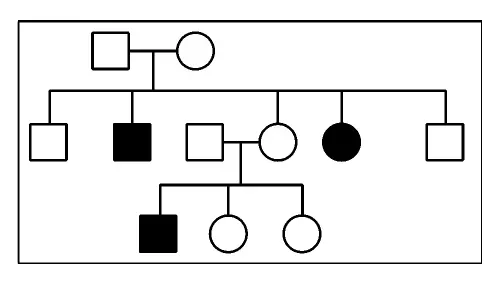
[Pedigree chart provided below the question.]
(a) What is pedigree analysis? Mention its importance in human genetics. (2 pts.) [1+1]
(b) Analyse the following pedigree and write the
(i) Pattern of inheritance. [½]
(ii) Give one example of disease showing such an inheritance pattern. [½]
[Pedigree chart provided below the question.]
Official answer
Reading the chart: both sexes are affected and affected children are born to unaffected parents — that fixes the pattern.
(a) Pedigree analysis and its importance:
- Pedigree analysis is the study of the inheritance of a trait/character across several generations of a family, represented as a chart (family tree) using standard symbols.
- Importance (any two):
- It helps trace the inheritance of a specific (Mendelian) trait and tell whether it is dominant or recessive, autosomal or sex-linked.
- It is used in genetic counselling — to predict the probability of a disorder appearing in future offspring and to advise families.
(b) Analysis of the given pedigree:
- (i) Pattern of inheritance: Autosomal recessive — both males and females are affected, and affected children are born to unaffected (carrier) parents, so the allele is recessive and not on the sex chromosome.
- (ii) Example of such a disease: Sickle-cell anaemia (also acceptable: thalassemia, cystic fibrosis, phenylketonuria).
Marking scheme
- 1.1 mark: definition of pedigree analysis — study of inheritance of a trait across generations of a family using a chart of standard symbols.
- 2.1 mark: any two importances — tracing Mendelian inheritance / determining dominant-recessive or autosomal-sex-linked nature / genetic counselling & predicting risk in offspring (½ each).
- 3.½ mark: pattern of inheritance = autosomal recessive.
- 4.½ mark: correct example — sickle-cell anaemia (or thalassemia/cystic fibrosis/phenylketonuria).
Hint
Both sexes affected + affected child from unaffected parents = autosomal recessive; sickle-cell anaemia is a textbook example.
Quick oral answer
Pedigree analysis is the study of how a trait is inherited across generations of a family using a symbol chart; here both sexes are affected and unaffected parents have affected children, so the pattern is autosomal recessive, as in sickle-cell anaemia, and it is widely used in genetic counselling.
Common mistakes
- 1.Calling the pattern 'dominant' — an affected child from two unaffected parents proves the trait is recessive.
- 2.Labelling it X-linked/sex-linked even though both sexes are affected equally, which points to an autosome.
- 3.Giving a mismatched disease example (e.g. haemophilia, which is X-linked recessive) instead of an autosomal recessive disorder like sickle-cell anaemia or thalassemia.
Analysis and explanation
Concept — pedigree analysis:
Since controlled crosses are impossible in humans, geneticists study a family tree (pedigree) drawn with standard symbols — squares for males, circles for females, filled symbols for affected individuals, horizontal lines for matings and vertical lines to offspring.
How to read this chart to get the pattern:
- Both sexes are affected → the gene is on an autosome, not sex-linked.
- Unaffected parents produce an affected child (Generation II couple → affected son in III) → the trait must be recessive (parents are heterozygous carriers, Aa × Aa).
- Together these two clues give autosomal recessive inheritance.
Exam trap:
- 'Affected child from two unaffected parents' is the classic signature of a recessive trait — do not call it dominant.
- Because both sexes are affected, do not label it X-linked; give an autosomal recessive answer with a matching disease example.
Real-world link:
Pedigree analysis is the backbone of genetic counselling: for an autosomal recessive disorder like sickle-cell anaemia, two carrier parents have a 25% chance of an affected child in each pregnancy — information families use to make informed decisions.
Interesting facts
Sickle-cell anaemia is caused by a single base substitution (GAG→GTG) that swaps glutamic acid for valine at the sixth position of the beta-globin chain — one of the first 'molecular diseases' ever described (Linus Pauling, 1949).
Carriers of one sickle-cell allele are largely healthy and gain partial resistance to malaria, which is why the allele persists at high frequency in malaria-endemic regions.
Standard pedigree symbols were formalised so that geneticists worldwide can read any family tree at a glance — squares for males, circles for females, and filled shapes for affected individuals.
Question details
Q23 of 37 questions
- Board
- CBSE
- Class
- Class 12
- Subject
- Biology
- Year
- 2026
- Section
- Section C
- Marks
- 3
- Type
- Short Answer
- Chapter
- Principles of Inheritance and Variation
- Topic
- Pedigree analysis and autosomal recessive inheritance
- Bloom's level
- analyze
- Syllabus topic
- Unit VII: Genetics and Evolution — Principles of Inheritance and Variation: Pedigree Analysis
- Author
- CBSE
- Reviewed by
- Padhantu Academic Team
Spotted a mistake or something unclear?
Tell us and we will fix it.
Frequently asked questions
What is pedigree analysis and why is it used?
Pedigree analysis is the study of the inheritance of a trait across several generations of a family, drawn as a chart with standard symbols. It is used because controlled crosses are impossible in humans; it lets geneticists determine whether a trait is dominant or recessive, autosomal or sex-linked, and predict the risk of a disorder in offspring for genetic counselling.
How do you identify autosomal recessive inheritance in a pedigree?
Two clues: both males and females are affected (so the gene is on an autosome, not sex-linked), and an affected child is born to two unaffected parents (so the allele is recessive, with the parents being carriers). Together these indicate autosomal recessive inheritance.
Give an example of an autosomal recessive disorder.
Sickle-cell anaemia is a classic example; thalassemia, cystic fibrosis and phenylketonuria are also autosomal recessive disorders.