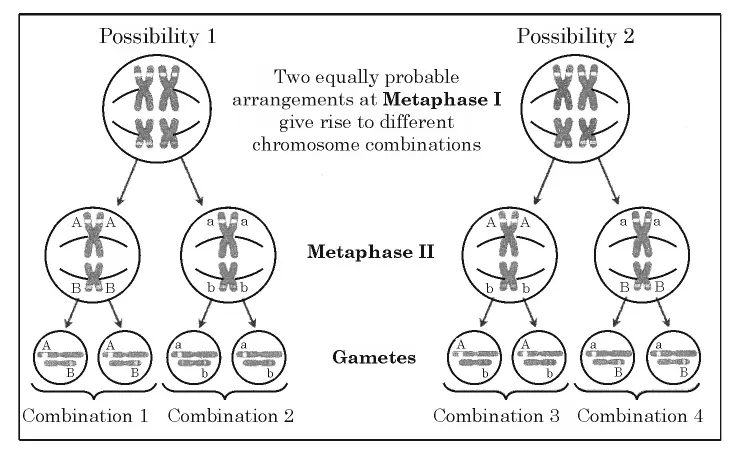
In the following figure, two ways of pairing of two homologous pairs of chromosomes are shown. Which of the following phenomena is expressed ?
In the following figure, two ways of pairing of two homologous pairs of chromosomes are shown. Which of the following phenomena is expressed ?
Options
Official answer
Correct option: B — Independent assortment of genes
The figure shows two homologous pairs lining up on the metaphase-I plate in two equally likely orientations, giving four gamete types (AB, ab, Ab, aB).
- This random orientation of non-homologous chromosomes is the cytological basis of Mendel's Law of Independent Assortment.
Marking scheme
- 1.1 mark: correct option B (Independent assortment of genes).
- 2.No partial credit; distractor A (linkage) is the common wrong choice.
Hint
Two orientations of two chromosome pairs → four gamete types → Mendel's second law.
Quick oral answer
Two homologous pairs orient in two independent ways at metaphase I, giving four gamete types — this illustrates independent assortment, so the answer is B.
Common mistakes
- 1.Choosing 'Linkage of genes' — but linkage keeps genes together on one chromosome and gives fewer combinations, whereas the figure gives all four combinations.
- 2.Assuming independent assortment needs a specific phenotype ratio to be shown; here it is demonstrated purely at the level of chromosome orientation.
Analysis and explanation
Concept
During metaphase I of meiosis, each pair of homologous chromosomes orients on the equatorial plate independently of every other pair. With two pairs there are two possible arrangements, producing four kinds of gametes in equal numbers — this is independent assortment.
Why B is correct
The two "possibilities" and the four gamete combinations (AB, ab, Ab, aB) are the textbook diagram of how alleles of genes on different chromosomes assort independently.
Why the distractors are wrong
- A — Linkage: Linkage is when genes lie on the same chromosome and tend to be inherited together, reducing recombinant gametes — the opposite of what the figure shows.
- C — Multiple alleles: This is when a gene has more than two allelic forms in a population (e.g. ABO blood group); the figure only shows two alleles per gene.
- D — Incomplete dominance: A phenotypic blending in the F1 (e.g. pink Antirrhinum); it concerns dominance relationships, not chromosome pairing.
Real-world
Independent assortment is a major source of genetic variation, giving possible gamete types for n chromosome pairs — (over 8 million) in humans.
Interesting facts
Mendel deduced independent assortment from dihybrid crosses giving a 9:3:3:1 ratio long before chromosomes were seen at meiosis.
In humans (23 chromosome pairs), independent assortment alone can generate genetically different gametes, before crossing over adds even more variety.
Question details
Q8 of 37 questions
- Board
- CBSE
- Class
- Class 12
- Subject
- Biology
- Year
- 2026
- Section
- Section A
- Marks
- 1
- Type
- MCQ
- Chapter
- Principles of Inheritance and Variation
- Topic
- Independent Assortment of Chromosomes
- Bloom's level
- understand
- Syllabus topic
- Unit VII: Genetics and Evolution — Principles of Inheritance and Variation: Law of Independent Assortment
- Author
- CBSE
- Reviewed by
- Padhantu Academic Team
Spotted a mistake or something unclear?
Tell us and we will fix it.
Frequently asked questions
How does meiosis produce independent assortment?
At metaphase I, each homologous pair aligns on the spindle equator independently of other pairs. This random orientation means the maternal and paternal chromosomes of different pairs can end up in any combination in the gametes, producing gamete types for n pairs.
How is independent assortment different from linkage?
Independent assortment applies to genes on different (non-homologous) chromosomes, giving all combinations equally. Linkage applies to genes on the same chromosome; they tend to be inherited together, so recombinant gametes are fewer than expected.