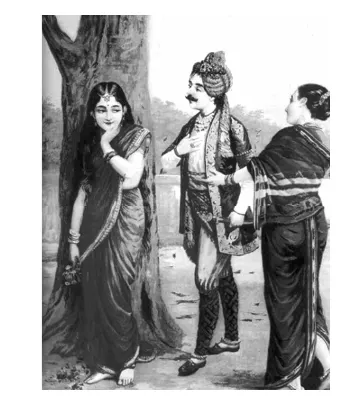
The given image shows a famous painting. Choose the painter of this art work from the following options :
The given image shows a famous painting. Choose the painter of this art work from the following options :
Options
Official answer
Option (D): Raja Ravi Varma — recognised for multi-figure, period-costume mythological/social paintings mass-reproduced as oleograph prints. (Verify against the exact textbook image if the printed figure differs.)
Marking scheme
- 1.1 mark: selecting option (D) — Raja Ravi Verma, correctly identified as the painter of the multi-figure period-costume artwork shown. No partial marks for MCQs.
Hint
Recall that Raja Ravi Varma's paintings — often mythological/period scenes with multiple figures — were mass-produced as oleograph prints in colonial India.
Quick oral answer
The painter is Raja Ravi Verma, known for mythological and period-costume paintings that were mass-reproduced as prints in colonial India — option (D).
Common mistakes
- 1.Confusing Raja Ravi Varma with Abanindranath Tagore, since both are famous colonial-era Indian painters covered in the same chapter.
- 2.Assuming Rabindranath Tagore (the poet) is the painter simply because his name is more familiar to students.
- 3.Not looking carefully at the number of figures and style in the image before selecting an option, since Bharat Mata (Tagore) is a single-figure painting while the given image has three figures.
Analysis and explanation
Tests identification of artists linked to mass-reproduced prints, set in the chapter 'Print Culture and the Modern World'.
Concept
- Raja Ravi Varma painted mythological/social scenes with figures in period costume that were mass-produced as cheap oleograph prints, making his work widely circulated visual art of the era.
Key point
- Abanindranath Tagore is known instead for the single-figure 'Bharat Mata' (Swadeshi symbol), not multi-figure period scenes.
- Rabindranath Tagore was primarily a writer/poet, later a modernist painter, unrelated to this genre.
- Satyendranath Bishi is not a recognised painter in the NCERT print-culture narrative — a distractor.
Common mistakes
- Confusing image-identification questions with generic name familiarity; always cross-check the printed image against the NCERT reproduction before finalising.
Interesting facts
Raja Ravi Varma set up his own printing press near Bombay in the 1890s specifically to mass-produce oleograph copies of his paintings for the growing middle-class market.
Ravi Varma's prints often depicted Hindu mythological scenes and were among the earliest instances of religious and cultural imagery being commercially mass-produced in India.
In contrast, Abanindranath Tagore's 'Bharat Mata' (1905) became an iconic nationalist symbol during the Swadeshi movement following the partition of Bengal.
Question details
Q3 of 57 questions
- Board
- CBSE
- Class
- Class 10
- Subject
- Social Science
- Year
- 2026
- Section
- Section A
- Marks
- 1
- Type
- MCQ
- Chapter
- Print Culture and the Modern World
- Topic
- Identification of artist of a mass-reproduced painting used in print culture
- Bloom's level
- remember
- Syllabus topic
- Unit 1: India and the Contemporary World – II — Print Culture and the Modern World: mass-produced prints and paintings
- Author
- CBSE
- Reviewed by
- Padhantu Academic Team
Spotted a mistake or something unclear?
Tell us and we will fix it.
Frequently asked questions
Why is Raja Ravi Varma linked to print culture rather than just painting?
Because he set up a press to mass-produce oleograph (print) versions of his paintings, making his art some of the most widely circulated visual material in colonial India, directly relevant to the 'Print Culture' chapter.
How can I distinguish a Ravi Varma painting from a Tagore painting in an exam image?
Ravi Varma's works are typically realistic, multi-figure, and mythological/period scenes, while Abanindranath Tagore's iconic work 'Bharat Mata' is a single stylised nationalist figure in a simpler wash technique.