Choose the appropriate option to fill in the blank :
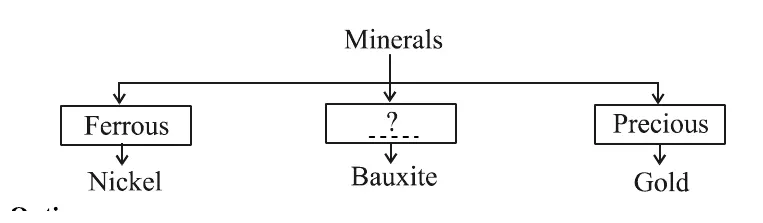
[Flow chart: Minerals → Ferrous → Nickel ; Minerals → ? → Bauxite ; Minerals → Precious → Gold]
Choose the appropriate option to fill in the blank :
[Flow chart: Minerals → Ferrous → Nickel ; Minerals → ? → Bauxite ; Minerals → Precious → Gold]
Options
Official answer
Option C: Non-Ferrous Minerals — bauxite contains no iron and is the main ore of aluminium, so it belongs under the non-ferrous branch.
Marking scheme
- 1.1 mark for selecting Option C: Non-Ferrous Minerals; no partial marks for MCQ.
Hint
Bauxite is the ore of aluminium — it is metallic but contains no iron, so it is classified as a Non-Ferrous mineral.
Quick oral answer
The blank should be filled with 'Non-Ferrous Minerals' because bauxite, the ore of aluminium, contains no iron and is classified as a non-ferrous metallic mineral.
Common mistakes
- 1.Confusing 'non-ferrous' (metallic, no iron) with 'non-metallic' (like mica, coal) and wrongly classifying bauxite as non-metallic.
- 2.Forgetting that nickel is a ferrous mineral, not a non-ferrous one.
Analysis and explanation
Fills the blank in the minerals classification flow chart using the ferrous/non-ferrous/precious split.
Concept
- Metallic minerals split into Ferrous, Non-Ferrous, and Precious categories.
Key points
- Ferrous: contains iron — iron ore, manganese, chromite, nickel (~3/4 of India's metallic mineral value).
- Non-Ferrous: no iron — copper, bauxite (aluminium ore), tin, lead.
- Precious: gold, silver, platinum — valued for rarity.
Common mistakes
- Placing bauxite under 'Non-Metallic Minerals' (mica, gypsum, coal) instead of 'Non-Ferrous' — bauxite is a metallic ore of aluminium, just iron-free, so it is non-ferrous, not non-metallic.
Interesting facts
India is one of the leading producers of bauxite in the world, with major deposits in Odisha, which alone accounts for over 50% of India's bauxite reserves.
Aluminium extracted from bauxite is prized in industry because it combines the strength of iron with extraordinary lightness and resistance to rust.
Question details
Q20 of 57 questions
- Board
- CBSE
- Class
- Class 10
- Subject
- Social Science
- Year
- 2026
- Section
- Section B
- Marks
- 1
- Type
- MCQ
- Chapter
- Minerals and Energy Resources
- Topic
- Classification of Minerals
- Bloom's level
- remember
- Syllabus topic
- Unit 2: Contemporary India II — Minerals and Energy Resources: Classification of Minerals (Ferrous, Non-Ferrous, Non-Metallic, Energy)
- Author
- CBSE
- Reviewed by
- Padhantu Academic Team
Spotted a mistake or something unclear?
Tell us and we will fix it.
Frequently asked questions
Why is bauxite called a non-ferrous mineral?
Because it does not contain iron; it is the principal ore of aluminium, a metal, so it is classified as a metallic but non-ferrous mineral.
What are examples of non-ferrous minerals other than bauxite?
Copper, lead, zinc and tin are other common examples of non-ferrous minerals.