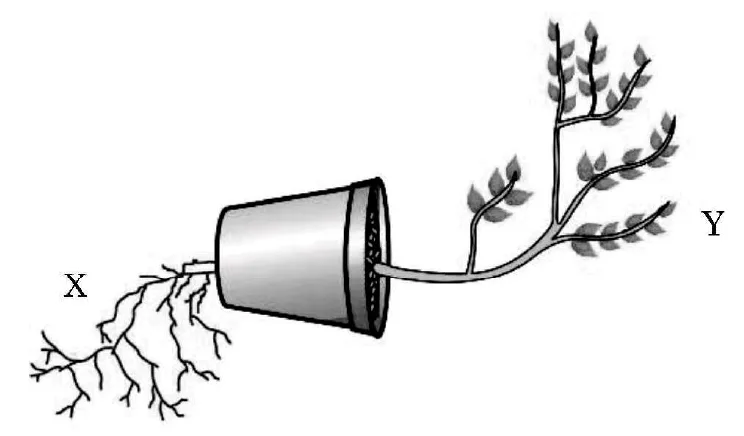
The growth movements of plant parts in which the direction of the stimulus determines the direction of the response is known as tropic movements or tropism. Plants also have non-directional movements which may not be growth dependent. (I) Name the movement which causes 'X' and 'Y' to grow downwards and upwards respectively. (II) Write the name of a hormone that plays a major role in (i) falling of leaves (ii) rapid cell division. (III) (a) Leaves of the sensitive plant move very quickly in response to 'touch'. How is this stimulus of touch communicated and explain how the movement takes place. OR (III) (b) Name the plant hormone which is synthesized at the shoot tip. How does this hormone helps the plant to bend towards light?
The growth movements of plant parts in which the direction of the stimulus determines the direction of the response is known as tropic movements or tropism. Plants also have non-directional movements which may not be growth dependent. (I) Name the movement which causes 'X' and 'Y' to grow downwards and upwards respectively. (II) Write the name of a hormone that plays a major role in (i) falling of leaves (ii) rapid cell division. (III) (a) Leaves of the sensitive plant move very quickly in response to 'touch'. How is this stimulus of touch communicated and explain how the movement takes place. OR (III) (b) Name the plant hormone which is synthesized at the shoot tip. How does this hormone helps the plant to bend towards light?
Official answer
The movement that causes 'X' and 'Y' to grow downwards and upwards respectively is called geotropism. The hormone that plays a major role in (i) falling of leaves is ethylene, and (ii) rapid cell division is auxin. (III) (a) The stimulus of touch is communicated through the plant's nervous system, which consists of specialized cells called neurons. When a leaf is touched, it sends a signal to the brain, which then sends a response back to the leaf, causing it to move. The movement takes place through the contraction and relaxation of muscles in the leaf. OR (III) (b) The plant hormone synthesized at the shoot tip is auxin. Auxin helps the plant to bend towards light by promoting cell elongation on the side of the stem opposite the light source. This causes the stem to bend towards the light, a process known as phototropism.
Marking scheme
- 1.None
Hint
None
Quick oral answer
None
Common mistakes
- 1.None
Analysis and explanation
None
Interesting facts
None
Question details
Q38 of 39 questions
- Board
- CBSE
- Class
- Class 10
- Subject
- Science
- Year
- 2025
- Section
- Section E
- Marks
- 4
- Chapter
- Chemical Reactions and Equations
- Topic
- Tropic Movements or Tropism
- Bloom's level
- Analyzing
- Syllabus topic
- Plant Hormones
Spotted a mistake or something unclear?
Tell us and we will fix it.
Frequently asked questions
How many marks does this question carry in CBSE Class 10 Science 2025?
This question carries 4 marks in the CBSE Class 10 Science 2025 examination.
Which chapter does this question come from in Science?
This question is from the chapter "Chemical Reactions and Equations" in the CBSE Class 10 Science syllabus.
What topic does this question cover in Science?
This question covers the topic "Tropic Movements or Tropism" from CBSE Class 10 Science.
What type of question is this in the CBSE Class 10 Science 2025 paper?
This question appears in Section E in the CBSE Class 10 Science 2025 paper.