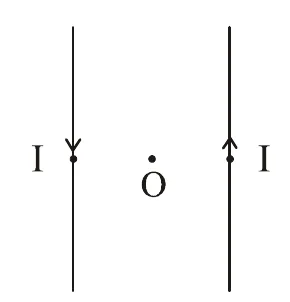
(A) (i) Draw the pattern of the magnetic field lines for the two parallel straight conductors carrying current of same magnitude 'I' in opposite directions as shown. Show the direction of magnetic field at a point O which is equidistant from the two conductors. (Consider that the conductors are inserted normal to the plane of a rectangular cardboard.)
(ii) In our houses we receive A.C. electric power of . In electric iron or electric heater cables having three wires with insulation of three different colours - red, black and green are used to draw current from the mains.
(a) What are these three different wires called? Name them colourwise.
(b) What is the potential difference between the red wire and the black wire?
(c) What is the role of the wire with green insulation in case of accidental leakage of electric current to the metallic body of an electrical appliance?
OR
(B) (i) By using the given experimental set-up. How can it be shown that:
(a) a force is exerted on the current-carrying conductor AB when it is placed in a magnetic field.
(b) the direction of force can be reversed in two ways.
(ii) When will the magnitude of the force be highest?
(iii) State Fleming's left hand rule.
(A) (i) Draw the pattern of the magnetic field lines for the two parallel straight conductors carrying current of same magnitude 'I' in opposite directions as shown. Show the direction of magnetic field at a point O which is equidistant from the two conductors. (Consider that the conductors are inserted normal to the plane of a rectangular cardboard.)
(ii) In our houses we receive A.C. electric power of . In electric iron or electric heater cables having three wires with insulation of three different colours - red, black and green are used to draw current from the mains.
(a) What are these three different wires called? Name them colourwise.
(b) What is the potential difference between the red wire and the black wire?
(c) What is the role of the wire with green insulation in case of accidental leakage of electric current to the metallic body of an electrical appliance?
OR
(B) (i) By using the given experimental set-up. How can it be shown that:
(a) a force is exerted on the current-carrying conductor AB when it is placed in a magnetic field.
(b) the direction of force can be reversed in two ways.
(ii) When will the magnitude of the force be highest?
(iii) State Fleming's left hand rule.
Official answer
(A) (i) The pattern of the magnetic field lines for the two parallel straight conductors carrying current of same magnitude 'I' in opposite directions is shown below:
(ii) (a) The three different wires are called live wire (red), neutral wire (black), and earth wire (green).
(b) The potential difference between the red wire and the black wire is 220 V.
(c) The role of the wire with green insulation is to provide a safe path for the electric current to flow to the ground in case of accidental leakage of electric current to the metallic body of an electrical appliance.
OR
(B) (i) (a) A force is exerted on the current-carrying conductor AB when it is placed in a magnetic field because the magnetic field exerts a force on the moving charges in the conductor.
(b) The direction of force can be reversed in two ways: by reversing the direction of the current in the conductor or by reversing the direction of the magnetic field.
(ii) The magnitude of the force will be highest when the conductor is perpendicular to the magnetic field.
(iii) Fleming's left hand rule states that if the thumb, index finger, and middle finger of the left hand are stretched at right angles to each other, then the thumb will point in the direction of the force, the index finger will point in the direction of the magnetic field, and the middle finger will point in the direction of the current.
Marking scheme
- 1.Magnetic field lines
- 2.Fleming's left hand rule
- 3.Force exerted on a conductor
Hint
Use Fleming's left hand rule to determine the direction of the force exerted on the conductor.
Quick oral answer
The magnetic field lines around a conductor carrying current can be visualized using iron filings or a compass. Fleming's left hand rule is used to determine the direction of the force exerted on a conductor carrying current in a magnetic field. The magnitude of the force exerted on the conductor depends on the strength of the magnetic field and the current flowing through the conductor.
Common mistakes
- 1.not understanding the concept of magnetic field lines
- 2.not applying Fleming's left hand rule correctly
Analysis and explanation
The problem requires the application of the concept of magnetic field lines and Fleming's left hand rule to determine the direction and magnitude of the force exerted on a conductor carrying current in a magnetic field. The correct answer is based on the understanding of the magnetic field lines and the application of Fleming's left hand rule.
Interesting facts
Magnetic field lines are used to visualize the magnetic field around a conductor.
Fleming's left hand rule is used to determine the direction of the force exerted on a conductor carrying current in a magnetic field.
Question details
Q36 of 39 questions
- Board
- CBSE
- Class
- Class 10
- Subject
- Science
- Year
- 2025
- Section
- Section D
- Marks
- 5
- Type
- Long Answer
- Chapter
- Magnetic Effects of Electric Current
- Topic
- Magnetic Field Lines
- Bloom's level
- Remembering
- Syllabus topic
- Magnetic Effects of Current
Spotted a mistake or something unclear?
Tell us and we will fix it.
Frequently asked questions
How many marks does this question carry in CBSE Class 10 Science 2025?
This question carries 5 marks in the CBSE Class 10 Science 2025 examination.
Which chapter does this question come from in Science?
This question is from the chapter "Magnetic Effects of Electric Current" in the CBSE Class 10 Science syllabus.
What topic does this question cover in Science?
This question covers the topic "Magnetic Field Lines" from CBSE Class 10 Science.
What type of question is this in the CBSE Class 10 Science 2025 paper?
This is a Long Answer question from Section D in the CBSE Class 10 Science 2025 paper.