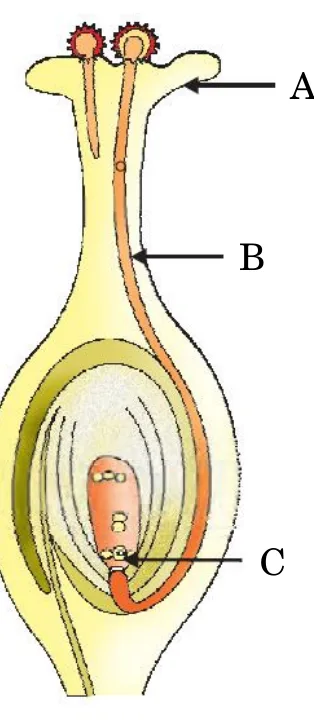
(a) (i) Write the functions of the following parts of human female reproductive system : (I) Ovary (II) Fallopian tube (III) Uterus (ii) State briefly two contraceptive methods used by human males. OR (b) (i) Differentiate between self-pollination and cross-pollination. (ii) Identify A, B and C in the diagram given below and write one function of each.
(a) (i) Write the functions of the following parts of human female reproductive system : (I) Ovary (II) Fallopian tube (III) Uterus (ii) State briefly two contraceptive methods used by human males. OR (b) (i) Differentiate between self-pollination and cross-pollination. (ii) Identify A, B and C in the diagram given below and write one function of each.
Official answer
The functions of the following parts of human female reproductive system are: (I) Ovary: The ovary produces eggs and hormones that regulate the menstrual cycle. (II) Fallopian tube: The fallopian tube provides a passage for the egg to travel from the ovary to the uterus. (III) Uterus: The uterus is where the fertilized egg implants and develops during pregnancy. Two contraceptive methods used by human males are: (i) Condoms: Condoms are a barrier method that prevents sperm from entering the vagina during intercourse. (ii) Vasectomy: Vasectomy is a surgical procedure that cuts or blocks the vas deferens, preventing sperm from being released during ejaculation.
Marking scheme
- 1.Ovary: produces eggs and hormones
- 2.Fallopian tube: provides passage for egg to travel from ovary to uterus
- 3.Uterus: where fertilized egg implants and develops during pregnancy
- 4.Condoms: barrier method that prevents sperm from entering vagina during intercourse
- 5.Vasectomy: surgical procedure that cuts or blocks vas deferens, preventing sperm from being released during ejaculation
Hint
The student should focus on the functions of the ovary, fallopian tube, and uterus, as well as the two contraceptive methods used by human males. The student should also consider the importance of these functions and methods in the context of human reproduction.
Quick oral answer
The functions of the following parts of human female reproductive system are: (I) Ovary: The ovary produces eggs and hormones that regulate the menstrual cycle. (II) Fallopian tube: The fallopian tube provides a passage for the egg to travel from the ovary to the uterus. (III) Uterus: The uterus is where the fertilized egg implants and develops during pregnancy. Two contraceptive methods used by human males are: (i) Condoms: Condoms are a barrier method that prevents sperm from entering the vagina during intercourse. (ii) Vasectomy: Vasectomy is a surgical procedure that cuts or blocks the vas deferens, preventing sperm from being released during ejaculation.
Common mistakes
- 1.confusing the functions of the ovary, fallopian tube, and uterus
- 2.not providing accurate information about the two contraceptive methods
Analysis and explanation
The question requires the student to identify the functions of different parts of the human female reproductive system and to describe two contraceptive methods used by human males. The student should be able to provide accurate and detailed information about the functions of the ovary, fallopian tube, and uterus, as well as the two contraceptive methods. The student should also be able to explain the importance of these functions and methods in the context of human reproduction.
Interesting facts
The ovary produces eggs and hormones that regulate the menstrual cycle.
The fallopian tube provides a passage for the egg to travel from the ovary to the uterus.
The uterus is where the fertilized egg implants and develops during pregnancy.
Condoms are a barrier method that prevents sperm from entering the vagina during intercourse.
Vasectomy is a surgical procedure that cuts or blocks the vas deferens, preventing sperm from being released during ejaculation.
Question details
Q35 of 39 questions
- Board
- CBSE
- Class
- Class 10
- Subject
- Science
- Year
- 2025
- Section
- Section D
- Marks
- 5
- Type
- Long Answer
- Chapter
- Chemical Reactions and Equations
- Topic
- Chemical Reactions and Equations
- Bloom's level
- Knowledge
- Syllabus topic
- Chemical Reactions and Equations
Spotted a mistake or something unclear?
Tell us and we will fix it.
Frequently asked questions
How many marks does this question carry in CBSE Class 10 Science 2025?
This question carries 5 marks in the CBSE Class 10 Science 2025 examination.
Which chapter does this question come from in Science?
This question is from the chapter "Chemical Reactions and Equations" in the CBSE Class 10 Science syllabus.
What topic does this question cover in Science?
This question covers the topic "Chemical Reactions and Equations" from CBSE Class 10 Science.
What type of question is this in the CBSE Class 10 Science 2025 paper?
This is a Long Answer question from Section D in the CBSE Class 10 Science 2025 paper.