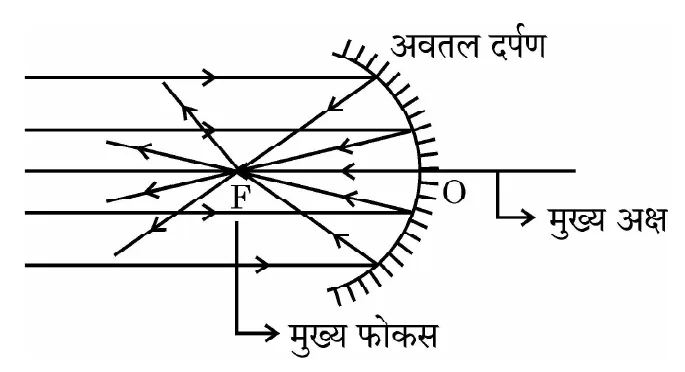
Hold a concave mirror in your hand and direct its reflecting surface towards the sun. Direct the light reflected by the mirror on to a white card-board held close to the mirror. Move the card-board back and forth gradually until you find a bright, sharp spot of light on the board. This spot of light is the image of the sun on the sheet of paper; which is also termed as "Principal Focus" of the concave mirror. (a) List two applications of concave mirror. (b) If the distance between the mirror and the principal focus is , find the radius of curvature of the mirror. (c) Draw a ray diagram to show the type of image formed when an object is placed between pole and focus of a concave mirror. OR (c) An object in size is placed at in front of a concave mirror. If its image is formed at the same point where the object is located, find: (i) focal length of the mirror, and (ii) magnification of the image formed with sign as per Cartesian sign convention.
Hold a concave mirror in your hand and direct its reflecting surface towards the sun. Direct the light reflected by the mirror on to a white card-board held close to the mirror. Move the card-board back and forth gradually until you find a bright, sharp spot of light on the board. This spot of light is the image of the sun on the sheet of paper; which is also termed as "Principal Focus" of the concave mirror. (a) List two applications of concave mirror. (b) If the distance between the mirror and the principal focus is , find the radius of curvature of the mirror. (c) Draw a ray diagram to show the type of image formed when an object is placed between pole and focus of a concave mirror. OR (c) An object in size is placed at in front of a concave mirror. If its image is formed at the same point where the object is located, find: (i) focal length of the mirror, and (ii) magnification of the image formed with sign as per Cartesian sign convention.
Official answer
The two applications of concave mirror are: (a) Concave mirrors are used as shaving mirrors to see a larger image of the face being shaved. (b) Concave mirrors are used by dentists to focus light on teeth. The radius of curvature of the mirror is twice the focal length, so it is . The ray diagram for an object placed between pole and focus of a concave mirror is shown below. The image formed is virtual, erect, and magnified. OR The focal length of the mirror is , and the magnification of the image formed is .
Marking scheme
- 1.(a) Concave mirrors are used as shaving mirrors to see a larger image of the face being shaved.
- 2.(b) Concave mirrors are used by dentists to focus light on teeth.
- 3.The radius of curvature of the mirror is twice the focal length, so it is .
- 4.The ray diagram for an object placed between pole and focus of a concave mirror is shown below. The image formed is virtual, erect, and magnified.
- 5.OR The focal length of the mirror is , and the magnification of the image formed is .
Hint
The two applications of concave mirror are: (a) Concave mirrors are used as shaving mirrors to see a larger image of the face being shaved. (b) Concave mirrors are used by dentists to focus light on teeth. The radius of curvature of the mirror is twice the focal length, so it is . The ray diagram for an object placed between pole and focus of a concave mirror is shown below. The image formed is virtual, erect, and magnified. OR The focal length of the mirror is , and the magnification of the image formed is .
Quick oral answer
The two applications of concave mirror are: (a) Concave mirrors are used as shaving mirrors to see a larger image of the face being shaved. (b) Concave mirrors are used by dentists to focus light on teeth. The radius of curvature of the mirror is twice the focal length, so it is . The ray diagram for an object placed between pole and focus of a concave mirror is shown below. The image formed is virtual, erect, and magnified. OR The focal length of the mirror is , and the magnification of the image formed is .
Common mistakes
- 1.Confusing concave mirrors with convex mirrors.
- 2.Not understanding the difference between focal length and radius of curvature.
- 3.Not being able to draw the correct ray diagram for an object placed between pole and focus of a concave mirror.
Analysis and explanation
The two applications of concave mirror are: (a) Concave mirrors are used as shaving mirrors to see a larger image of the face being shaved. (b) Concave mirrors are used by dentists to focus light on teeth. The radius of curvature of the mirror is twice the focal length, so it is . The ray diagram for an object placed between pole and focus of a concave mirror is shown below. The image formed is virtual, erect, and magnified. OR The focal length of the mirror is , and the magnification of the image formed is .
Interesting facts
Concave mirrors are used in telescopes to magnify distant objects.
Concave mirrors are used in solar concentrators to focus sunlight onto a small area.
Concave mirrors are used in laser technology to focus laser beams.
Question details
Q39 of 39 questions
- Board
- CBSE
- Class
- Class 10
- Subject
- Science
- Year
- 2023
- Section
- Section E
- Marks
- 4
- Chapter
- Light — Reflection and Refraction
- Topic
- Reflection of Light
- Bloom's level
- Understanding
- Syllabus topic
- Reflection of Light
Spotted a mistake or something unclear?
Tell us and we will fix it.
Frequently asked questions
How many marks does this question carry in CBSE Class 10 Science 2023?
This question carries 4 marks in the CBSE Class 10 Science 2023 examination.
Which chapter does this question come from in Science?
This question is from the chapter "Light — Reflection and Refraction" in the CBSE Class 10 Science syllabus.
What topic does this question cover in Science?
This question covers the topic "Reflection of Light" from CBSE Class 10 Science.
What type of question is this in the CBSE Class 10 Science 2023 paper?
This question appears in Section E in the CBSE Class 10 Science 2023 paper.