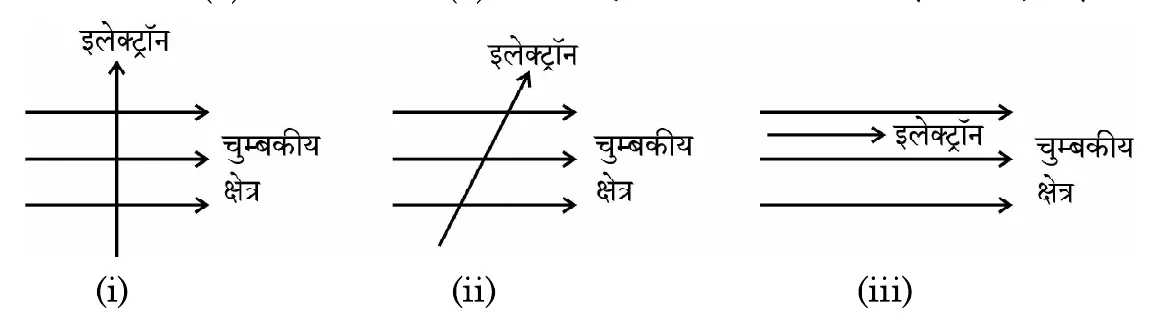
(a) (i) State the rule used to find the force acting on a current carrying conductor placed in a magnetic field. (ii) Given below are three diagrams showing entry of an electron in a magnetic field. Identify the case in which the force will be (1) maximum and (2) minimum respectively. Give reason for your answer. OR (b) (i) Draw the pattern of magnetic field lines of (1) a current carrying solenoid (2) a bar magnet (ii) List two distinguishing features between the two fields.
(a) (i) State the rule used to find the force acting on a current carrying conductor placed in a magnetic field. (ii) Given below are three diagrams showing entry of an electron in a magnetic field. Identify the case in which the force will be (1) maximum and (2) minimum respectively. Give reason for your answer. OR (b) (i) Draw the pattern of magnetic field lines of (1) a current carrying solenoid (2) a bar magnet (ii) List two distinguishing features between the two fields.
Official answer
(a) (i) The rule used to find the force acting on a current carrying conductor placed in a magnetic field is the Fleming's Left Hand Rule. (ii) (1) The force will be maximum in case (iii) because the electron is moving perpendicular to the magnetic field. (2) The force will be minimum in case (i) because the electron is moving parallel to the magnetic field. OR (b) (i) (1) The pattern of magnetic field lines of a current carrying solenoid is shown in Fig. 12.4. (2) The pattern of magnetic field lines of a bar magnet is shown in Fig. 12.4. (ii) Two distinguishing features between the two fields are: (1) The magnetic field lines of a current carrying solenoid are circular and closed, while the magnetic field lines of a bar magnet are straight and open. (2) The magnetic field of a current carrying solenoid is stronger near the center of the solenoid, while the magnetic field of a bar magnet is stronger near the poles.
Marking scheme
- 1.Fleming's Left Hand Rule
- 2.Force on a current carrying conductor
- 3.Magnetic field lines of a current carrying solenoid
- 4.Magnetic field lines of a bar magnet
- 5.Distinguishing features between the two fields
Hint
Use the Fleming's Left Hand Rule to find the force acting on a current carrying conductor placed in a magnetic field. Analyze the diagrams showing entry of an electron in a magnetic field and identify the case in which the force will be maximum and minimum respectively. Draw the pattern of magnetic field lines of a current carrying solenoid and a bar magnet. List two distinguishing features between the two fields.
Quick oral answer
The Fleming's Left Hand Rule is used to find the force acting on a current carrying conductor placed in a magnetic field. The force will be maximum when the electron is moving perpendicular to the magnetic field and minimum when the electron is moving parallel to the magnetic field. The magnetic field lines of a current carrying solenoid are circular and closed, while the magnetic field lines of a bar magnet are straight and open. The magnetic field of a current carrying solenoid is stronger near the center of the solenoid, while the magnetic field of a bar magnet is stronger near the poles.
Common mistakes
- 1.Confusing the direction of the force with the direction of the magnetic field
- 2.Not considering the angle between the current carrying conductor and the magnetic field
- 3.Not drawing the correct pattern of magnetic field lines
Analysis and explanation
The Fleming's Left Hand Rule is used to find the force acting on a current carrying conductor placed in a magnetic field. The force will be maximum when the electron is moving perpendicular to the magnetic field and minimum when the electron is moving parallel to the magnetic field. The magnetic field lines of a current carrying solenoid are circular and closed, while the magnetic field lines of a bar magnet are straight and open. The magnetic field of a current carrying solenoid is stronger near the center of the solenoid, while the magnetic field of a bar magnet is stronger near the poles.
Interesting facts
The Fleming's Left Hand Rule is used to find the force acting on a current carrying conductor placed in a magnetic field.
The magnetic field lines of a current carrying solenoid are circular and closed, while the magnetic field lines of a bar magnet are straight and open.
The magnetic field of a current carrying solenoid is stronger near the center of the solenoid, while the magnetic field of a bar magnet is stronger near the poles.
Question details
Q32 of 39 questions
- Board
- CBSE
- Class
- Class 10
- Subject
- Science
- Year
- 2023
- Section
- Section C
- Marks
- 3
- Type
- Short Answer
- Chapter
- Magnetic Effects of Electric Current
- Topic
- Magnetic Field
- Bloom's level
- Application
- Syllabus topic
- Magnetic Field and Field Lines
Spotted a mistake or something unclear?
Tell us and we will fix it.
Frequently asked questions
How many marks does this question carry in CBSE Class 10 Science 2023?
This question carries 3 marks in the CBSE Class 10 Science 2023 examination.
Which chapter does this question come from in Science?
This question is from the chapter "Magnetic Effects of Electric Current" in the CBSE Class 10 Science syllabus.
What topic does this question cover in Science?
This question covers the topic "Magnetic Field" from CBSE Class 10 Science.
What type of question is this in the CBSE Class 10 Science 2023 paper?
This is a Short Answer question from Section C in the CBSE Class 10 Science 2023 paper.