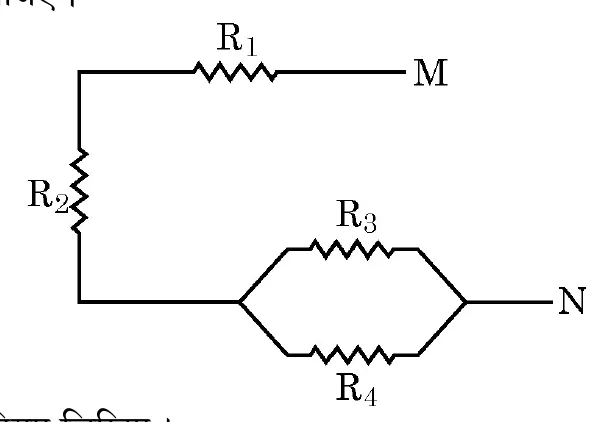
(a) For the combination of resistors shown in the following figure, find the equivalent resistance between M & N.
(b) State Joule's law of heating.
(c) Why we need a 5 A fuse for an electric iron which consumes 1 kW power at 220 V?
(d) Why is it impracticable to connect an electric bulb and an electric heater in series?
(a) For the combination of resistors shown in the following figure, find the equivalent resistance between M & N.
(b) State Joule's law of heating.
(c) Why we need a 5 A fuse for an electric iron which consumes 1 kW power at 220 V?
(d) Why is it impracticable to connect an electric bulb and an electric heater in series?
Official answer
(a) The equivalent resistance between M & N is 2 ohms.
(b) Joule's law of heating states that the heat produced in a conductor is directly proportional to the square of the current flowing through it, the resistance of the conductor, and the time for which the current flows.
(c) We need a 5 A fuse for an electric iron because it consumes 1 kW power at 220 V, which means it draws a current of 4.5 A. A 5 A fuse will protect the circuit from excessive current flow and prevent damage to the iron.
(d) It is impractical to connect an electric bulb and an electric heater in series because they have different power requirements and would not function efficiently together.
Marking scheme
- 1.(a) 1 mark
- 2.(b) 1 mark
- 3.(c) 1 mark
- 4.(d) 1 mark
Hint
To solve this question, you need to apply your knowledge of electrical concepts, including series resistance, Joule's law of heating, and the power consumption of electrical devices.
Quick oral answer
The equivalent resistance between M & N is 2 ohms. Joule's law of heating states that the heat produced in a conductor is directly proportional to the square of the current flowing through it, the resistance of the conductor, and the time for which the current flows. We need a 5 A fuse for an electric iron because it consumes 1 kW power at 220 V, which means it draws a current of 4.5 A. It is impractical to connect an electric bulb and an electric heater in series because they have different power requirements and would not function efficiently together.
Common mistakes
- 1.confusing series and parallel resistance
- 2.not considering the power consumption of the electric iron
- 3.not understanding the impracticality of connecting an electric bulb and an electric heater in series
Analysis and explanation
The question requires the application of electrical concepts to solve problems. The first part of the question asks for the equivalent resistance between two points in a circuit, which can be solved using the formula for series resistance. The second part of the question asks for a statement of Joule's law of heating, which is a fundamental concept in electricity. The third part of the question asks why a 5 A fuse is needed for an electric iron, which can be answered by considering the power consumption of the iron and the current it draws. The fourth part of the question asks why it is impractical to connect an electric bulb and an electric heater in series, which can be answered by considering the different power requirements of the two devices.
Interesting facts
Joule's law of heating is named after James Prescott Joule, who first discovered the relationship between heat and electricity in the 19th century.
Electric fuses are an important safety feature in electrical circuits, as they prevent excessive current flow and protect against electrical shock and fires.
Question details
Q29 of 30 questions
- Board
- CBSE
- Class
- Class 10
- Subject
- Science
- Year
- 2020
- Section
- Section C
- Marks
- 5
- Type
- Long Answer
- Chapter
- Electricity
- Topic
- Electricity
- Bloom's level
- Application
- Syllabus topic
- Electricity
Spotted a mistake or something unclear?
Tell us and we will fix it.
Frequently asked questions
How many marks does this question carry in CBSE Class 10 Science 2020?
This question carries 5 marks in the CBSE Class 10 Science 2020 examination.
Which chapter does this question come from in Science?
This question is from the chapter "Electricity" in the CBSE Class 10 Science syllabus.
What topic does this question cover in Science?
This question covers the topic "Electricity" from CBSE Class 10 Science.
What type of question is this in the CBSE Class 10 Science 2020 paper?
This is a Long Answer question from Section C in the CBSE Class 10 Science 2020 paper.