What is a rainbow? Draw a labelled diagram to show the formation of a rainbow.
What is a rainbow? Draw a labelled diagram to show the formation of a rainbow.
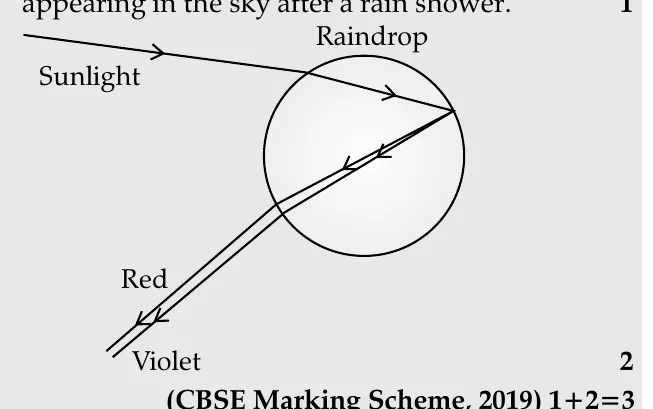
Official answer
A rainbow is a beautiful natural phenomenon that occurs when sunlight passes through water droplets in the air. It is characterized by its colorful arc shape and is often seen after a rain shower or near a waterfall or mist.
Marking scheme
- 1.Draw a large circle to represent the sun.
- 2.Draw a smaller circle inside the larger circle to represent the Earth.
- 3.Draw a line from the sun to the Earth to represent the path of sunlight.
- 4.Draw a series of small circles along the path of sunlight to represent the water droplets in the air.
- 5.Add color to the diagram to show the different colors of the rainbow.
Hint
To draw a labelled diagram to show the formation of a rainbow, start by drawing a large circle to represent the sun. Then, draw a smaller circle inside the larger circle to represent the Earth. Next, draw a line from the sun to the Earth to represent the path of sunlight. Finally, draw a series of small circles along the path of sunlight to represent the water droplets in the air, and add color to the diagram to show the different colors of the rainbow.
Quick oral answer
A rainbow is a beautiful natural phenomenon that occurs when sunlight passes through water droplets in the air. It is characterized by its colorful arc shape and is often seen after a rain shower or near a waterfall or mist. To draw a labelled diagram to show the formation of a rainbow, start by drawing a large circle to represent the sun. Then, draw a smaller circle inside the larger circle to represent the Earth. Next, draw a line from the sun to the Earth to represent the path of sunlight. Finally, draw a series of small circles along the path of sunlight to represent the water droplets in the air, and add color to the diagram to show the different colors of the rainbow.
Common mistakes
- 1.Drawing the sun and Earth as the same size.
- 2.Not including the path of sunlight in the diagram.
- 3.Not showing the different colors of the rainbow.
- 4.Not labeling the different parts of the diagram.
Analysis and explanation
The formation of a rainbow is a complex process that involves the refraction and dispersion of sunlight as it passes through water droplets in the air. The different colors of the rainbow are caused by the different wavelengths of light being refracted at slightly different angles. The diagram shows the path of sunlight as it passes through the water droplets and is refracted, creating the colorful arc shape of the rainbow.
Interesting facts
The word 'rainbow' comes from the Old English words 'regn' meaning 'rain' and 'boga' meaning 'bow' or 'arc'.
Rainbows can occur at night, but they are much fainter than daytime rainbows because the Moon is much weaker than the Sun.
Rainbows can be seen in the spray of a waterfall or fountain, as well as in the mist of an ocean wave.
Question details
Q13 of 37 questions
- Board
- CBSE
- Class
- Class 10
- Subject
- Science
- Year
- 2019
- Section
- Section C
- Marks
- 3
- Type
- Short Answer
- Chapter
- Chemical Reactions and Equations
- Topic
- Rainbow Formation
- Bloom's level
- Knowledge
- Syllabus topic
- Light and Its Reflection
Spotted a mistake or something unclear?
Tell us and we will fix it.
Frequently asked questions
How many marks does this question carry in CBSE Class 10 Science 2019?
This question carries 3 marks in the CBSE Class 10 Science 2019 examination.
Which chapter does this question come from in Science?
This question is from the chapter "Chemical Reactions and Equations" in the CBSE Class 10 Science syllabus.
What topic does this question cover in Science?
This question covers the topic "Rainbow Formation" from CBSE Class 10 Science.
What type of question is this in the CBSE Class 10 Science 2019 paper?
This is a Short Answer question from Section C in the CBSE Class 10 Science 2019 paper.