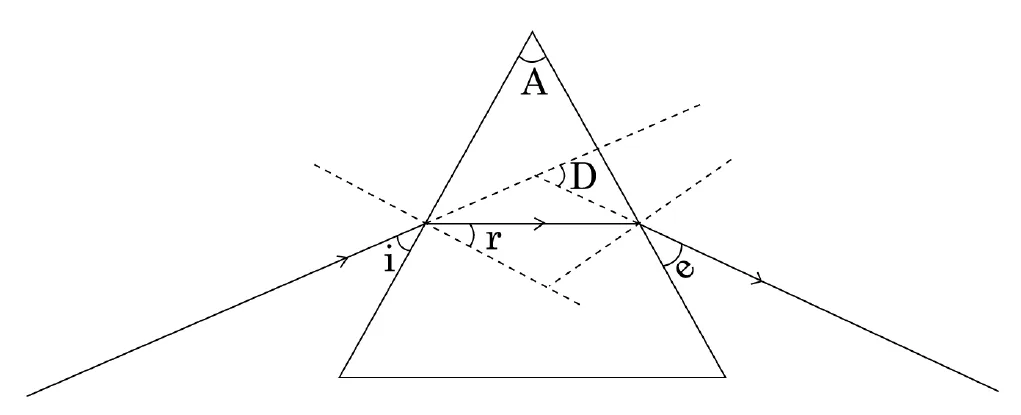
In the following ray diagram the correctly marked angle are:
In the following ray diagram the correctly marked angle are:
Options
Official answer
The correct answer is (c) , and .
Marking scheme
- 1.1 mark for correct answer
- 2.0 marks for incorrect answer
Hint
The ray diagram shows the path of light as it passes through a prism. The angles marked in the diagram are , , , , and . The angle of incidence () is the angle between the incident ray and the normal to the surface of the prism. The angle of emergence () is the angle between the emergent ray and the normal to the surface of the prism. The angle of deviation () is the angle between the incident ray and the emergent ray. The angle of refraction () is the angle between the refracted ray and the normal to the surface of the prism. The angle of reflection () is the angle between the reflected ray and the normal to the surface of the prism. The correct answer is (c) , and .
Quick oral answer
The correct answer is (c) , and .
Common mistakes
- 1.confusing angle of incidence with angle of emergence
- 2.confusing angle of deviation with angle of refraction
- 3.confusing angle of reflection with angle of incidence
Analysis and explanation
The ray diagram shows the path of light as it passes through a prism. The angles marked in the diagram are , , , , and . The angle of incidence () is the angle between the incident ray and the normal to the surface of the prism. The angle of emergence () is the angle between the emergent ray and the normal to the surface of the prism. The angle of deviation () is the angle between the incident ray and the emergent ray. The angle of refraction () is the angle between the refracted ray and the normal to the surface of the prism. The angle of reflection () is the angle between the reflected ray and the normal to the surface of the prism. The correct answer is (c) , and .
Interesting facts
The ray diagram shows the path of light as it passes through a prism.
The angles marked in the diagram are , , , , and .
The angle of incidence () is the angle between the incident ray and the normal to the surface of the prism.
The angle of emergence () is the angle between the emergent ray and the normal to the surface of the prism.
The angle of deviation () is the angle between the incident ray and the emergent ray.
The angle of refraction () is the angle between the refracted ray and the normal to the surface of the prism.
The angle of reflection () is the angle between the reflected ray and the normal to the surface of the prism.
Question details
Q27 of 36 questions
- Board
- CBSE
- Class
- Class 10
- Subject
- Science
- Year
- 2016
- Section
- Section B
- Marks
- 1
- Type
- MCQ
- Chapter
- Chemical Reactions and Equations
- Topic
- Chemical Reactions and Equations
- Also asked in
- 2016
- Bloom's level
- Remembering
- Syllabus topic
- Chemical Reactions and Equations
Spotted a mistake or something unclear?
Tell us and we will fix it.
Frequently asked questions
How many marks does this question carry in CBSE Class 10 Science 2016?
This question carries 1 mark in the CBSE Class 10 Science 2016 examination.
Which chapter does this question come from in Science?
This question is from the chapter "Chemical Reactions and Equations" in the CBSE Class 10 Science syllabus.
What topic does this question cover in Science?
This question covers the topic "Chemical Reactions and Equations" from CBSE Class 10 Science.
Has this question appeared in other CBSE Science papers?
Yes, a similar question appeared in the 2016 CBSE Class 10 Science paper.
What type of question is this in the CBSE Class 10 Science 2016 paper?
This is a MCQ question from Section B in the CBSE Class 10 Science 2016 paper.