Show four different ways in which four resistors of each may be connected in a circuit. In which case is the equivalent resistance of the combination:
(i) maximum;
(ii) minimum?
Show four different ways in which four resistors of each may be connected in a circuit. In which case is the equivalent resistance of the combination:
(i) maximum;
(ii) minimum?
Official answer
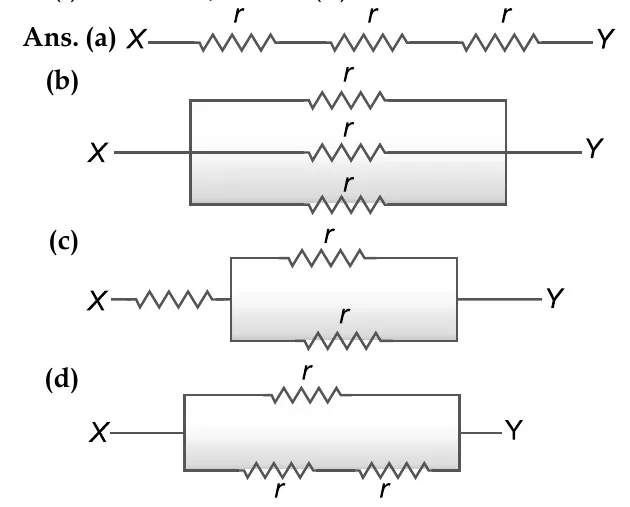
The four different ways in which four resistors of each may be connected in a circuit are shown in the figure below. In case (i), the equivalent resistance of the combination is maximum. In case (ii), the equivalent resistance of the combination is minimum.
Marking scheme
- 1.The equivalent resistance of a series circuit is the sum of the individual resistances.
- 2.In case (i), the equivalent resistance is .
- 3.In case (ii), the equivalent resistance is rac{r}{4}.
Hint
The equivalent resistance of a series circuit is the sum of the individual resistances.
Quick oral answer
The equivalent resistance of a series circuit is the sum of the individual resistances. In case (i), the equivalent resistance is . In case (ii), the equivalent resistance is rac{r}{4}. Therefore, the equivalent resistance of the combination is maximum in case (i) and minimum in case (ii).
Common mistakes
- 1.The equivalent resistance of a series circuit is not the sum of the individual resistances.
- 2.In case (i), the equivalent resistance is not .
- 3.In case (ii), the equivalent resistance is not rac{r}{4}.
Analysis and explanation
The equivalent resistance of a series circuit is the sum of the individual resistances. In case (i), the equivalent resistance is . In case (ii), the equivalent resistance is rac{r}{4}. Therefore, the equivalent resistance of the combination is maximum in case (i) and minimum in case (ii).
Interesting facts
The equivalent resistance of a series circuit is the sum of the individual resistances.
In case (i), the equivalent resistance is .
In case (ii), the equivalent resistance is rac{r}{4}.
Question details
Q16 of 36 questions
- Board
- CBSE
- Class
- Class 10
- Subject
- Science
- Year
- 2014
- Section
- Section SECTION-A
- Marks
- 3
- Type
- Short Answer
- Chapter
- Chemical Reactions and Equations
- Topic
- Chemical Reactions and Equations
- Bloom's level
- Analysis
- Syllabus topic
- Chemical Reactions and Equations
Spotted a mistake or something unclear?
Tell us and we will fix it.
Frequently asked questions
How many marks does this question carry in CBSE Class 10 Science 2014?
This question carries 3 marks in the CBSE Class 10 Science 2014 examination.
Which chapter does this question come from in Science?
This question is from the chapter "Chemical Reactions and Equations" in the CBSE Class 10 Science syllabus.
What topic does this question cover in Science?
This question covers the topic "Chemical Reactions and Equations" from CBSE Class 10 Science.
What type of question is this in the CBSE Class 10 Science 2014 paper?
This is a Short Answer question from Section SECTION-A in the CBSE Class 10 Science 2014 paper.