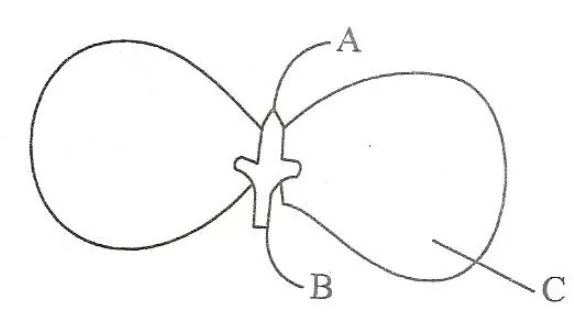
In the figure, the parts marked A, B and C are sequentially:
In the figure, the parts marked A, B and C are sequentially:
Options
Official answer
Radicle, Cotyledon and Plumule
Marking scheme
- 1.Radicle
- 2.Cotyledon
- 3.Plumule
Hint
Look at the figure and identify the different parts of the seedling. Then, determine their sequence based on their position and function.
Quick oral answer
The parts marked A, B, and C are sequentially Radicle, Cotyledon, and Plumule.
Common mistakes
- 1.Confusing the radicle with the plumule
- 2.Thinking that the cotyledon is the primary root
Analysis and explanation
This question requires the student to identify the different parts of a seedling and their sequence. The student needs to understand the structure and development of a seedling to answer this question correctly.
Interesting facts
The radicle is the first root to emerge from the seed
The cotyledon is the first leaf to emerge from the seed
The plumule is the growing tip of the stem
Question details
Q42 of 40 questions
- Board
- CBSE
- Class
- Class 10
- Subject
- Science
- Year
- 2013
- Section
- Section B
- Marks
- 1
- Type
- MCQ
- Chapter
- How do Organisms Reproduce?
- Topic
- Reproduction in Organisms
- Bloom's level
- Knowledge
- Syllabus topic
- Modes of Reproduction
Spotted a mistake or something unclear?
Tell us and we will fix it.
Frequently asked questions
How many marks does this question carry in CBSE Class 10 Science 2013?
This question carries 1 mark in the CBSE Class 10 Science 2013 examination.
Which chapter does this question come from in Science?
This question is from the chapter "How do Organisms Reproduce?" in the CBSE Class 10 Science syllabus.
What topic does this question cover in Science?
This question covers the topic "Reproduction in Organisms" from CBSE Class 10 Science.
What type of question is this in the CBSE Class 10 Science 2013 paper?
This is a MCQ question from Section B in the CBSE Class 10 Science 2013 paper.