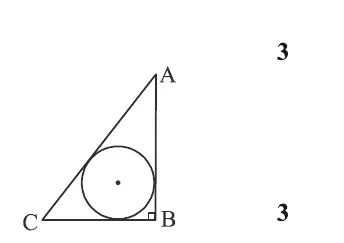
In the given figure, Δ ABC is a right triangle in which , AB = 4 cm and BC = 3 cm. Find the radius of the circle inscribed in the triangle ABC.
In the given figure, Δ ABC is a right triangle in which , AB = 4 cm and BC = 3 cm. Find the radius of the circle inscribed in the triangle ABC.
Official answer
Radius of inscribed circle . Using Pythagoras, (3-4-5 triplet); since a right triangle's incircle radius is , confirmed by .
Marking scheme
- 1.1 mark: correctly finding using Pythagoras theorem ().
- 2.1 mark: setting up correct relation for the incircle — either or with justification (tangent lengths from a vertex are equal).
- 3.1 mark: correct final computation giving with proper units.
Hint
First find the hypotenuse using Pythagoras theorem, then use for the incircle of a right triangle, or .
Quick oral answer
First find by Pythagoras theorem, then use the shortcut for a right triangle's incircle: .
Common mistakes
- 1.Forgetting to first calculate the hypotenuse AC and mistakenly using AB or BC as the hypotenuse in the radius formula.
- 2.Using the circumradius formula () instead of the incircle radius formula by confusing inscribed and circumscribed circles.
- 3.Errors in the semi-perimeter method: forgetting to divide the sum of all three sides by 2 before dividing area by it.
Analysis and explanation
A right-triangle mensuration problem linking Pythagoras' theorem with the incircle tangent-length property.
Concept
- AC (hypotenuse) is found via Pythagoras: ; recognise the 3-4-5 triplet instantly.
- For a right triangle with legs a, b and hypotenuse c, the incircle radius .
Key points
- Alternative method: , using .
- Both methods must give the same answer — a strong self-check.
Common mistakes
- Forgetting that tangents from the same external point are equal, so BP = BQ = r only because ∠B = 90° makes OPBQ a square.
- Skipping the cross-check with .
Real-world
- Incircle radius calculations are used in design and fabrication where a circular fitting must be inscribed within a triangular frame.
Interesting facts
The 3-4-5 triangle is the smallest and most famous Pythagorean triple, known to ancient Egyptian surveyors ('rope stretchers') who used knotted ropes of these proportions to construct right angles for pyramids and land boundaries.
For any right triangle, the incircle radius always equals , a fast shortcut that avoids computing area and semi-perimeter separately.
The point where the incircle touches the two legs of a right triangle, together with the right-angle vertex, always forms a perfect square of side r — this is why the tangent length from the right-angle vertex equals r exactly.
Question details
Q32 of 56 questions
- Board
- CBSE
- Class
- Class 10
- Subject
- Mathematics (Standard)
- Year
- 2026
- Section
- Section C
- Marks
- 3
- Type
- Short Answer
- Chapter
- Circles
- Topic
- Incircle of a Right Triangle
- Bloom's level
- apply
- Syllabus topic
- Unit 6: Coordinate Geometry / Geometry — Circles: Tangents from an External Point and Incircle Radius
- Author
- CBSE
- Reviewed by
- Padhantu Academic Team
Spotted a mistake or something unclear?
Tell us and we will fix it.
Frequently asked questions
What is the direct formula for the incircle radius of a right triangle?
For a right triangle with legs a, b and hypotenuse c, the incircle radius is . This comes from equal tangent lengths from each vertex to the incircle.
Can this problem be solved using area instead of the direct formula?
Yes. Compute and semi-perimeter , then — the same answer as the direct formula.