OR
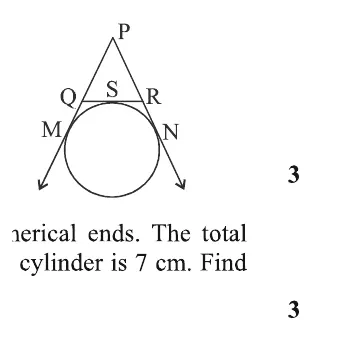
In the given figure, if a circle touches the side QR of Δ PQR at S and extended sides PQ and PR at M and N respectively, then prove that :
OR
In the given figure, if a circle touches the side QR of Δ PQR at S and extended sides PQ and PR at M and N respectively, then prove that :
Official answer
, i.e. PM equals the semi-perimeter of ΔPQR. This follows because tangents from each external point (P, Q, R) to the circle are equal in length, and adding the three sides while using these equal tangent pairs makes all extra terms cancel, leaving .
Marking scheme
- 1.1 mark: correctly stating the tangent property for all three external points — (from P), (from Q), (from R).
- 2.1 mark: correctly expressing , , and , and substituting into the perimeter PQ+QR+PR.
- 3.1 mark: simplification showing the QM, QS, RN, RS terms cancel to leave , hence , with concluding 'Hence Proved'.
Hint
Use 'tangents from an external point are equal': , then add PQ+QR+RP and simplify.
Quick oral answer
Using equal tangents from each vertex — — and substituting into the perimeter PQ+QR+RP, all the QM/QS/RN/RS terms cancel out, leaving , so .
Common mistakes
- 1.Treating this as a standard incircle problem and assuming the circle touches PQ and PR directly rather than their extensions, which reverses the sign in .
- 2.Forgetting to use the equal-tangent property for all three vertices (P, Q, and R) — some students apply it only at P and get stuck.
- 3.Sign errors when substituting into the perimeter expression, leading to an incorrect cancellation.
Analysis and explanation
A tangent-length proof for a triangle's excircle, distinguishing it from a simple incircle.
Concept
- Tangents drawn from an external point to a circle are equal in length — applied here at three vertices P, Q, R.
- Because the circle touches the extensions of PQ and PR beyond Q and R, this is an excircle configuration, not an incircle.
Key steps
- Write and since M, N lie beyond Q, R.
- Add the perimeter PQ+QR+PR and use to cancel terms, leaving 2PM.
Common mistakes
- Misreading the figure as an incircle configuration, reversing the relation.
- Forgetting before substitution.
Real-world
- This excircle tangent-length result underlies the semi-perimeter formulas used later in Heron's formula-based area problems.
Interesting facts
This configuration describes an 'excircle' of triangle PQR — a circle outside the triangle that is tangent to one side and the extensions of the other two, one of three such excircles every triangle has (plus one incircle, giving four tangent circles in total).
The general result proved here — that the tangent length from a vertex to its opposite excircle equals the triangle's semi-perimeter — is a stepping stone to deriving Heron's formula for the area of a triangle.
Tangent-length theorems like this one date back to Euclid's Elements (Book III), among the earliest recorded formal proofs about circles.
Question details
Q33 of 56 questions
- Board
- CBSE
- Class
- Class 10
- Subject
- Mathematics (Standard)
- Year
- 2026
- Section
- Section C
- Marks
- 3
- Type
- Short Answer
- Chapter
- Circles
- Topic
- Tangents from an External Point
- Bloom's level
- analyze
- Syllabus topic
- Unit 6: Geometry — Circles: Tangent Length Property from an External Point
- Author
- CBSE
- Reviewed by
- Padhantu Academic Team
Spotted a mistake or something unclear?
Tell us and we will fix it.
Frequently asked questions
What circle theorem is essential for this proof?
The theorem that the two tangent segments drawn from any external point to a circle are equal in length. It is applied separately at vertices P, Q, and R.
Is the circle in this question the incircle of triangle PQR?
No, it is an excircle — it touches one side (QR) directly but touches the other two sides only after they are extended beyond Q and R, which is why PM turns out longer than PQ and PR individually.