(iii) (a) What is the total length of silver wire required ?
(iii) (a) What is the total length of silver wire required ?
Official answer
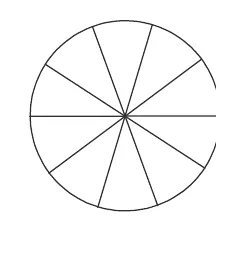
Total length of silver wire required = 285 cm, obtained by adding the circumference of the rim (110 cm) and the length of the 5 diameters (175 cm) that form the internal spokes of the brooch.
Marking scheme
- 1.½ mark: correctly identifying that total wire = circumference + 5 diameters.
- 2.½ mark: computing circumference = .
- 3.½ mark: computing length of 5 diameters = .
- 4.½ mark: correct final answer, total wire = (with unit cm).
Hint
Total wire = circumference of the circle + length of the 5 diameters . Use since is a multiple of 7.
Quick oral answer
Total wire equals the circumference of the circle plus the length of the 5 diameters: .
Common mistakes
- 1.Calculating only the circumference (110 cm) and forgetting to add the wire used for the 5 internal diameters.
- 2.Adding 10 radii as using the wrong count of diameters versus number of sectors, though the numeric result coincides here — confusion often leads to errors with different sector counts.
- 3.Using instead of , leading to a non-exact, messier value when the diameter is a multiple of 7.
Analysis and explanation
Tests whether the wire used is only the circumference or also the internal diameters of the brooch design.
Concept
- The brooch's wire outline = circular rim (circumference) + 5 straight diameters through the centre.
- Diameter is given so that gives a clean value.
Key points
- .
- Length of 5 diameters = .
- Total wire = .
Common mistakes
- Computing only the circumference and forgetting the 5 diameters.
- Confusing 5 diameters with 10 radii counted twice with wrong values.
Real-world
- Mirrors how a jeweller/wire-craft designer budgets material for both the outer frame and internal decorative lines.
Interesting facts
Case-study/brooch-style circle mensuration questions have appeared in CBSE Class 10 board papers regularly since 2020 as part of the 'competency-based' question format introduced in that year.
Real jewellery designers use similar wire-length calculations (circumference + internal partitions) to estimate the exact grams of precious metal wire needed, since silver/gold wire is costed by weight per unit length.
Using a diameter that is a multiple of 7 (like 35 cm here) is a deliberate CBSE design choice so that π = 22/7 yields whole-number answers, making the question gradeable without calculators.
Question details
Q55 of 56 questions
- Board
- CBSE
- Class
- Class 10
- Subject
- Mathematics (Standard)
- Year
- 2026
- Section
- Section E
- Marks
- 2
- Type
- Short Answer
- Chapter
- Areas Related to Circles
- Topic
- Circles — Circumference and Perimeter of Composite Shape
- Bloom's level
- apply
- Syllabus topic
- Unit 5: Mensuration — Areas Related to Circles: Circumference of a Circle and Perimeter of Combined Figures
- Author
- CBSE
- Reviewed by
- Padhantu Academic Team
Spotted a mistake or something unclear?
Tell us and we will fix it.
Frequently asked questions
Why is used instead of 3.14 in this problem?
Because the diameter 35 cm is a multiple of 7, using gives a clean, exact answer (110 cm) without decimals, which is the intended approach for such CBSE case-study numbers.
Why do we add 5 diameters and not 10 radii separately?
Each of the 5 straight wires passes fully through the centre from one side of the circle to the other, so each one is a complete diameter (35 cm long), not two separate radii — though mathematically 5 diameters = 10 radii in total length, the wire is physically laid as 5 straight pieces.