OR
(iii) (b) What is the area of each sector of the brooch ?
OR
(iii) (b) What is the area of each sector of the brooch ?
Official answer
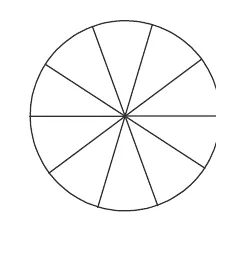
Area of each sector of the brooch = 96.25 cm². This is found by dividing the circle's total area (, with ) equally among the 10 congruent sectors created by the 5 diameters (or equivalently using the sector formula with ).
Marking scheme
- 1.½ mark: correctly finding radius (or using it directly from diameter 35 cm).
- 2.½ mark: total area of circle = .
- 3.½ mark: correctly identifying 10 equal sectors (angle 36° each) and dividing appropriately.
- 4.½ mark: correct final answer = per sector (with unit cm²).
Hint
The 5 diameters create 10 equal sectors, each subtending an angle of at the centre. Area of each sector = .
Quick oral answer
The 5 diameters split the circle into 10 equal sectors of 36° each; area of each sector = .
Common mistakes
- 1.Dividing the total area by 5 (number of diameters) instead of 10 (number of sectors actually formed), giving double the correct area.
- 2.Using diameter instead of radius in the area formula , i.e., mistakenly computing instead of .
- 3.Forgetting to state the correct unit cm² for area, or leaving the answer as a fraction (77/... ) instead of the simplified decimal .
Analysis and explanation
Tests division of a circle's area into equal sectors formed by diameters drawn through the centre.
Concept
- 5 diameters through the centre create 10 equal sectors, each of angle .
- Area of each sector = total circle area ÷ 10 (or directly by the sector formula).
Key points
- .
- Total area = .
- Area of each sector = .
Common mistakes
- Dividing by 5 instead of 10 (forgetting each diameter makes 2 sectors), giving double the correct area.
- Squaring the diameter instead of the radius.
Real-world
- Same idea used in dividing a circular pizza, clock face, or decorative motif into equal wedge-shaped parts.
Interesting facts
A full circle always measures 360°, so dividing it into n equal sectors always gives each sector an angle of — here , a fact widely used in pie-chart design in statistics as well.
CBSE frequently reuses the 'brooch' or 'pizza/pie' context for sector-area case studies because it visually and intuitively demonstrates equal angular division of a circle.
The area of a full circle with diameter 35 cm is a recurring 'nice' value in CBSE papers because , and , showing why multiples of 7 are favoured for diameter values.
Question details
Q56 of 56 questions
- Board
- CBSE
- Class
- Class 10
- Subject
- Mathematics (Standard)
- Year
- 2026
- Section
- Section E
- Marks
- 2
- Type
- Short Answer
- Chapter
- Areas Related to Circles
- Topic
- Circles — Area of a Sector
- Bloom's level
- apply
- Syllabus topic
- Unit 5: Mensuration — Areas Related to Circles: Area of Sectors formed by Dividing a Circle
- Author
- CBSE
- Reviewed by
- Padhantu Academic Team
Spotted a mistake or something unclear?
Tell us and we will fix it.
Frequently asked questions
Why are there 10 sectors and not 5, if there are only 5 diameters?
Each diameter is a straight line passing through the centre and touching both sides of the circle, so it splits the circle into two sectors along its length; with 5 such diameters spaced apart, the circle gets divided into 10 equal sectors in total, each subtending 36° at the centre.
Can we use the direct sector formula instead of dividing total area by 10?
Yes — using Area of sector = with gives the same answer, , and is an equally acceptable method for full marks.