(a) State the two conditions under which total internal reflection occurs.
(b) A transparent container contains layers of three immiscible transparent liquids A, B and C of refractive indices n, and , respectively. A laser beam is incident at the interface between A and B at an angle θ as shown in figure. Prove that the beam does not enter region C at all for .
(a) State the two conditions under which total internal reflection occurs.
(b) A transparent container contains layers of three immiscible transparent liquids A, B and C of refractive indices n, and , respectively. A laser beam is incident at the interface between A and B at an angle θ as shown in figure. Prove that the beam does not enter region C at all for .
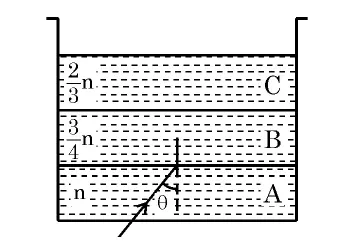
Official answer
(a) Two conditions for total internal reflection (TIR):
- Light must travel from an optically denser to an optically rarer medium (higher n to lower n).
- The angle of incidence must exceed the critical angle () for that pair of media.
(b) Proof that the beam does not enter C for :
Step 1 — refraction at the A–B interface. Applying Snell's law with , , and refraction angle r in B:
Step 2 — critical angle at the B–C interface. The B–C interface is parallel to A–B, so the ray strikes it at angle r. Critical angle i_c for B → C:
Step 3 — condition for TIR at B–C. The beam fails to enter C when , i.e. . Substituting :
Conclusion: For , the angle in B satisfies , so TIR occurs at the B–C interface and the beam does not enter region C. Hence proved.
Marking scheme
- 1.1 mark: both TIR conditions — denser to rarer medium, and angle of incidence greater than the critical angle.
- 2.1 mark: Snell's law at A–B giving , and critical angle at B–C giving .
- 3.1 mark: combining to show TIR at B–C requires , hence the beam does not enter C (with correct conclusion).
Hint
Snell at A–B gives ; critical angle at B–C gives . Beam is blocked when .
Quick oral answer
Refraction at A–B gives , and the critical angle at the parallel B–C interface has ; the beam is totally internally reflected at B–C, and so cannot reach C, whenever , which reduces exactly to .
Common mistakes
- 1.Using the wrong interface — computing the critical angle for A–B or A–C instead of B–C, the boundary the beam must cross to reach C.
- 2.Forgetting that the refraction angle in B equals the angle of incidence at B–C because the layers are parallel.
- 3.Arithmetic slip in ; it equals , not or .
Analysis and explanation
Concept: The beam crosses two parallel interfaces. Because the layers are parallel, the angle of refraction in B is exactly the angle of incidence at the next (B–C) boundary — this is the key geometric link that lets one angle θ control whether light reaches C.
Chained reasoning: Snell's law at A–B converts θ into r; the critical-angle condition at B–C converts the 'does it enter C?' question into an inequality on r. Substituting r back gives a clean threshold on θ. Note n cancels everywhere, so the answer is independent of the actual value of n.
Exam trap: A common error is computing the critical angle for the A–C or A–B pair instead of B–C, the boundary the beam actually needs to cross to reach C. Also, students sometimes check TIR at A–B — but A→B is denser to rarer too, yet the question is specifically about entering C. Always identify the correct interface.
Real-world: This layered-TIR idea underlies optical fibres (core denser than cladding), fibre-optic sensors, and mirages, where light bends through air layers of changing density and totally reflects, creating the illusion of water on hot roads.
Interesting facts
The critical angle for a common water–air surface is about 48.6°, which is why an underwater swimmer sees a bright circular 'window' of sky (Snell's window) surrounded by mirror-like reflection.
Total internal reflection loses essentially no light, unlike a metal mirror — this is why optical fibres can carry signals across oceans with very low loss.
The refractive index cancelled out of this proof, showing the threshold depends only on the ratios 3/4 and 2/3, not the base value n.
Question details
Q28 of 39 questions
- Board
- CBSE
- Class
- Class 12
- Subject
- Physics
- Year
- 2026
- Section
- Section C
- Marks
- 3
- Type
- Short Answer
- Chapter
- Ray Optics and Optical Instruments
- Topic
- Total internal reflection through liquid layers
- Bloom's level
- analyze
- Syllabus topic
- Unit 6: Optics — Refraction: Total Internal Reflection, Critical Angle across multiple media
- Author
- CBSE
- Reviewed by
- Padhantu Academic Team
Spotted a mistake or something unclear?
Tell us and we will fix it.
Frequently asked questions
Why is the critical angle taken at the B–C interface and not A–B?
The question asks whether the beam enters region C, so the decisive boundary is B–C — the last surface before C. TIR there stops the light from reaching C. The A–B interface only sets the direction (angle r) of the ray inside B.
How does the refraction angle in B become the incidence angle at B–C?
The three liquid layers are horizontal and parallel, so their normals are all vertical and parallel. The ray refracted into B at angle r travels straight to the B–C interface and meets it at the same angle r from the normal, which is therefore the angle of incidence at B–C.
Does the answer depend on the actual value of n?
No. The refractive index n appears in every term and cancels out. Only the ratios and matter, giving the threshold regardless of the base value n.