(a) Using Gauss's law, deduce an expression for electric field at a point due to a uniformly charged infinite plane thin sheet.
(b) Two large thin plane sheets, each having surface charge density σ, are held close and parallel to each other in air. What is the net electric field at a point (i) inside and (ii) outside, the sheets?
OR
(a) Obtain the condition of balance of a Wheatstone bridge.
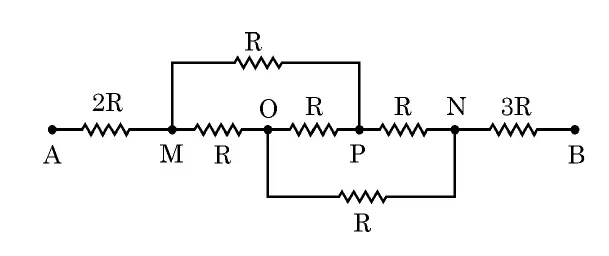
(b) Find net resistance of the network of resistors connected between A and B, as shown in figure.
(a) Using Gauss's law, deduce an expression for electric field at a point due to a uniformly charged infinite plane thin sheet.
(b) Two large thin plane sheets, each having surface charge density σ, are held close and parallel to each other in air. What is the net electric field at a point (i) inside and (ii) outside, the sheets?
OR
(a) Obtain the condition of balance of a Wheatstone bridge.
(b) Find net resistance of the network of resistors connected between A and B, as shown in figure.
Official answer
(a) Field of an infinite charged sheet (Gauss's law)
Take a cylindrical Gaussian pillbox of cross-section A piercing the sheet symmetrically, with its flat faces parallel to the sheet.
- By symmetry, E is perpendicular to the sheet and equal on both faces; the curved surface contributes no flux.
- Total flux = .
- Charge enclosed . By Gauss's law, .
Hence , directed away from the sheet (for +σ), independent of distance.
(b) Two parallel sheets, each of charge density σ
Each sheet alone gives .
- (i) Inside (between the sheets): the two fields are oppositely directed → .
- (ii) Outside (either side): the two fields add → , directed away from the sheets.
OR (Wheatstone / network)
- Balance condition: (no galvanometer deflection).
- Network A–B: the three resistors between M and P (2R via O, and two direct R's) are in parallel . Total .
Marking scheme
- 1.1 mark: Gaussian pillbox setup and flux giving .
- 2.0.5 mark: direction (perpendicular, away from a positively charged sheet; independent of distance).
- 3.0.5 mark (b-i): net field inside the two like-charged sheets .
- 4.1 mark (b-ii): net field outside with direction. [OR: 0.5 balance condition + 1 mark network .]
Hint
Use a symmetric cylindrical pillbox (flux ); for two like-charged sheets, add or subtract on each side.
Quick oral answer
For an infinite charged sheet a symmetric pillbox gives , so regardless of distance; two like-charged sheets cancel to zero field between them and add to outside.
Common mistakes
- 1.Writing for a single sheet by forgetting the factor 2 from the pillbox's two faces.
- 2.Confusing this like-charged pair with a capacitor: getting zero outside and inside — it is the opposite here.
- 3.In the OR network, treating the three M–P resistors as series instead of parallel (they all connect the same two nodes M and P), giving a wrong total.
Analysis and explanation
Concept
Gauss's law turns a hard integral into a one-line result whenever the charge has high symmetry. For an infinite sheet the field is uniform and does not fall off with distance — a striking contrast to point and line charges.
Why the pillbox works
Only the two flat faces have flux (E is parallel to the curved wall), and enclosed charge is σ times the face area A, so A cancels and emerges cleanly.
The two-sheet trap
- Note the sheets here have the same sign σ, so the geometry is the reverse of a capacitor: fields cancel between the sheets () and add outside ().
- Contrast this with a parallel-plate capacitor (equal and opposite charges), where the field is inside and zero outside — a very common mix-up.
Real-world link
The uniform, distance-independent field of a sheet is the model behind parallel-plate capacitors and the CRO/deflection systems (as in Q24), where a uniform E-field steers charged beams.
Interesting facts
The field of an infinite sheet is genuinely independent of distance — moving twice as far away does not weaken it, because the 'more distant' charge that comes into view exactly compensates the inverse-square falloff.
Gauss stated this law in 1835 but it was published only in 1867, after his death; it later became one of the four Maxwell equations that unified electricity, magnetism and light.
Question details
Q22 of 39 questions
- Board
- CBSE
- Class
- Class 12
- Subject
- Physics
- Year
- 2026
- Section
- Section C
- Marks
- 3
- Type
- Short Answer
- Chapter
- Electric Charges and Fields
- Topic
- Gauss's law — field of an infinite charged sheet
- Bloom's level
- apply
- Syllabus topic
- Unit I: Electric Charges and Fields — Applications of Gauss's law (uniformly charged infinite plane sheet)
- Author
- CBSE
- Reviewed by
- Padhantu Academic Team
Spotted a mistake or something unclear?
Tell us and we will fix it.
Frequently asked questions
Why is the field of an infinite sheet independent of distance?
Gauss's law gives with no r-dependence. Physically, as you move away, a larger area of the (infinite) sheet contributes to the field, and this exactly offsets the inverse-square weakening of each element — so the net field stays uniform.
How is this two-sheet result different from a parallel-plate capacitor?
Here both sheets carry the same sign σ, so the fields cancel between them () and add outside (). In a capacitor the plates carry equal and opposite charges, so the situation flips: the field is between the plates and zero outside.