Figure shows a narrow beam of electrons entering with a velocity of m/s, symmetrically through the space between two parallel horizontal plates and kept 2 cm apart. If each plate is 3 cm long, calculate the potential difference V applied between the plates so that the beam just strikes the end .
Figure shows a narrow beam of electrons entering with a velocity of m/s, symmetrically through the space between two parallel horizontal plates and kept 2 cm apart. If each plate is 3 cm long, calculate the potential difference V applied between the plates so that the beam just strikes the end .
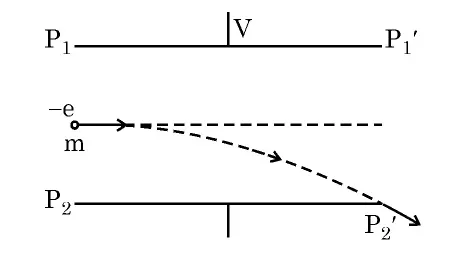
Official answer
Data & setup
- Entry speed (horizontal) m/s; plate length ; separation .
- Entering midway, the beam must deflect m to just hit end .
- kg, C.
Motion (like a projectile)
- Time between plates: s.
- Vertical acceleration: .
- Deflection: .
Solve for V
V V
Marking scheme
- 1.1 mark: recognising projectile motion — and required deflection .
- 2.1 mark: correct equation leading to .
- 3.1 mark: correct substitution and final value V ( V).
Hint
It is projectile motion: horizontally, and vertical drop must equal (beam enters at the centre).
Quick oral answer
The electron crosses the 3 cm plates in a nanosecond while the field pulls it sideways like a projectile; setting the drop equal to half the 2 cm gap gives volts.
Common mistakes
- 1.Taking the required deflection as the full gap instead of , because the beam enters symmetrically (midway) — this doubles the voltage.
- 2.Forgetting to convert cm to metres, giving answers off by powers of ten.
- 3.Using the plate separation instead of the plate length to find the transit time .
Analysis and explanation
Concept
Inside parallel plates the field is uniform, so a charged particle moves exactly like a horizontal projectile: constant horizontal velocity and constant vertical acceleration . This is the working principle of a cathode-ray oscilloscope deflection system.
Key modelling choices
- The beam enters midway, so 'just striking the far end ' means the vertical drop equals half the gap, cm.
- The horizontal length l fixes the transit time ; the field acts only during this time.
Exam trap
- Using (full gap) instead of doubles the answer — remember the beam starts at the centre.
- Mixing cm and m; keep everything in SI. Watch that , a very small number.
Real-world link
Exactly this deflection physics steered the electron beam in old CRT televisions and oscilloscopes; the same E-field-vs-transit-time balance governs ink-jet printer droplet steering and mass-spectrometer beam control.
Interesting facts
This is precisely how a cathode-ray oscilloscope works: a voltage on the deflecting plates steers the electron beam, and because electrons are so light they respond within nanoseconds.
In J. J. Thomson's 1897 experiment the very same plate-deflection geometry, combined with a magnetic field, first yielded the electron's charge-to-mass ratio e/m.
Question details
Q24 of 39 questions
- Board
- CBSE
- Class
- Class 12
- Subject
- Physics
- Year
- 2026
- Section
- Section C
- Marks
- 3
- Type
- Short Answer
- Chapter
- Electric Charges and Fields
- Topic
- Deflection of an electron beam in a uniform electric field
- Bloom's level
- apply
- Syllabus topic
- Unit I: Electric Charges and Fields — Motion of a charged particle in a uniform electric field (parallel-plate deflection)
- Author
- CBSE
- Reviewed by
- Padhantu Academic Team
Spotted a mistake or something unclear?
Tell us and we will fix it.
Frequently asked questions
Why is the required vertical deflection and not ?
The beam enters exactly midway between the plates (symmetrically). To 'just strike the far end ' — the edge of the lower plate — it needs to drop only half the plate separation, i.e. cm, not the full 2 cm gap.
Does the electron's entry speed appear in the final formula?
Yes, through the transit time. A faster electron spends less time () in the field, so it deflects less; to still hit the end you would need a larger voltage. Here m/s gives ns and V.