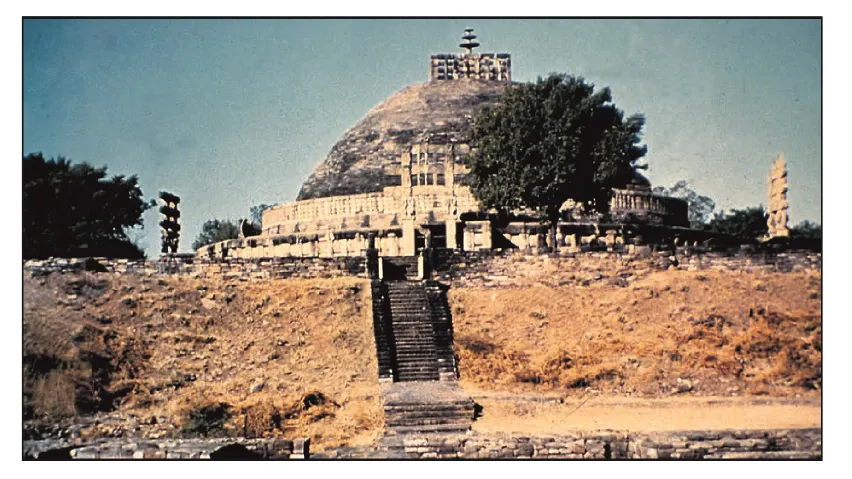
Identify the following structure from the options given below. OR (For Visually Impaired Candidates in lieu of Question No. 7) In which of the following modern states of India is Sanchi Stupa located ? (A) Maharashtra (B) Madhya Pradesh (C) Tamil Nadu (D) Uttar Pradesh
Identify the following structure from the options given below. OR (For Visually Impaired Candidates in lieu of Question No. 7) In which of the following modern states of India is Sanchi Stupa located ? (A) Maharashtra (B) Madhya Pradesh (C) Tamil Nadu (D) Uttar Pradesh
Options
Official answer
The correct option is (B) Sanchi Stupa.
Why: The photograph shows the great hemispherical dome, railings and ornately carved gateways (toranas) of the Sanchi Stupa in Madhya Pradesh — the best-preserved early Buddhist stupa in India, originally commissioned by Emperor Ashoka.
For Visually Impaired candidates (alternate MCQ): Sanchi Stupa is located in (B) Madhya Pradesh.
Marking scheme
- 1.1 mark for selecting option (B) Sanchi Stupa (or Madhya Pradesh for the visually impaired alternate question).
- 2.No partial marks for MCQ.
Hint
The intact hemispherical dome with four carved gateways in Madhya Pradesh is the Sanchi Stupa.
Quick oral answer
The structure with the intact dome and four carved toranas is the Sanchi Stupa in Madhya Pradesh, so the answer is option B.
Common mistakes
- 1.Confusing Sanchi with the Amravati Stupa, which no longer survives intact.
- 2.Identifying the Sarnath (Dhamek) Stupa, which has a tall cylindrical rather than dome shape.
- 3.For the alternate question, placing Sanchi in Uttar Pradesh instead of Madhya Pradesh.
Analysis and explanation
This is a visual-identification question testing knowledge of Buddhist monuments, complemented by an alternate factual MCQ for visually impaired candidates.
Why (B) is correct: The Sanchi Stupa is famous for its intact structure — the anda (dome), harmika, chhatri and four richly sculpted toranas. It survived largely because it lay away from later disturbances and was carefully restored, making it the standard NCERT image of a stupa. Sanchi is located in Madhya Pradesh, which is also the answer to the alternate question.
Why the other options are wrong:
- (A) Amravati Stupa — in Andhra Pradesh; it was largely dismantled and its sculptures dispersed, so little survives in situ.
- (C) Barhut Stupa — in Madhya Pradesh but now mostly demolished, with its railings and gateways moved to the Indian Museum, Kolkata.
- (D) Sarnath Stupa — the Dhamek Stupa at Sarnath (UP) has a very different tall cylindrical form, not the low hemispherical dome shown.
Exam trap: Sanchi and Amravati are often confused; remember Sanchi survives intact with its gateways while Amravati was reduced to fragments.
Interesting facts
The Sanchi Stupa was originally built by Emperor Ashoka in the 3rd century BCE and later enlarged, with the carved gateways added around the 1st century BCE.
Sanchi survived partly because the rulers of Bhopal, Shahjehan Begum and Sultan Jehan Begum, funded its preservation and a museum in the 19th–20th centuries.
Sanchi was declared a UNESCO World Heritage Site in 1989 and its imagery appears on the reverse of the Indian 200-rupee note.
Question details
Q7 of 41 questions
- Board
- CBSE
- Class
- Class 12
- Subject
- History
- Year
- 2026
- Section
- Section A
- Marks
- 1
- Type
- MCQ
- Chapter
- Thinkers, Beliefs and Buildings — Cultural Developments
- Topic
- Buddhist Stupas — Sanchi
- Bloom's level
- understand
- Syllabus topic
- Theme 4: Thinkers, Beliefs and Buildings — Stupas and Buddhist Architecture: Sanchi
- Author
- CBSE
- Reviewed by
- Padhantu Academic Team
Spotted a mistake or something unclear?
Tell us and we will fix it.
Frequently asked questions
Why did the Sanchi Stupa survive when others did not?
Sanchi survived because it lay away from later urban disturbance and, crucially, because the Begums of Bhopal funded its preservation and John Marshall documented and restored it. In contrast, the Amravati Stupa was dismantled and its sculptures carried away.
What are the main architectural parts of a stupa like Sanchi?
A stupa has an anda (hemispherical dome symbolising a mound), a harmika (a balcony-like structure on top), a chhatri (umbrella), and surrounding railings with ornate gateways called toranas through which devotees circumambulate the structure.