(a) (i) Why CH₃ – NH₂ is a stronger base than (CH₃)₃N in aqueous solution? (2 × 1)
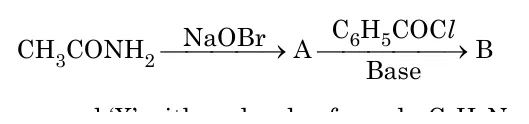
(ii) Write structural formulae of the compound A and B:
CH₃CONH₂ —(NaOBr)→ A —(C₆H₅COCl / Base)→ B
(a) (i) Why CH₃ – NH₂ is a stronger base than (CH₃)₃N in aqueous solution? (2 × 1)
(ii) Write structural formulae of the compound A and B:
CH₃CONH₂ —(NaOBr)→ A —(C₆H₅COCl / Base)→ B
Official answer
(i) Why CH₃NH₂ is a stronger base than (CH₃)₃N in water:
Basicity in aqueous solution is a balance of the +I (electron-donating) effect, steric hindrance, and solvation (H-bonding) of the protonated cation.
- In (CH₃)₃N the three bulky methyl groups cause steric crowding and the cation (CH₃)₃NH⁺ has only one N–H to hydrogen-bond with water, so it is poorly solvated/stabilised.
- CH₃NH₃⁺ has three N–H bonds, so it is extensively solvated and stabilised by water.
- The greater stabilisation of the conjugate acid of CH₃NH₂ makes CH₃NH₂ the stronger base in aqueous medium.
(ii) Hofmann bromamide degradation:
CH₃CONH₂ (acetamide) with NaOBr (Br₂/NaOH) loses one carbon to give a primary amine, which is then benzoylated.
- A = CH₃NH₂ (methanamine)
- B = C₆H₅CONHCH₃ (N-methylbenzamide)
Marking scheme
- 1.1 mark (i): correct reason citing steric hindrance and/or greater solvation (more N–H hydrogen bonding) of CH₃NH₃⁺ versus (CH₃)₃NH⁺ in aqueous medium.
- 2.½ mark: A = CH₃NH₂ (methylamine).
- 3.½ mark: B = C₆H₅CONHCH₃ (N-methylbenzamide).
Hint
Basicity in water is decided by solvation of the cation: more N–H bonds = better solvated = stronger base, so CH₃NH₂ (three N–H in cation) beats (CH₃)₃N; and Hofmann bromamide shortens the chain by one carbon (acetamide → methylamine).
Quick oral answer
In water CH₃NH₂ is more basic than (CH₃)₃N because its protonated cation has three N–H bonds and is far better solvated and less sterically crowded; and in the given sequence acetamide undergoes Hofmann bromamide degradation to methylamine (A), which on benzoylation gives N-methylbenzamide (B).
Common mistakes
- 1.Explaining the basicity order only by the +I effect (which would wrongly make (CH₃)₃N strongest) and ignoring the decisive solvation/steric factors in water.
- 2.Writing A as ethylamine — Hofmann bromamide degradation removes one carbon, so acetamide (CH₃CONH₂) gives methylamine, not ethylamine.
- 3.Writing B as an ester or as benzamide without the N-methyl group — benzoylation of methylamine gives the N-substituted amide C₆H₅CONHCH₃.
Analysis and explanation
This case-based part uses the passage's statement that 'aliphatic amines are stronger bases than ammonia' and pushes further into the subtle order among methylamines in water.
(i) The three competing factors (in water):
- +I effect would predict (CH₃)₃N most basic (three electron-donating methyls).
- Steric hindrance disfavours protonation of the crowded tertiary nitrogen.
- Solvation is decisive: the more N–H bonds the ammonium ion has, the more hydrogen bonds it forms with water and the more stable it is.
Since (CH₃)₃NH⁺ has just one N–H (poor solvation) while CH₃NH₃⁺ has three, the net effect makes CH₃NH₂ the stronger base in aqueous solution. (In the gas phase, where solvation is absent, the order reverses.)
(ii) Hofmann bromamide — a carbon-shortening amine synthesis:
- An amide RCONH₂ treated with Br₂/NaOH (i.e. NaOBr) gives the primary amine RNH₂ with one fewer carbon.
- Here acetamide (2 C) → methylamine A (1 C).
- Methylamine (a 1° amine) then reacts with benzoyl chloride C₆H₅COCl (benzoylation, a nucleophilic acyl substitution mentioned in the passage) to give N-methylbenzamide, C₆H₅CONHCH₃ (B).
Exam trap: Don't write A as acetamide-derived 'ethylamine' — Hofmann degradation removes a carbon, so acetamide gives methylamine, not ethylamine.
Interesting facts
The reversal of amine basicity between water and the gas phase is a classic demonstration that solvent (solvation) can outweigh intrinsic electronic effects.
The Hofmann bromamide (Hofmann degradation of amides) reaction, discovered by August Wilhelm von Hofmann in 1881, is one of the few reactions that shortens a carbon chain by exactly one carbon, proceeding through an isocyanate intermediate.
Benzoylation (the Schotten–Baumann-type reaction here) is used to protect and characterise amines because the solid benzamide derivatives have sharp melting points.
Question details
Q29 of 37 questions
- Board
- CBSE
- Class
- Class 12
- Subject
- Chemistry
- Year
- 2026
- Section
- Section D
- Marks
- 2
- Chapter
- Amines
- Topic
- Basicity of Amines and Hofmann Bromamide Degradation
- Bloom's level
- understand
- Syllabus topic
- Unit: Amines — basic strength in aqueous solution and preparation of amines (Hofmann bromamide reaction)
- Author
- CBSE
- Reviewed by
- Padhantu Academic Team
Spotted a mistake or something unclear?
Tell us and we will fix it.
Frequently asked questions
Why is CH₃NH₂ a stronger base than (CH₃)₃N in aqueous solution but not in the gas phase?
In water, basicity depends on how well the protonated cation is stabilised by solvation. CH₃NH₃⁺ has three N–H bonds and hydrogen-bonds strongly to water, while the crowded (CH₃)₃NH⁺ has only one N–H and is poorly solvated, so CH₃NH₂ is the stronger base. In the gas phase there is no solvation, so only the +I effect matters and the order reverses in favour of (CH₃)₃N.
What is the Hofmann bromamide degradation and what does it produce from acetamide?
The Hofmann bromamide (or Hofmann degradation) reaction converts a primary amide RCONH₂ into a primary amine RNH₂ using Br₂ and NaOH (i.e. NaOBr), shortening the chain by one carbon through an isocyanate intermediate. Acetamide (CH₃CONH₂) therefore gives methylamine (CH₃NH₂).