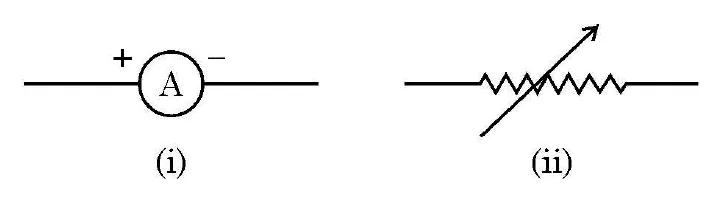
(a) Explain the statement "Potential difference between two points is 1 volt". (b) What do the symbols given below represent in an electric circuit? Write one function of each.
(a) Explain the statement "Potential difference between two points is 1 volt". (b) What do the symbols given below represent in an electric circuit? Write one function of each.
Official answer
(a) The potential difference between two points is 1 volt if 1 joule of work is done in moving 1 coulomb of charge from one point to the other. (b) (i) A cell or battery (ii) A switch (iii) A variable resistor (iv) A key (v) A rheostat (vi) A voltmeter (vii) An ammeter (viii) A fuse (ix) A bulb (x) A battery of several cells
Marking scheme
- 1.(a) 1 mark for defining potential difference
- 2.(b) 1 mark for identifying each symbol and explaining its function
Hint
The potential difference between two points is defined as the work done in moving a unit charge from one point to the other. The symbols used in an electric circuit represent different components such as cells, switches, resistors, and meters. Each component has a specific function in the circuit.
Quick oral answer
The potential difference between two points is defined as the work done in moving a unit charge from one point to the other. The symbols used in an electric circuit represent different components such as cells, switches, resistors, and meters. Each component has a specific function in the circuit. For example, a cell or battery produces a potential difference between its terminals, which drives electric current through the circuit. A switch is used to control the flow of electric current in a circuit. A variable resistor is used to control the current in a circuit. A voltmeter is used to measure the potential difference between two points in a circuit. An ammeter is used to measure the current flowing through a circuit. A fuse is used to protect a circuit from excessive current. A bulb is used to produce light when an electric current flows through it. A battery of several cells is used to produce a higher voltage.
Common mistakes
- 1.confusing potential difference with voltage
- 2.not understanding the function of each symbol
- 3.not explaining the concept of potential difference clearly
Analysis and explanation
This question requires the student to explain the concept of potential difference and identify the symbols used in an electric circuit. The student should be able to define potential difference and explain how it is measured. They should also be able to identify the symbols used in an electric circuit and explain their functions. This question assesses the student's understanding of electric potential and their ability to apply this knowledge to real-world situations.
Interesting facts
The concept of potential difference was first introduced by Alessandro Volta in the 18th century.
The unit of potential difference is named after Volta.
Potential difference is a measure of the energy required to move a charge from one point to another.
Question details
Q33 of 39 questions
- Board
- CBSE
- Class
- Class 10
- Subject
- Science
- Year
- 2025
- Section
- Section C
- Marks
- 3
- Type
- Short Answer
- Chapter
- Electricity
- Topic
- Electric Potential
- Bloom's level
- Understanding
- Syllabus topic
- Electric Potential and Potential Difference
Spotted a mistake or something unclear?
Tell us and we will fix it.
Frequently asked questions
How many marks does this question carry in CBSE Class 10 Science 2025?
This question carries 3 marks in the CBSE Class 10 Science 2025 examination.
Which chapter does this question come from in Science?
This question is from the chapter "Electricity" in the CBSE Class 10 Science syllabus.
What topic does this question cover in Science?
This question covers the topic "Electric Potential" from CBSE Class 10 Science.
What type of question is this in the CBSE Class 10 Science 2025 paper?
This is a Short Answer question from Section C in the CBSE Class 10 Science 2025 paper.