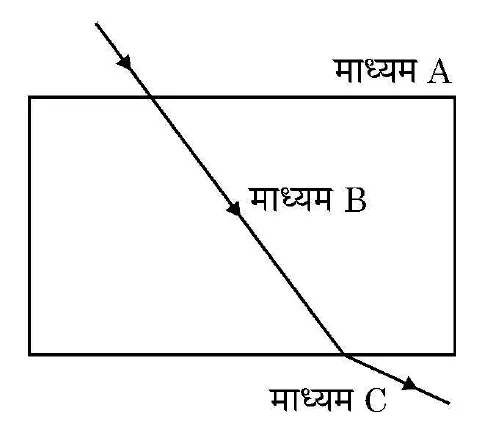
(A) (a) Observe the following diagram and compare (i) speed of light and (ii) optical densities of the three media A, B and C. Also give justification for your answer of any one of the two cases in terms of refractive indices of A, B and C.
(b) Redraw the path of a ray of light through the three media, if the ray of light starting from medium A falls on the medium B
(i) Obliquely and the optical density of medium B is made more than that of A and C.
(ii) The ray falls normally from medium A to medium B.
OR
(B) Analyse the following observation table showing variation of image distance (v) with object distance (u) in case of a convex lens and answer the questions that follow without doing any calculations:
Observation Number Object distance (u) in cm Image distance (v) in cm 1 -15 -60 2 -25 +100 3 -30 +60 4 -40 +40 5 -60 +30 6 -100 +25
(a) Determine the focal length of the lens. Give reason for your answer.
(b) Find magnification of the image formed in Observation No. 3.
(c) The numerical value of magnifications in cases of observation 1 and 2 is same. List two differences in the images formed in these two cases.
(A) (a) Observe the following diagram and compare (i) speed of light and (ii) optical densities of the three media A, B and C. Also give justification for your answer of any one of the two cases in terms of refractive indices of A, B and C.
(b) Redraw the path of a ray of light through the three media, if the ray of light starting from medium A falls on the medium B
(i) Obliquely and the optical density of medium B is made more than that of A and C.
(ii) The ray falls normally from medium A to medium B.
OR
(B) Analyse the following observation table showing variation of image distance (v) with object distance (u) in case of a convex lens and answer the questions that follow without doing any calculations:
| Observation Number | Object distance (u) in cm | Image distance (v) in cm |
|---|---|---|
| 1 | -15 | -60 |
| 2 | -25 | +100 |
| 3 | -30 | +60 |
| 4 | -40 | +40 |
| 5 | -60 | +30 |
| 6 | -100 | +25 |
(a) Determine the focal length of the lens. Give reason for your answer.
(b) Find magnification of the image formed in Observation No. 3.
(c) The numerical value of magnifications in cases of observation 1 and 2 is same. List two differences in the images formed in these two cases.
Official answer
The speed of light is the same in all three media, as it is a fundamental constant of nature. The optical density of medium B is greater than that of A and C, as it bends the light ray more. This is because the refractive index of medium B is higher than that of A and C.
Marking scheme
- 1.The speed of light is the same in all three media.
- 2.The optical density of medium B is greater than that of A and C.
Hint
The speed of light is a fundamental constant of nature and is the same in all three media. The optical density of medium B is greater than that of A and C, as it bends the light ray more. This is because the refractive index of medium B is higher than that of A and C.
Quick oral answer
The speed of light is the same in all three media, as it is a fundamental constant of nature. The optical density of medium B is greater than that of A and C, as it bends the light ray more. This is because the refractive index of medium B is higher than that of A and C.
Common mistakes
- 1.Thinking that the speed of light is different in different media.
- 2.Thinking that the optical density of medium B is less than that of A and C.
Analysis and explanation
The speed of light is a fundamental constant of nature and is the same in all three media. The optical density of medium B is greater than that of A and C, as it bends the light ray more. This is because the refractive index of medium B is higher than that of A and C.
Interesting facts
The speed of light is a fundamental constant of nature and is the same in all three media.
The optical density of medium B is greater than that of A and C, as it bends the light ray more. This is because the refractive index of medium B is higher than that of A and C.
Question details
Q36 of 39 questions
- Board
- CBSE
- Class
- Class 10
- Subject
- Science
- Year
- 2025
- Section
- Section D
- Marks
- 5
- Type
- Long Answer
- Chapter
- Chemical Reactions and Equations
- Topic
- Chemical Reactions and Equations
- Bloom's level
- Analysis
- Syllabus topic
- Chemical Reactions and Equations
Spotted a mistake or something unclear?
Tell us and we will fix it.
Frequently asked questions
How many marks does this question carry in CBSE Class 10 Science 2025?
This question carries 5 marks in the CBSE Class 10 Science 2025 examination.
Which chapter does this question come from in Science?
This question is from the chapter "Chemical Reactions and Equations" in the CBSE Class 10 Science syllabus.
What topic does this question cover in Science?
This question covers the topic "Chemical Reactions and Equations" from CBSE Class 10 Science.
What type of question is this in the CBSE Class 10 Science 2025 paper?
This is a Long Answer question from Section D in the CBSE Class 10 Science 2025 paper.