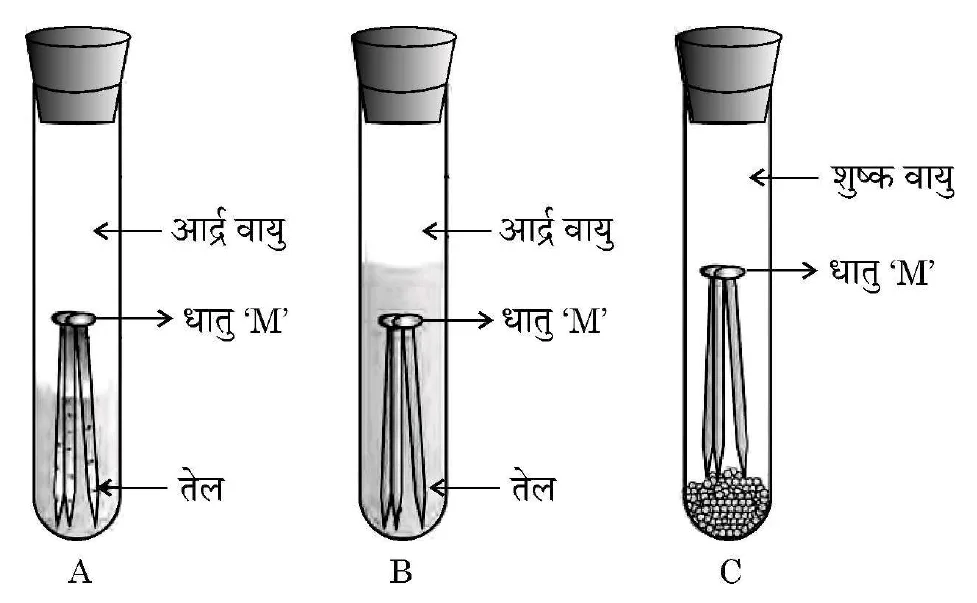
(A) Observe the following diagram showing an experiment to determine the conditions under which a metal 'M' corrodes.
List your observations in each of the three cases A, B and C with reason, if the metal 'M' is generally protected against corrosion by the method of galvanisation.
OR
(B) (a) Show the formation of Aluminium Nitride (AlN) by the transfer of electrons. [At. no. of Al = 13; At. no. of N = 7]
(b) "Ionic compounds are solids and are generally brittle and break into pieces when pressure is applied." Give reason to justify the statement.
(A) Observe the following diagram showing an experiment to determine the conditions under which a metal 'M' corrodes.
List your observations in each of the three cases A, B and C with reason, if the metal 'M' is generally protected against corrosion by the method of galvanisation.
OR
(B) (a) Show the formation of Aluminium Nitride (AlN) by the transfer of electrons. [At. no. of Al = 13; At. no. of N = 7]
(b) "Ionic compounds are solids and are generally brittle and break into pieces when pressure is applied." Give reason to justify the statement.
Official answer
The metal 'M' is generally protected against corrosion by the method of galvanisation. In case A, the metal 'M' is not corroded because it is not in contact with air or water. In case B, the metal 'M' is corroded because it is in contact with air and water. In case C, the metal 'M' is not corroded because it is coated with a layer of zinc, which protects it from corrosion.
Marking scheme
- 1.The metal 'M' is generally protected against corrosion by the method of galvanisation.
- 2.In case A, the metal 'M' is not corroded because it is not in contact with air or water.
- 3.In case B, the metal 'M' is corroded because it is in contact with air and water.
- 4.In case C, the metal 'M' is not corroded because it is coated with a layer of zinc, which protects it from corrosion.
Hint
The metal 'M' is generally protected against corrosion by the method of galvanisation.
Quick oral answer
The metal 'M' is generally protected against corrosion by the method of galvanisation. In case A, the metal 'M' is not corroded because it is not in contact with air or water. In case B, the metal 'M' is corroded because it is in contact with air and water. In case C, the metal 'M' is not corroded because it is coated with a layer of zinc, which protects it from corrosion.
Common mistakes
- 1.The metal 'M' is not protected against corrosion by the method of galvanisation.
- 2.In case A, the metal 'M' is corroded because it is not in contact with air or water.
- 3.In case B, the metal 'M' is not corroded because it is in contact with air and water.
- 4.In case C, the metal 'M' is corroded because it is coated with a layer of zinc, which protects it from corrosion.
Analysis and explanation
The metal 'M' is generally protected against corrosion by the method of galvanisation. In case A, the metal 'M' is not corroded because it is not in contact with air or water. In case B, the metal 'M' is corroded because it is in contact with air and water. In case C, the metal 'M' is not corroded because it is coated with a layer of zinc, which protects it from corrosion.
Interesting facts
The metal 'M' is generally protected against corrosion by the method of galvanisation.
Galvanisation is a process of coating a metal with a layer of zinc to protect it from corrosion.
The metal 'M' is not corroded in case A because it is not in contact with air or water.
The metal 'M' is corroded in case B because it is in contact with air and water.
The metal 'M' is not corroded in case C because it is coated with a layer of zinc, which protects it from corrosion.
Question details
Q28 of 39 questions
- Board
- CBSE
- Class
- Class 10
- Subject
- Science
- Year
- 2025
- Section
- Section C
- Marks
- 3
- Type
- Short Answer
- Chapter
- Chemical Reactions and Equations
- Topic
- Chemical Reactions and Equations
- Bloom's level
- Analysis
- Syllabus topic
- Chemical Reactions and Equations
Spotted a mistake or something unclear?
Tell us and we will fix it.
Frequently asked questions
How many marks does this question carry in CBSE Class 10 Science 2025?
This question carries 3 marks in the CBSE Class 10 Science 2025 examination.
Which chapter does this question come from in Science?
This question is from the chapter "Chemical Reactions and Equations" in the CBSE Class 10 Science syllabus.
What topic does this question cover in Science?
This question covers the topic "Chemical Reactions and Equations" from CBSE Class 10 Science.
What type of question is this in the CBSE Class 10 Science 2025 paper?
This is a Short Answer question from Section C in the CBSE Class 10 Science 2025 paper.