(A) How is lymph formed ? State its important function.
OR
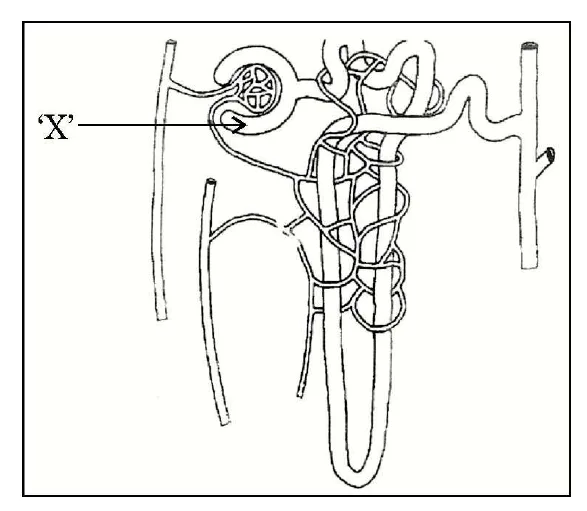
(B) (a) Identify 'X' in the figure of human nephron shown below. What role does it play in the process of urine formation ?
(b) Why some substances are selectively reabsorbed from the initial filtrate of urine, as it flows along the tabular part of nephron ?
(A) How is lymph formed ? State its important function.
OR
(B) (a) Identify 'X' in the figure of human nephron shown below. What role does it play in the process of urine formation ?
(b) Why some substances are selectively reabsorbed from the initial filtrate of urine, as it flows along the tabular part of nephron ?
Official answer
The correct answer is B. The figure shows a human nephron, which is the functional unit of the kidney responsible for filtering waste and excess substances from the blood. The 'X' in the figure represents the glomerulus, a cluster of blood vessels that filters the blood and produces the initial filtrate of urine. The glomerulus plays a crucial role in the process of urine formation by allowing small molecules such as water, ions, and glucose to pass through while keeping larger molecules like proteins and blood cells in the bloodstream. The initial filtrate then flows through the tubular part of the nephron, where some substances are selectively reabsorbed back into the bloodstream. This process helps to regulate the concentration of substances in the body and maintain proper bodily functions.
Marking scheme
- 1.The figure shows a human nephron, which is the functional unit of the kidney responsible for filtering waste and excess substances from the blood. The 'X' in the figure represents the glomerulus, a cluster of blood vessels that filters the blood and produces the initial filtrate of urine. The glomerulus plays a crucial role in the process of urine formation by allowing small molecules such as water, ions, and glucose to pass through while keeping larger molecules like proteins and blood cells in the bloodstream. The initial filtrate then flows through the tubular part of the nephron, where some substances are selectively reabsorbed back into the bloodstream. This process helps to regulate the concentration of substances in the body and maintain proper bodily functions.
Hint
The figure shows a human nephron, which is the functional unit of the kidney responsible for filtering waste and excess substances from the blood. The 'X' in the figure represents the glomerulus, a cluster of blood vessels that filters the blood and produces the initial filtrate of urine. The glomerulus plays a crucial role in the process of urine formation by allowing small molecules such as water, ions, and glucose to pass through while keeping larger molecules like proteins and blood cells in the bloodstream. The initial filtrate then flows through the tubular part of the nephron, where some substances are selectively reabsorbed back into the bloodstream. This process helps to regulate the concentration of substances in the body and maintain proper bodily functions.
Quick oral answer
The figure shows a human nephron, which is the functional unit of the kidney responsible for filtering waste and excess substances from the blood. The 'X' in the figure represents the glomerulus, a cluster of blood vessels that filters the blood and produces the initial filtrate of urine. The glomerulus plays a crucial role in the process of urine formation by allowing small molecules such as water, ions, and glucose to pass through while keeping larger molecules like proteins and blood cells in the bloodstream. The initial filtrate then flows through the tubular part of the nephron, where some substances are selectively reabsorbed back into the bloodstream. This process helps to regulate the concentration of substances in the body and maintain proper bodily functions.
Common mistakes
- 1.The figure shows a human nephron, which is the functional unit of the kidney responsible for filtering waste and excess substances from the blood. The 'X' in the figure represents the glomerulus, a cluster of blood vessels that filters the blood and produces the initial filtrate of urine. The glomerulus plays a crucial role in the process of urine formation by allowing small molecules such as water, ions, and glucose to pass through while keeping larger molecules like proteins and blood cells in the bloodstream. The initial filtrate then flows through the tubular part of the nephron, where some substances are selectively reabsorbed back into the bloodstream. This process helps to regulate the concentration of substances in the body and maintain proper bodily functions.
Analysis and explanation
The figure shows a human nephron, which is the functional unit of the kidney responsible for filtering waste and excess substances from the blood. The 'X' in the figure represents the glomerulus, a cluster of blood vessels that filters the blood and produces the initial filtrate of urine. The glomerulus plays a crucial role in the process of urine formation by allowing small molecules such as water, ions, and glucose to pass through while keeping larger molecules like proteins and blood cells in the bloodstream. The initial filtrate then flows through the tubular part of the nephron, where some substances are selectively reabsorbed back into the bloodstream. This process helps to regulate the concentration of substances in the body and maintain proper bodily functions.
Interesting facts
The figure shows a human nephron, which is the functional unit of the kidney responsible for filtering waste and excess substances from the blood. The 'X' in the figure represents the glomerulus, a cluster of blood vessels that filters the blood and produces the initial filtrate of urine. The glomerulus plays a crucial role in the process of urine formation by allowing small molecules such as water, ions, and glucose to pass through while keeping larger molecules like proteins and blood cells in the bloodstream. The initial filtrate then flows through the tubular part of the nephron, where some substances are selectively reabsorbed back into the bloodstream. This process helps to regulate the concentration of substances in the body and maintain proper bodily functions.
Question details
Q23 of 39 questions
- Board
- CBSE
- Class
- Class 10
- Subject
- Science
- Year
- 2025
- Section
- Section B
- Marks
- 2
- Type
- Very Short Answer
- Chapter
- Chemical Reactions and Equations
- Topic
- Chemical Reactions and Equations
- Bloom's level
- Remembering
- Syllabus topic
- Chemical Reactions and Equations
Spotted a mistake or something unclear?
Tell us and we will fix it.
Frequently asked questions
How many marks does this question carry in CBSE Class 10 Science 2025?
This question carries 2 marks in the CBSE Class 10 Science 2025 examination.
Which chapter does this question come from in Science?
This question is from the chapter "Chemical Reactions and Equations" in the CBSE Class 10 Science syllabus.
What topic does this question cover in Science?
This question covers the topic "Chemical Reactions and Equations" from CBSE Class 10 Science.
What type of question is this in the CBSE Class 10 Science 2025 paper?
This is a Very Short Answer question from Section B in the CBSE Class 10 Science 2025 paper.