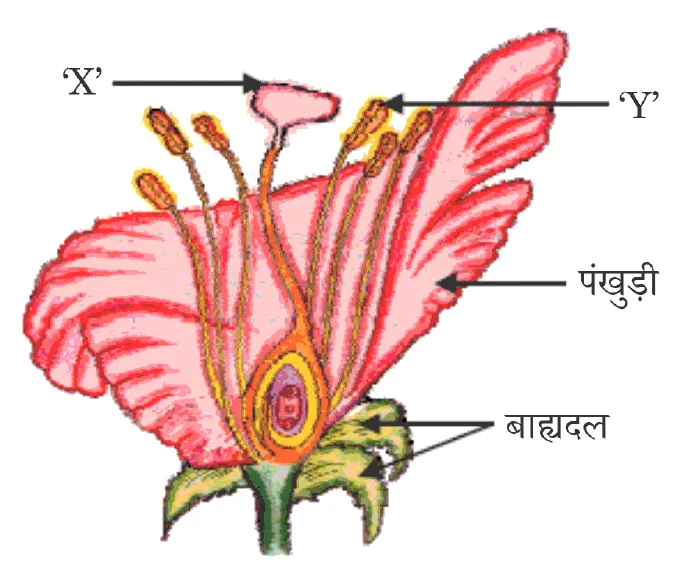
(a) (i) Identify the parts 'X' and 'Y' in the figure given below :
(ii) Name the yellowish coloured structures produced by the part labelled as 'Y'.
(iii) Write the name of the process by which these are transferred to the part labelled as 'X'.
(iv) Explain the process of seed formation in a flowering plant.
OR
(b) (i) Name the type of asexual mode of reproduction shown in the given figure.
(ii) Identify the unicellular organism in the diagram.
(iii) List any two advantages of asexual reproduction over sexual reproduction.
(iv) Name and explain any one mode of asexual reproduction observed in Hydra.
(a) (i) Identify the parts 'X' and 'Y' in the figure given below :
(ii) Name the yellowish coloured structures produced by the part labelled as 'Y'.
(iii) Write the name of the process by which these are transferred to the part labelled as 'X'.
(iv) Explain the process of seed formation in a flowering plant.
OR
(b) (i) Name the type of asexual mode of reproduction shown in the given figure.
(ii) Identify the unicellular organism in the diagram.
(iii) List any two advantages of asexual reproduction over sexual reproduction.
(iv) Name and explain any one mode of asexual reproduction observed in Hydra.
Official answer
(a) (i) The part 'X' is the stigma and the part 'Y' is the anther.
(ii) The yellowish coloured structures produced by the part labelled as 'Y' are pollen grains.
(iii) The process by which these are transferred to the part labelled as 'X' is called pollination.
(iv) Seed formation in a flowering plant occurs through the process of fertilization, where the male gamete (pollen) fuses with the female gamete (egg) to form a zygote, which then develops into an embryo and eventually forms a seed.
OR
(b) (i) The type of asexual mode of reproduction shown in the given figure is budding.
(ii) The unicellular organism in the diagram is Hydra.
(iii) Two advantages of asexual reproduction over sexual reproduction are that it allows for rapid reproduction and does not require the presence of a mate.
(iv) One mode of asexual reproduction observed in Hydra is budding, where a new individual grows from a bud on the parent organism.
Marking scheme
- 1.(a) (i) The part 'X' is the stigma and the part 'Y' is the anther.
- 2.(a) (ii) The yellowish coloured structures produced by the part labelled as 'Y' are pollen grains.
- 3.(a) (iii) The process by which these are transferred to the part labelled as 'X' is called pollination.
- 4.(a) (iv) Seed formation in a flowering plant occurs through the process of fertilization, where the male gamete (pollen) fuses with the female gamete (egg) to form a zygote, which then develops into an embryo and eventually forms a seed.
- 5.(b) (i) The type of asexual mode of reproduction shown in the given figure is budding.
- 6.(b) (ii) The unicellular organism in the diagram is Hydra.
- 7.(b) (iii) Two advantages of asexual reproduction over sexual reproduction are that it allows for rapid reproduction and does not require the presence of a mate.
- 8.(b) (iv) One mode of asexual reproduction observed in Hydra is budding, where a new individual grows from a bud on the parent organism.
Hint
To answer this question, we need to identify the parts 'X' and 'Y' in the figure and explain the process of seed formation in a flowering plant. We also need to identify the type of asexual mode of reproduction shown in the given figure and explain one mode of asexual reproduction observed in Hydra.
Quick oral answer
The parts 'X' and 'Y' in the figure are the stigma and anther, respectively. The yellowish coloured structures produced by the part labelled as 'Y' are pollen grains. The process by which these are transferred to the part labelled as 'X' is called pollination. Seed formation in a flowering plant occurs through the process of fertilization, where the male gamete (pollen) fuses with the female gamete (egg) to form a zygote, which then develops into an embryo and eventually forms a seed. The type of asexual mode of reproduction shown in the given figure is budding, where a new individual grows from a bud on the parent organism. Two advantages of asexual reproduction over sexual reproduction are that it allows for rapid reproduction and does not require the presence of a mate.
Common mistakes
- 1.Confusing the stigma and anther
- 2.Not understanding the process of pollination
- 3.Not explaining the process of seed formation
- 4.Not identifying the type of asexual mode of reproduction
- 5.Not explaining one mode of asexual reproduction observed in Hydra
Analysis and explanation
The figure shows a flower with the stigma and anther labeled as 'X' and 'Y', respectively. The yellowish coloured structures produced by the part labelled as 'Y' are pollen grains. The process by which these are transferred to the part labelled as 'X' is called pollination. Seed formation in a flowering plant occurs through the process of fertilization, where the male gamete (pollen) fuses with the female gamete (egg) to form a zygote, which then develops into an embryo and eventually forms a seed. The type of asexual mode of reproduction shown in the given figure is budding, where a new individual grows from a bud on the parent organism. Two advantages of asexual reproduction over sexual reproduction are that it allows for rapid reproduction and does not require the presence of a mate.
Interesting facts
The stigma is the female reproductive organ of a flower.
The anther is the male reproductive organ of a flower.
Pollen grains are produced by the anther and contain the male gametes.
Pollination is the transfer of pollen grains from the anther to the stigma.
Fertilization is the fusion of the male and female gametes to form a zygote.
A zygote develops into an embryo and eventually forms a seed.
Budding is a type of asexual reproduction where a new individual grows from a bud on the parent organism.
Hydra is a unicellular organism that reproduces by budding.
Question details
Q35 of 39 questions
- Board
- CBSE
- Class
- Class 10
- Subject
- Science
- Year
- 2025
- Section
- Section D
- Marks
- 5
- Type
- Long Answer
- Chapter
- How do Organisms Reproduce?
- Topic
- Reproduction in Flowering Plants
- Bloom's level
- Knowledge
- Syllabus topic
- Reproduction in Flowering Plants
Spotted a mistake or something unclear?
Tell us and we will fix it.
Frequently asked questions
How many marks does this question carry in CBSE Class 10 Science 2025?
This question carries 5 marks in the CBSE Class 10 Science 2025 examination.
Which chapter does this question come from in Science?
This question is from the chapter "How do Organisms Reproduce?" in the CBSE Class 10 Science syllabus.
What topic does this question cover in Science?
This question covers the topic "Reproduction in Flowering Plants" from CBSE Class 10 Science.
What type of question is this in the CBSE Class 10 Science 2025 paper?
This is a Long Answer question from Section D in the CBSE Class 10 Science 2025 paper.