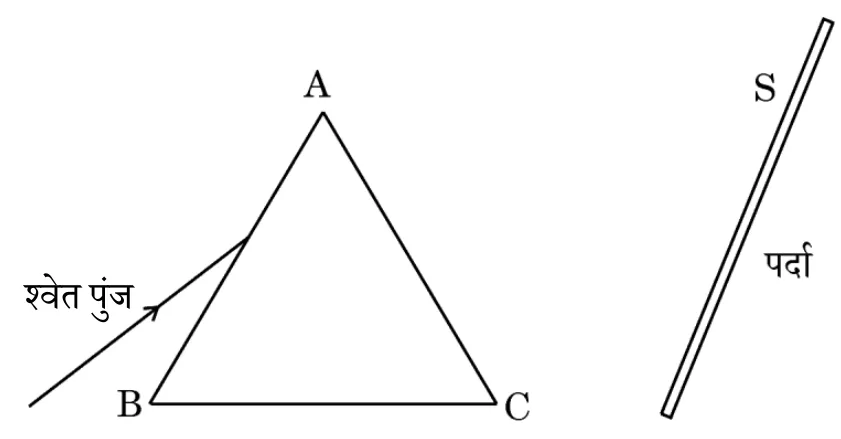
A person allowed a narrow beam of white light from the sun to enter a dark room through a small aperture and placed a glass prism in its path in such a manner that the beam falls on the face AB of the prism as shown in the figure.
A screen S is placed on the other side of the prism, facing AC. On turning the prism slowly, a beautiful band of colours is obtained on the screen. It is the spectrum of sunlight.
(a) Name the phenomenon due to which a prism splits the incident white light into a band of colours. [1]
(b) State the reason of getting a band of seven colours in the above case. [1]
(c) (i) Explain with the help of a labelled ray diagram, an experimental arrangement to show the recombination of the spectrum of white light. [2]
OR
(c) (ii) Draw a labelled ray diagram to show the formation of a rainbow. [2]
A person allowed a narrow beam of white light from the sun to enter a dark room through a small aperture and placed a glass prism in its path in such a manner that the beam falls on the face AB of the prism as shown in the figure.
A screen S is placed on the other side of the prism, facing AC. On turning the prism slowly, a beautiful band of colours is obtained on the screen. It is the spectrum of sunlight.
(a) Name the phenomenon due to which a prism splits the incident white light into a band of colours. [1]
(b) State the reason of getting a band of seven colours in the above case. [1]
(c) (i) Explain with the help of a labelled ray diagram, an experimental arrangement to show the recombination of the spectrum of white light. [2]
OR
(c) (ii) Draw a labelled ray diagram to show the formation of a rainbow. [2]
Official answer
The phenomenon due to which a prism splits the incident white light into a band of colours is called dispersion. The reason for getting a band of seven colours in the above case is that the different wavelengths of light are refracted at slightly different angles as they pass through the prism, resulting in a spectrum of colours. The experimental arrangement to show the recombination of the spectrum of white light involves passing the dispersed light through a second prism, which refracts the light back to its original direction, resulting in the recombination of the colours. The formation of a rainbow occurs when sunlight passes through water droplets in the air, causing the light to be refracted and dispersed into its component colours, which are then reflected back to the observer's eye.
Marking scheme
- 1.Dispersion of light
- 2.Recombination of the spectrum of white light
- 3.Formation of a rainbow
Hint
The dispersion of light through a prism is a fundamental concept in optics, and it is essential to understand the principles behind it. The recombination of the spectrum of white light is a crucial aspect of this phenomenon, and it is achieved by passing the dispersed light through a second prism. The formation of a rainbow is a beautiful example of the dispersion of light, and it is a result of the refraction and reflection of sunlight as it passes through water droplets in the air.
Quick oral answer
The dispersion of light through a prism is a fundamental concept in optics, and it is essential to understand the principles behind it. The recombination of the spectrum of white light is a crucial aspect of this phenomenon, and it is achieved by passing the dispersed light through a second prism. The formation of a rainbow is a beautiful example of the dispersion of light, and it is a result of the refraction and reflection of sunlight as it passes through water droplets in the air.
Common mistakes
- 1.Confusing dispersion with refraction
- 2.Not understanding the recombination of the spectrum of white light
- 3.Not recognizing the formation of a rainbow as an example of dispersion
Analysis and explanation
The dispersion of light through a prism is a fundamental concept in optics, and it is essential to understand the principles behind it. The recombination of the spectrum of white light is a crucial aspect of this phenomenon, and it is achieved by passing the dispersed light through a second prism. The formation of a rainbow is a beautiful example of the dispersion of light, and it is a result of the refraction and reflection of sunlight as it passes through water droplets in the air.
Interesting facts
The dispersion of light through a prism is a fundamental concept in optics
The recombination of the spectrum of white light is a crucial aspect of this phenomenon
The formation of a rainbow is a beautiful example of the dispersion of light
Question details
Q39 of 39 questions
- Board
- CBSE
- Class
- Class 10
- Subject
- Science
- Year
- 2025
- Section
- Section E
- Marks
- 4
- Chapter
- The Human Eye and the Colourful World
- Topic
- Refraction of Light through a Prism
- Bloom's level
- Understanding
- Syllabus topic
- Refraction of Light through a Prism
Spotted a mistake or something unclear?
Tell us and we will fix it.
Frequently asked questions
How many marks does this question carry in CBSE Class 10 Science 2025?
This question carries 4 marks in the CBSE Class 10 Science 2025 examination.
Which chapter does this question come from in Science?
This question is from the chapter "The Human Eye and the Colourful World" in the CBSE Class 10 Science syllabus.
What topic does this question cover in Science?
This question covers the topic "Refraction of Light through a Prism" from CBSE Class 10 Science.
What type of question is this in the CBSE Class 10 Science 2025 paper?
This question appears in Section E in the CBSE Class 10 Science 2025 paper.