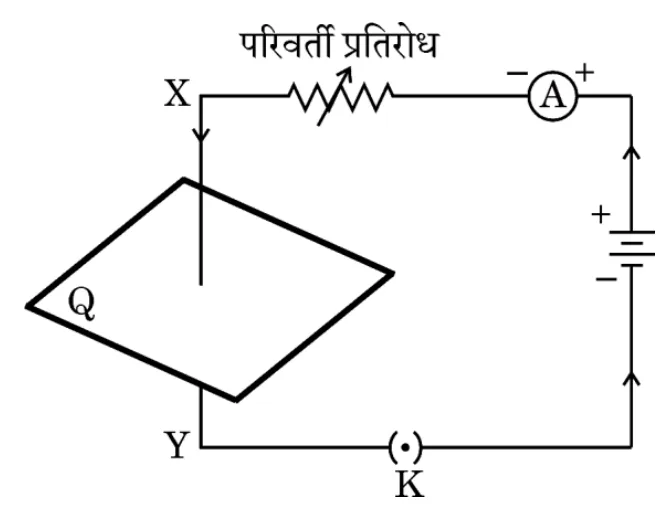
(a) The given figure shows the current passing through the straight conductor XY.
(i) Copy the diagram and draw the magnetic field lines when current flows from conductor X to Y.
(ii) Name and state the rule used in determining the direction of the magnetic field lines in the situation given above.
(iii) State Fleming's left hand rule. Using this rule, determine the direction of force applied on an electron entering a uniform magnetic field as shown in the figure.
OR
(b) (i) Define the term solenoid. Draw the pattern of the magnetic field lines in and around a current carrying straight solenoid. Mark on the pattern the (i) direction of current, (ii) direction of field lines near the ends of the solenoid, and (iii) region where the magnetic field is uniform.
(ii) How would you make an electromagnet using a current carrying solenoid?
(a) The given figure shows the current passing through the straight conductor XY.
(i) Copy the diagram and draw the magnetic field lines when current flows from conductor X to Y.
(ii) Name and state the rule used in determining the direction of the magnetic field lines in the situation given above.
(iii) State Fleming's left hand rule. Using this rule, determine the direction of force applied on an electron entering a uniform magnetic field as shown in the figure.
OR
(b) (i) Define the term solenoid. Draw the pattern of the magnetic field lines in and around a current carrying straight solenoid. Mark on the pattern the (i) direction of current, (ii) direction of field lines near the ends of the solenoid, and (iii) region where the magnetic field is uniform.
(ii) How would you make an electromagnet using a current carrying solenoid?
Official answer
(a) (i) The magnetic field lines are shown in the figure below. The direction of the magnetic field lines can be determined using the right-hand thumb rule. When the thumb points in the direction of the current, the fingers will wrap around the conductor in the direction of the magnetic field lines. (ii) The rule used to determine the direction of the magnetic field lines is the right-hand thumb rule. (iii) Fleming's left-hand rule states that if the thumb, index finger, and middle finger of the left hand are held perpendicular to each other, with the thumb pointing in the direction of the magnetic field, the index finger pointing in the direction of the current, and the middle finger pointing in the direction of the force on the conductor, then the force on the conductor will be in the direction of the middle finger. Using this rule, we can determine that the force on the electron entering the uniform magnetic field will be in the direction of the middle finger, which is perpendicular to both the magnetic field and the current. (b) (i) A solenoid is a coil of wire that carries an electric current. The pattern of the magnetic field lines in and around a current-carrying straight solenoid is shown in the figure below. The direction of the current is shown by the arrows on the solenoid. The direction of the magnetic field lines near the ends of the solenoid is shown by the arrows on the magnetic field lines. The region where the magnetic field is uniform is shown by the shaded area inside the solenoid. (ii) An electromagnet can be made using a current-carrying solenoid by wrapping a coil of wire around a core of ferromagnetic material, such as iron. When an electric current flows through the coil, a magnetic field is generated, which magnetizes the core and creates an electromagnet.
Marking scheme
- 1.(a) (i) 2 marks
- 2.(a) (ii) 1 mark
- 3.(a) (iii) 2 marks
- 4.(b) (i) 3 marks
- 5.(b) (ii) 2 marks
Hint
Use the right-hand thumb rule to determine the direction of magnetic field lines, and Fleming's left-hand rule to determine the direction of force on a conductor in a magnetic field. Recall the definition of a solenoid and the pattern of magnetic field lines in and around a current-carrying straight solenoid.
Quick oral answer
The magnetic field lines around a current-carrying conductor can be determined using the right-hand thumb rule. The direction of the magnetic field lines is perpendicular to the direction of the current. Fleming's left-hand rule can be used to determine the direction of force on a conductor in a magnetic field. A solenoid is a coil of wire that carries an electric current, and the pattern of magnetic field lines in and around a current-carrying straight solenoid can be determined using the right-hand thumb rule. An electromagnet can be made using a current-carrying solenoid by wrapping a coil of wire around a core of ferromagnetic material.
Common mistakes
- 1.confusing the direction of magnetic field lines with the direction of current
- 2.not applying Fleming's left-hand rule correctly
- 3.not understanding the pattern of magnetic field lines in and around a current-carrying straight solenoid
Analysis and explanation
The problem requires the application of various concepts related to magnetic fields and electromagnetism. The right-hand thumb rule is used to determine the direction of magnetic field lines, while Fleming's left-hand rule is used to determine the direction of force on a conductor in a magnetic field. The pattern of magnetic field lines in and around a current-carrying straight solenoid is also discussed, along with the method of making an electromagnet using a current-carrying solenoid.
Interesting facts
The right-hand thumb rule was first described by the French physicist Andre-Marie Ampere in 1820.
Fleming's left-hand rule was first described by the British engineer John Ambrose Fleming in 1885.
Solenoids are widely used in many applications, including electromagnets, transformers, and inductors.
Question details
Q36 of 39 questions
- Board
- CBSE
- Class
- Class 10
- Subject
- Science
- Year
- 2025
- Section
- Section D
- Marks
- 5
- Type
- Long Answer
- Chapter
- Magnetic Effects of Electric Current
- Topic
- Magnetic Field Lines
- Bloom's level
- Remembering
- Syllabus topic
- Magnetic Field Lines
Spotted a mistake or something unclear?
Tell us and we will fix it.
Frequently asked questions
How many marks does this question carry in CBSE Class 10 Science 2025?
This question carries 5 marks in the CBSE Class 10 Science 2025 examination.
Which chapter does this question come from in Science?
This question is from the chapter "Magnetic Effects of Electric Current" in the CBSE Class 10 Science syllabus.
What topic does this question cover in Science?
This question covers the topic "Magnetic Field Lines" from CBSE Class 10 Science.
What type of question is this in the CBSE Class 10 Science 2025 paper?
This is a Long Answer question from Section D in the CBSE Class 10 Science 2025 paper.