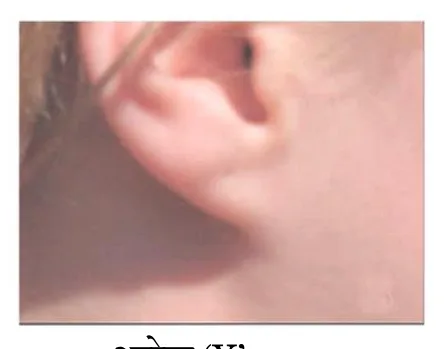
The lowest part of the ear called earlobe, is closely attached to the side of the head in some of us (Figure 'X'), and not in others, called free earlobe (Figure 'Y'). Attached and free earlobes are two variants found in human populations. The gene for free earlobe is dominant over attached earlobes.
(a) A man with attached earlobes marries a woman having free earlobes. of their children have free earlobes and have attached earlobes. Explain the inheritance of this trait and write the trait combinations of the progeny.
(b) Write the gene combinations of the father and the mother in the above case.
The lowest part of the ear called earlobe, is closely attached to the side of the head in some of us (Figure 'X'), and not in others, called free earlobe (Figure 'Y'). Attached and free earlobes are two variants found in human populations. The gene for free earlobe is dominant over attached earlobes.
(a) A man with attached earlobes marries a woman having free earlobes. of their children have free earlobes and have attached earlobes. Explain the inheritance of this trait and write the trait combinations of the progeny.
(b) Write the gene combinations of the father and the mother in the above case.
Official answer
The gene for free earlobe is dominant over attached earlobes. The man with attached earlobes is homozygous recessive (tt) and the woman with free earlobes is heterozygous (Tt). The possible genotypes of the offspring are Tt and tt. The phenotype of Tt is free earlobe and tt is attached earlobe. Therefore, 50% of the children have free earlobes and 50% have attached earlobes. The trait combinations of the progeny are Tt and tt.
Marking scheme
- 1.1 mark for correct genotype
- 2.1 mark for correct phenotype
- 3.1 mark for correct trait combination
Hint
Use Mendel's laws of inheritance to explain the inheritance of the trait.
Quick oral answer
The gene for free earlobe is dominant over attached earlobes. The man with attached earlobes is homozygous recessive (tt) and the woman with free earlobes is heterozygous (Tt). The possible genotypes of the offspring are Tt and tt. The phenotype of Tt is free earlobe and tt is attached earlobe. Therefore, 50% of the children have free earlobes and 50% have attached earlobes. The trait combinations of the progeny are Tt and tt.
Common mistakes
- 1.Confusing dominant and recessive genes
- 2.Not considering the genotype of the parents
Analysis and explanation
This question requires the application of Mendel's laws of inheritance to explain the inheritance of a trait. The correct answer is based on the understanding of dominant and recessive genes and how they interact to produce different phenotypes.
Interesting facts
Mendel's laws of inheritance were first proposed in 1865
The laws of inheritance are still widely used today to understand the transmission of traits from one generation to the next
Question details
Q30 of 39 questions
- Board
- CBSE
- Class
- Class 10
- Subject
- Science
- Year
- 2025
- Section
- Section C
- Marks
- 3
- Type
- Short Answer
- Chapter
- Heredity
- Topic
- Inheritance of Traits
- Bloom's level
- Analyzing
- Syllabus topic
- Heredity
Spotted a mistake or something unclear?
Tell us and we will fix it.
Frequently asked questions
How many marks does this question carry in CBSE Class 10 Science 2025?
This question carries 3 marks in the CBSE Class 10 Science 2025 examination.
Which chapter does this question come from in Science?
This question is from the chapter "Heredity" in the CBSE Class 10 Science syllabus.
What topic does this question cover in Science?
This question covers the topic "Inheritance of Traits" from CBSE Class 10 Science.
What type of question is this in the CBSE Class 10 Science 2025 paper?
This is a Short Answer question from Section C in the CBSE Class 10 Science 2025 paper.