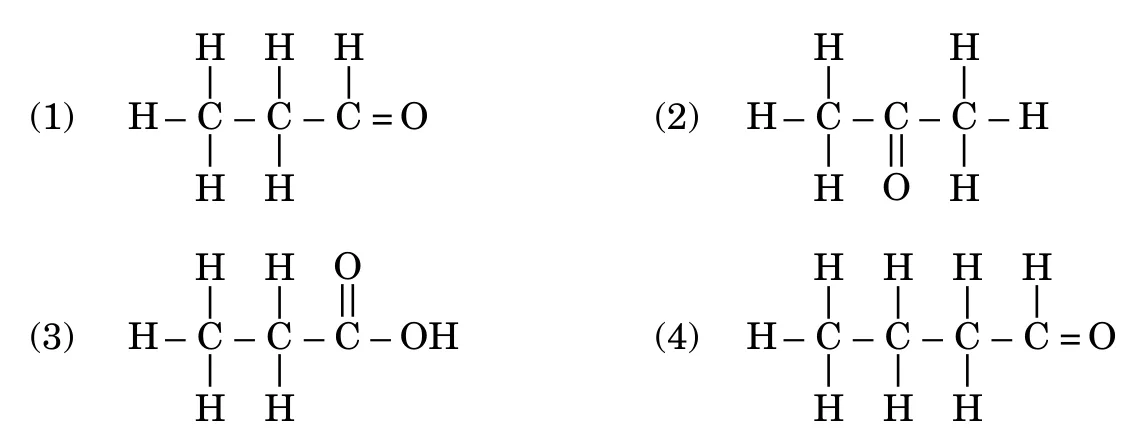
(a) Select from the following the members of same homologous series: [structures shown in the accompanying diagram]
(b) What happens to (i) the melting point, and (ii) the solubility of compounds as the molecular mass of the compounds in a homologous series increases?
(a) Select from the following the members of same homologous series: [structures shown in the accompanying diagram]
(b) What happens to (i) the melting point, and (ii) the solubility of compounds as the molecular mass of the compounds in a homologous series increases?
Official answer
(a) The members of the same homologous series are (1) and (3). (b) (i) The melting point increases as the molecular mass of the compounds in a homologous series increases. (ii) The solubility decreases as the molecular mass of the compounds in a homologous series increases.
Marking scheme
- 1.(a) 1 mark for identifying the members of the same homologous series
- 2.(b) 1 mark for explaining the changes in melting point and solubility
Hint
Look for the functional group and the number of carbon atoms in each structure to identify the members of the same homologous series.
Quick oral answer
The members of the same homologous series are (1) and (3). As the molecular mass of the compounds in a homologous series increases, the melting point increases and the solubility decreases.
Common mistakes
- 1.confusing homologous series with other types of series
- 2.not understanding the relationship between molecular mass and properties
Analysis and explanation
This question requires the student to understand the concept of homologous series and how the properties of compounds change as the molecular mass increases. The student needs to analyze the structures and identify the members of the same homologous series. The student also needs to explain the changes in melting point and solubility as the molecular mass increases.
Interesting facts
The concept of homologous series was first introduced by the French chemist Auguste Laurent in 1837.
Homologous series are important in organic chemistry because they help us understand the properties and behavior of compounds.
Question details
Q22 of 39 questions
- Board
- CBSE
- Class
- Class 10
- Subject
- Science
- Year
- 2025
- Section
- Section B
- Marks
- 2
- Type
- Very Short Answer
- Chapter
- Carbon and its Compounds
- Topic
- Homologous Series
- Bloom's level
- Remembering
- Syllabus topic
- Homologous Series
Spotted a mistake or something unclear?
Tell us and we will fix it.
Frequently asked questions
How many marks does this question carry in CBSE Class 10 Science 2025?
This question carries 2 marks in the CBSE Class 10 Science 2025 examination.
Which chapter does this question come from in Science?
This question is from the chapter "Carbon and its Compounds" in the CBSE Class 10 Science syllabus.
What topic does this question cover in Science?
This question covers the topic "Homologous Series" from CBSE Class 10 Science.
What type of question is this in the CBSE Class 10 Science 2025 paper?
This is a Very Short Answer question from Section B in the CBSE Class 10 Science 2025 paper.