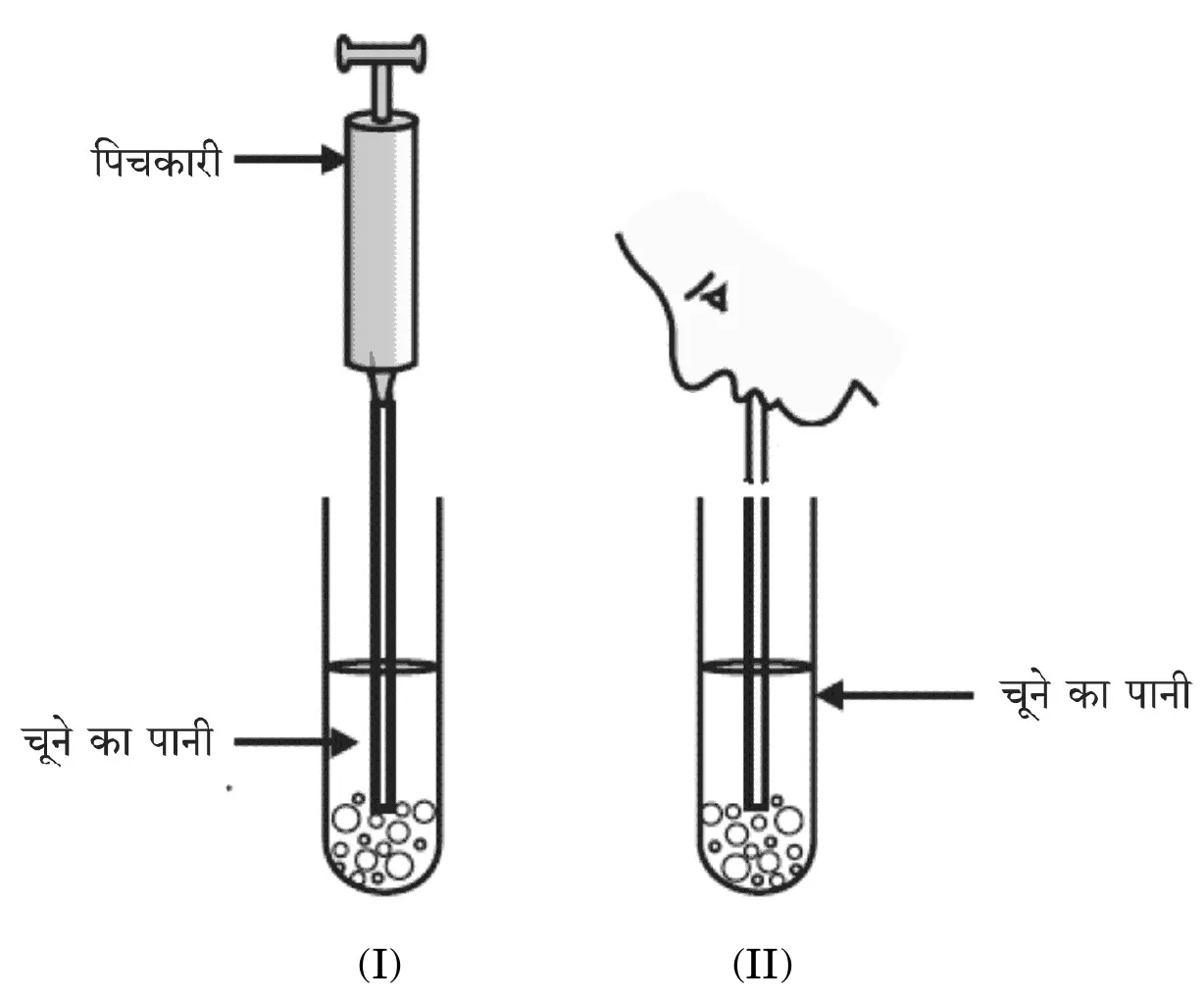
(a) Design an experiment to demonstrate that carbon dioxide is essential for photosynthesis. Write the observation and conclusion of the experiment. OR In the experimental set- up shown above in diagram (I) atmospheric air is being passed into lime water with a syringe while in diagram (II) air is being exhaled into lime water. The time taken for the lime water to turn milky in both the test tubes is different. Give reason. (ii) Draw the diagram of an open stomatal pore and label (I) Guard cells, and (II) Chloroplast on it. Mention two functions performed by stomata.
(a) Design an experiment to demonstrate that carbon dioxide is essential for photosynthesis. Write the observation and conclusion of the experiment. OR In the experimental set- up shown above in diagram (I) atmospheric air is being passed into lime water with a syringe while in diagram (II) air is being exhaled into lime water. The time taken for the lime water to turn milky in both the test tubes is different. Give reason. (ii) Draw the diagram of an open stomatal pore and label (I) Guard cells, and (II) Chloroplast on it. Mention two functions performed by stomata.
Official answer
(a) Experiment: Place a small potted plant in a bell jar and seal the jar. Pass carbon dioxide-free air through the plant using a syringe. Observe the plant after some time. Conclusion: The plant will not undergo photosynthesis as it does not receive carbon dioxide. (b) Diagram:  Figure 5.3 (a) Open and (b) closed stomatal pore (I) Guard cells (II) Chloroplast Functions of stomata: 1. Exchange of gases: Stomata allow the exchange of gases between the plant and the atmosphere. 2. Transpiration: Stomata play a crucial role in transpiration, which is the process by which plants release water vapor into the air.
Marking scheme
- 1.(a) Experiment: Place a small potted plant in a bell jar and seal the jar. Pass carbon dioxide-free air through the plant using a syringe. Observe the plant after some time. Conclusion: The plant will not undergo photosynthesis as it does not receive carbon dioxide.
- 2.(b) Diagram:  *Figure 5.3 (a) Open and (b) closed stomatal pore* (I) Guard cells (II) Chloroplast Functions of stomata: 1. Exchange of gases: Stomata allow the exchange of gases between the plant and the atmosphere. 2. Transpiration: Stomata play a crucial role in transpiration, which is the process by which plants release water vapor into the air.
Hint
Use a bell jar and a syringe to pass carbon dioxide-free air through the plant. Observe the plant after some time. Draw the diagram of an open stomatal pore and label (I) Guard cells, and (II) Chloroplast on it. Mention two functions performed by stomata.
Quick oral answer
Photosynthesis is the process by which plants convert light energy into chemical energy. Carbon dioxide is essential for photosynthesis. Stomata play a crucial role in transpiration, which is the process by which plants release water vapor into the air.
Common mistakes
- 1.Not using a bell jar and a syringe to pass carbon dioxide-free air through the plant.
- 2.Not observing the plant after some time.
- 3.Not drawing the diagram of an open stomatal pore and labeling (I) Guard cells, and (II) Chloroplast on it.
- 4.Not mentioning two functions performed by stomata.
Analysis and explanation
The experiment demonstrates that carbon dioxide is essential for photosynthesis. The plant will not undergo photosynthesis as it does not receive carbon dioxide. The diagram shows an open stomatal pore with guard cells and chloroplasts. The two functions performed by stomata are exchange of gases and transpiration.
Interesting facts
Photosynthesis is the process by which plants convert light energy into chemical energy.
Carbon dioxide is essential for photosynthesis.
Stomata play a crucial role in transpiration, which is the process by which plants release water vapor into the air.
Question details
Q35 of 39 questions
- Board
- CBSE
- Class
- Class 10
- Subject
- Science
- Year
- 2024
- Section
- Section D
- Marks
- 5
- Type
- Long Answer
- Chapter
- Life Processes
- Topic
- Photosynthesis
- Bloom's level
- Application
- Syllabus topic
- Nutrition
Spotted a mistake or something unclear?
Tell us and we will fix it.
Frequently asked questions
How many marks does this question carry in CBSE Class 10 Science 2024?
This question carries 5 marks in the CBSE Class 10 Science 2024 examination.
Which chapter does this question come from in Science?
This question is from the chapter "Life Processes" in the CBSE Class 10 Science syllabus.
What topic does this question cover in Science?
This question covers the topic "Photosynthesis" from CBSE Class 10 Science.
What type of question is this in the CBSE Class 10 Science 2024 paper?
This is a Long Answer question from Section D in the CBSE Class 10 Science 2024 paper.